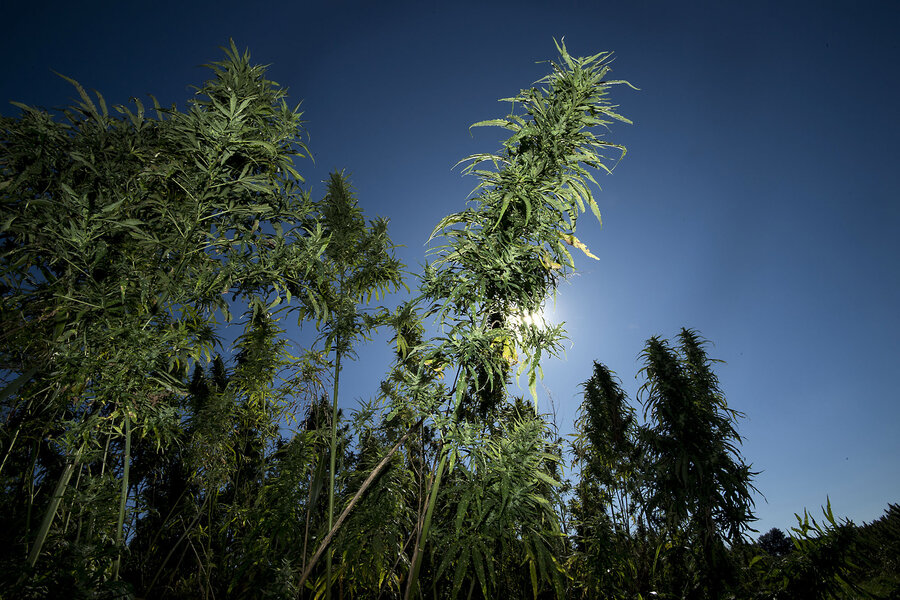
Deep in a region with a history of opposition to marijuana, farmer Allison Justice tends a crop that is laced with irony: hemp.
A plant scientist who was working in California’s cannabis industry before converting her family farm here, Dr. Justice was among the first to secure a South Carolina hemp license following Congress’ 2018 farm bill that legalized farming of the fast-growing cousin of marijuana.
Back then, analysts said the new bill would help create a market for hemp that could be used in everything from bioplastics to wellness products. (While both hemp and marijuana are forms of cannabis, raw hemp, rich in a compound called CBD, is not intoxicating.) The bill did create a market, defining hemp as having barely a trace of THC, the main cannabis compound that delivers a “high.”
Why We Wrote This
An unregulated market for hemp in the Carolinas is raising public health concerns. Lawmakers must now balance public safety, pressure from profit-makers, and consumer demand in a standoff likely to shape national cannabis policy.
And while thousands of local North and South Carolina farmers, family-owned CBD shops, and regional makers have built and sustained the new trade, national and out-of-state entrepreneurs have joined in to exploit regulatory loopholes, converting the hemp into highly intoxicating THC varieties and creating a multibillion-dollar industry. North Carolina’s hemp industry brings in over $3.2 billion in annual revenues ($4 billion including jobs). South Carolina produces about half that.
This turned North and South Carolina, with lots of old tobacco fields and few new hemp production rules, into vibrant marketplaces for what is essentially recreational marijuana. Though pot is still illegal in both states, neither of the Carolinas has put in place strict age limits for cannabis goods, leaving stores to enforce their own 21-and-over rules.
Few rules, big profits
That “Wild West” atmosphere for hemp growers here boosted a profitable industry. But it also brought problems. The amount of THC, the main active chemical that makes people feel high, that a plant contains is the legal and scientific line that separates hemp and marijuana. And without rules, hemp growers picked up strains or production processes that raise THC levels. As a result, communities are now struggling to address what happens when people get high off “legal” hemp – from drivers to service workers to children – and wind up in emergency rooms.
The wide availability of novel THC derivatives – sometimes called alternative cannabinoids or “gas station weed” – has caused confusion not just for consumers and store owners, but also for prosecutors tasked with enforcing marijuana laws. This has led lawmakers in both North and South Carolina to demand stronger, clearer rules, or at least the closure of loopholes.
Such tensions, compounded by a flooded market, have led many hemp farmers to quit. North Carolina has dropped from 1,500 licensed hemp growers in 2020 to fewer than 650, with planted acres falling from 16,000 to just over 1,000 in the same period. South Carolina’s hemp farming permits have also dropped by half.
“Right now, it’s a free-for-all,” says Dr. Justice, owner of the Hemp Mine farm in Anderson, South Carolina. “It’s tough to operate with all this going on. A lot of the damage has already been done.”
The cannabis conundrum won’t be tackled easily. Regulating hemp means acknowledging both its dangers and strong consumer demand – a tricky move for Carolina lawmakers. Do they alienate public health advocates and concerned families, or the lucrative industry and voters who want access to hemp-derived products?
Experts note that both states, particularly North Carolina, have emerged as critical battlegrounds as federal and state lawmakers are moving to reclassify hemp products with increased intoxicating potential – shifting where, how, and to whom they can be sold – while keeping voters happy.
How we got here
When Sen. Mitch McConnell, a Kentucky Republican, drafted the 2018 farm bill legislation that permitted hemp farming, he hoped to aid struggling Kentucky tobacco farmers. By late 2025, however, Congress was considering proposals to close loopholes by redefining hemp to include every form of the plant, regardless of the level of active ingredients. A federal ban on most hemp-derived CBD and cannabinoid products is scheduled to take effect Nov. 12.
The White House, meanwhile, has moved in the opposite direction, signaling support for the hemp industry. A bipartisan bill to delay the CBD ban for two years is now in early legislative stages.
In most states, including North and South Carolina, consumers must be age 21 or older to purchase alcohol.

But the situation with hemp is different. And in North Carolina, an unregulated hemp and marijuana marketplace has led to an almost tenfold increase in cannabis-related emergency room visits. Last year, 141 children experienced hemp-related overdoses, largely by ingesting products that their parents had left unattended. (No one has died in these accidental overdose incidents, though tobacco vaping products have been tied to at least one death of a minor in North Carolina.)
When doing nothing is not an option
Legislators have aggressively pursued restrictions. North Carolina senators passed a bill to ban intoxicating hemp products entirely, though its future in the House remains in legislative limbo. Similarly, the South Carolina House passed strict new rules on consumable hemp this spring, but the Senate adjourned without taking up the bill.
“We have gotten to such a point where doing nothing was not an option,” South Carolina Senate President Phil Berger said after the vote.
But efforts to regulate the industry in the Deep South have run up against corporate interests, shifting consumer sentiment, and long-held values of a region where leaders often preached prohibition while allowing illicit activities to flourish by letting counties opt out of bans.
“Whenever there is a huge consumer demand, the trade will find a way,” says historian Lee Willis, author of “Southern Prohibition.”
In February 2025, a Meredith College poll reported that 71% of North Carolinians support keeping medical marijuana – or cannabis used to treat symptoms of illness or disease – legal. Other polls show that majorities in the state favor recreational marijuana. In South Carolina, almost 3 out of 4 respondents to an Opinion Diagnostics poll said they preferred regulated sales of edible hemp products versus an all-out ban.
For farmers like Dr. Justice, this uncertainty threatens their livelihoods. Once operating over 60 acres, she now confines her farm’s hemp to less than 1 acre and sells it primarily for pharmaceutical research. Finding a viable future, she argues, will be a tall task. “It’s going to take politicians and lobbyists and scientists to get together and understand what’s rational here.”