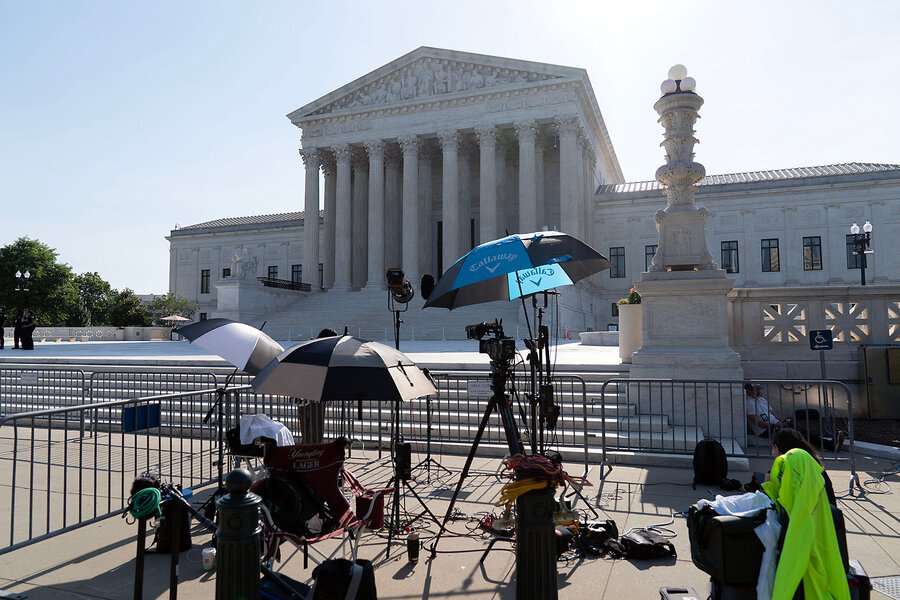
A deliberate, slow-moving institution like the U.S. Supreme Court measures time not in years or decades but in eras. In that context, the court’s recently concluded term will likely be remembered as one in which several long-term trends stopped being trends and became firm realities.
Specifically, the court solidified a decades-long movement concentrating executive power under the president alone – amid a broadening of presidential power in other directions. The justices did not give President Donald Trump victories on some of his most treasured policies, such as tariffs and birthright citizenship, however, even in the face of personal criticism from the president and his allies that lower court judges and some Supreme Court justices have been subjected to over the past 18 months.
Overall, at a time of high tension between the judiciary and the executive branch, the Supreme Court has recalibrated the constitutional separation of powers to significantly empower the president’s role. And while the court has pushed back on the president at times, it has been a willing partner in allowing the White House to effectively enact policies through emergencies, extending a yearslong trend that has seen the high court decide significant policy questions on its interim docket, with minimal briefing.
Why We Wrote This
The Supreme Court’s latest term featured landmark cases on presidential authority. While the high court deepened the president’s power over the executive branch, the justices also restrained it in some areas.
In terms of the separation of powers, the term was “a mixed bag,” says Jeff Powell, a professor at Duke Law School. But in his view, “the mixture [added to] a world that was already leaning too far towards the president.”
Still, it’s notable that the constitutional crisis that some feared at the outset of the term last fall appears to have been avoided – for now, at least. This Supreme Court, known for its expansive vision of executive power, still pushed back on the president at times.
“There was talk that the president might ignore Supreme Court opinions, but that talk has receded,” says Saikrishna Prakash, a professor at the University of Virginia School of Law.
“So, the court has successfully stood up to the president,” he adds. “That’s important to the court as an institution.”
There’s no question, however, that the presidency has emerged from this term with more power than when the term began.
How the court expanded presidential power
While the Supreme Court ruled against Mr. Trump in several cases this term, it also ruled in his favor in the most important separation of powers case the court has decided in decades.
That decision, in the case Trump v. Slaughter, was not a surprise to court watchers. The high court had for years expressed skepticism that the president is unable to remove leaders of the independent regulatory agencies that make up what Mr. Trump and his allies call the administrative state, or unelected career bureaucrats who they see as unaccountable to the American public.
The Slaughter case began when Mr. Trump fired Rebecca Slaughter, a commissioner at the Federal Trade Commission (FTC), claiming her service was “inconsistent with [the] administration’s priorities.”
With its decision in Slaughter last week – a 6-3 ruling that broke along the court’s ideological divide – the majority gave the president the authority to fire at will any leader of any regulatory agency, with an exception for the Federal Reserve, which the court in another case this term said played a different role in U.S. history and tradition.
“To remain accountable to the President, those officers must be removable by the President,” wrote Chief Justice John Roberts in the majority opinion.
The decision is a logical one, supporters say. But even some of those supporters acknowledge that it’s a decision with major implications.
The Slaughter ruling “is a clear win for the structure of the Constitution and accountability within that structure,” says Molly Nixon, a senior fellow at the libertarian Cato Institute, which filed an amicus brief in the case supporting Mr. Trump.
The decision does concentrate a lot of power in the president, she says, but only because Congress and the courts have allowed that power to be delegated to the agencies in the first place.
“We’ve got three branches of government,” she adds, “and these independent agencies were exercising powers of all three.”
Ms. Nixon says she “wholeheartedly” endorses a solo concurrence written by Justice Neil Gorsuch in the case.
“Would Congress have delegated so much power, including legislative and judicial power, to independent agencies had it known that the President would come to control them? How will Congress respond now – if realistically it can? And what, if anything, will this Court do about it?” asked Justice Gorsuch.
“The real safeguard against an imperial presidency was never actually a layer of unaccountable commissioners in an independent agency. It was always Congress,” says Ms. Nixon. “I think that’s clearer now.”
Where the court set limits
As the high court transferred those powers from independent agencies to the president, the court also hinted at some powers that would remain out of the president’s reach.
While the president has the power to remove FTC commissioners, wrote Chief Justice Roberts in the Slaughter majority opinion, the president may not have the power to do so when it comes to firing members of the Federal Reserve Board of Governors.
He elaborated on the Fed exception in a different ruling this term. In that case, Trump v. Cook, the court held that Lisa Cook can continue to serve as a Fed governor while she challenges her firing by Mr. Trump, emphasizing the importance of preserving the Fed’s independence from the president.

Manuel Balce Ceneta/AP/File
“Not only the fact of independence but also the appearance of independence is key to the Federal Reserve’s design,” wrote Chief Justice Roberts in the majority opinion, adding his emphasis. Such independence has its roots in the Fed’s “unique historical status and role,” he added.
Mr. Trump is attempting to fire Dr. Cook over allegations of mortgage fraud. (Dr. Cook denies the allegations, and she has yet to be indicted.) At the high court, Solicitor General D. John Sauer argued that courts could not even review the president’s decision to remove a Fed governor.
To accept the Trump administration’s arguments “would turn for-cause protection into little more than at-will employment,” wrote Chief Justice Roberts.
In another blow to Mr. Trump’s expansive vision of presidential power, the court in February struck down his emergency tariff regime. The tariffs had been one of Mr. Trump’s signature policies, but a fractured court held that he had levied them unlawfully by using an emergency economic powers law. And with the final decision of its term, the court ruled that his executive order reinterpreting birthright citizenship was unconstitutional.
The tariffs decision and the Federal Reserve exception laid out in the Slaughter and Cook rulings suggest an unwillingness on the part of a majority of the court to extend presidential control too far into the monetary and financial realm, says Dr. Powell at Duke Law School, whose work has focused on the powers of the executive branch. It is to Congress, after all, that the Constitution has granted the power of the purse.
“Chief Justice Roberts has a very pro-executive view of the separation of powers,” Dr. Powell adds. But “where Congress’s power over money [is concerned], he takes a different approach,”
“A majority of the court recognizes” the same, he continues.
Bigger wins on the emergency docket
While decisions on the merits docket this term were significant, it is on the court’s emergency docket where the Trump administration has often found its most success. While the brief, often unsigned orders have no precedential force, these interim decisions have overwhelmingly favored the government, paving the way for some of the administration’s biggest policy victories, from mass deportations to agency closures and funding freezes.
Criticisms of how the court uses its emergency docket – nicknamed the “shadow docket,” or interim docket, by its critics – have been growing as the docket itself has grown in prominence.
In the term that ended last year, the court issued more orders on its emergency docket than it did decisions on its merits docket, according to an analysis by ProPublica. This term, the court has decided 63 interim docket cases (more could come over the summer) and 66 merits docket cases, according to tracking by SCOTUSBlog.
Many of these decisions last term and this term have favored Trump administration policies. Last summer, a series of emergency docket orders paved the way for the administration’s mass deportation of immigrants under an 18th-century war powers law, including to “third countries” such as South Sudan and Eswatini. Emergency orders have upheld mass firings across the federal government, in particular at the U.S. Education Department.

Allison Bailey/NurPhoto/AP/File
While the court has often added a disclaimer with these rulings that they are interim decisions only, to be followed by a full review on the merits, the interim decisions have often materially advanced the Trump administration’s goals.
“Substantively, those wins are significant because they align with the main pillars of what [Mr. Trump] came into the White House to accomplish,” says Mitchel Sollenberger, a political scientist at the University of Michigan-Dearborn.
Navigating the power of presidential rhetoric
As an institution, the Supreme Court has walked a tightrope this term. The conservative court has upheld many of Mr. Trump’s actions, particularly on the shadow docket. But there have also been some high-profile defeats for the president from a court that he believes should be particularly loyal to him since he appointed three of its members.
Meanwhile, the president and his supporters have contributed to the stoking of an unprecedented surge in threats and intimidation toward federal judges and some Supreme Court justices. This has left Chief Justice Roberts in particular – who, as the head of the high court, also serves as the head of the federal judiciary as a whole – to stand up to verbal assaults from the leader of an equal branch of government, while also helping to determine the limits of Mr. Trump’s powers.
Numerous presidents have criticized Supreme Court decisions over the centuries. Mr. Trump arguably took it a step further when he criticized some justices personally after the court struck down his tariffs regime in February. In a news briefing hours after the decision, he said that Justices Neil Gorsuch and Amy Coney Barrett – whom he appointed during his first term and who were part of the majority in the case – were “an embarrassment to their families” for voting as they did.
Threats to federal judges doubled between 2021 and 2024, reported the U.S. Marshals Service, which is tasked with protecting federal judges.
The president and his allies have routinely criticized judges who ruled against him as “radical left,” as well as “evil” and “corrupt.” Early last year, tech billionaire and major Trump donor Elon Musk called for a “wave of judicial impeachments.”
This past March, Chief Justice Roberts said that “personally directed hostility” against federal jurists “is dangerous, and it’s got to stop.”
“It’s important that our decisions are subjected to scrutiny, and they are,” he added. “The problem sometimes is that the criticism can move from a focus on legal analysis to personalities.”
The chief justice focused his annual report on the federal judiciary in 2024 on the issue of rising threats against judges. “It is not in the nature of judicial work to make everyone happy,” he concluded. “But violence, intimidation, and defiance directed at our judges because of their work undermines our Republic.”
Mr. Trump dialed back some of his criticisms of the court at the end of the term. (After the court struck down his birthright citizenship executive order, he described the ruling in a social media post as “too bad for our Country.”)
But he had also taken the unprecedented step of observing the oral argument in that case in person – becoming the first president in history to attend a Supreme Court oral argument. It might be in Mr. Trump’s personal nature to believe he can influence justices’ legal views through his physical presence and with jabs in the media. But he is unlikely to be the last president to push the boundaries of power first and then ask the justices for permission later, according to Professor Prakash at the University of Virginia School of Law.
“It’s quite consequential that the lower courts and the Supreme Court have handed the president some defeats,” he adds.
But “all modern presidents are trying to expand their power, including at the risk of losing,” he continues. “If you try to change the law unilaterally, and your action is overturned, there’s not much of a penalty, not even a reputational penalty.”