Everyone seems to be adding AI to their CMS: AI writers, AI assistants, AI-powered search, AI-generated images, and the list keeps growing. But those features don’t answer the most important question: is the CMS itself actually built for AI?
The reality is that AI is only as good as the content it can access. If your content is scattered across disconnected systems, stored as static pages, or difficult for machines to understand, even the most advanced AI models will struggle to deliver accurate, relevant responses. In other words, AI success depends less on built-in AI features and more on the underlying content architecture.
That’s why the most forward-looking organizations are changing how they evaluate CMS platforms. Instead of asking, “Which CMS has the best AI tools?” they ask, “Which CMS gives AI the best foundation to work with?”
In this guide, we’ll explore 8 key capabilities that matter most when evaluating an AI-ready CMS in 2026.
Chapters
1. Structured Content, Not Page-Based Content
The first question to ask when evaluating an AI-ready CMS is simple: Does it manage structured content or just webpages?
Why It Matters
Many traditional CMSs organize content as complete pages made up of text, images, and design elements. While that approach works for publishing websites, it creates challenges for AI. Large language models perform best when they can retrieve individual pieces of structured information and understand how those pieces relate to one another, rather than interpreting an entire webpage as a single block of content.
The payoff is measurable: sites that implement structured data and FAQ markup have seen roughly a 44% increase in AI search citations, and pages with author schema are reportedly three times more likely to appear in AI answers.
What to Look For
The best solution is a CMS that stores content as reusable entities instead of static pages. Structured content for AI search should include product descriptions, FAQs, author profiles, specifications, and supporting assets that can be updated once and reused across websites, apps, AI assistants, and other digital experiences. The platform should also support relationships between content types, helping AI retrieve accurate information while giving teams a single source of truth for every channel.
2. APIs That AI Can Reliably Consume
An AI-ready CMS should make content easy to access, retrieve, and integrate into AI-powered applications. That’s only possible if the platform exposes content through reliable, well-designed APIs.
Why It Matters
AI assistants, chatbots, search tools, and automation platforms all rely on APIs to retrieve content. If those APIs are inconsistent, poorly documented, or require extensive customization, AI projects become slower to build and more difficult to maintain. A strong API layer also makes it easier to integrate your CMS with future AI applications without constantly rebuilding your architecture.
What to Look For
Choose a CMS that follows an API-first approach and provides predictable, well-documented APIs. Support for GraphQL is a strong advantage, allowing AI applications to request exactly the content they need instead of retrieving unnecessary data. Consistent schemas, developer-friendly documentation, and support for modern integration workflows are also signs that the platform is built to scale with evolving AI use cases.
3. Content Federation Instead of Content Duplication
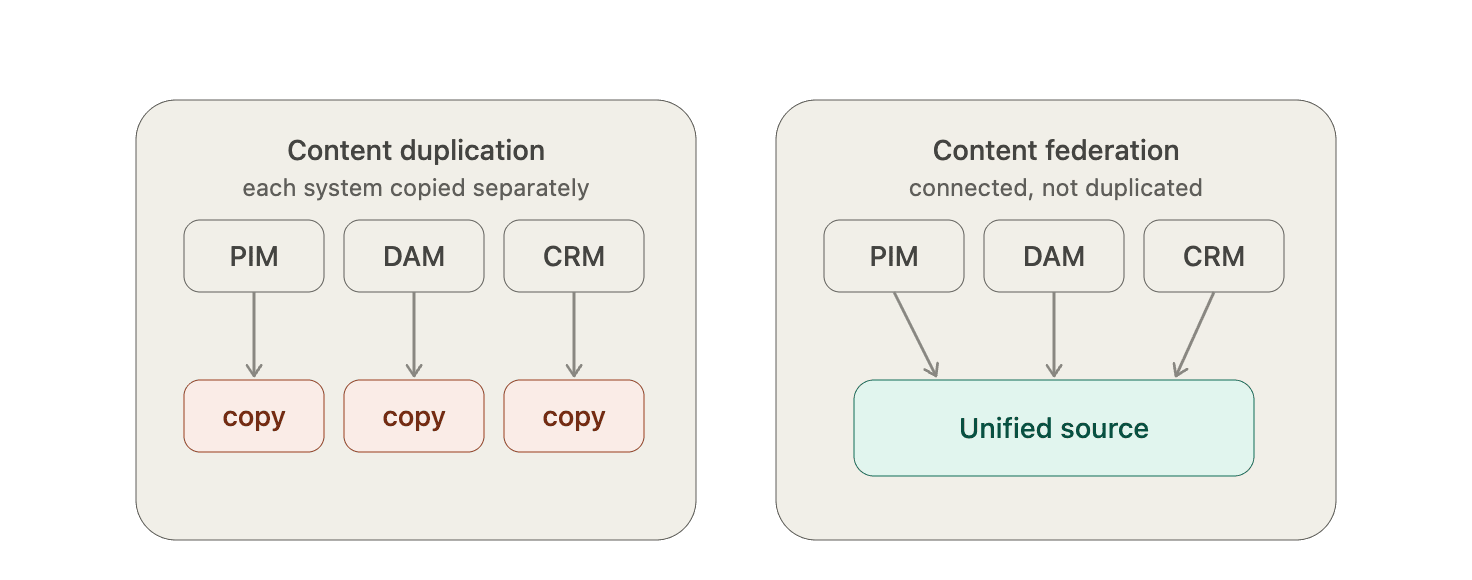
As organizations adopt more AI tools, they also accumulate more content systems. Product information may live in a PIM, marketing content in a CMS, digital assets in a DAM, and technical documentation in separate knowledge bases. Without a way to connect these sources, AI often relies on duplicate, outdated, or inconsistent information.
Why It Matters
Content duplication creates multiple versions of the same information, making it difficult for AI to determine which one is accurate. Every manual copy introduces the risk of inconsistencies across websites, apps, customer support, and AI-powered experiences.
The scale of this problem tends to surprise teams once they look closely: when agencies run a content audit ahead of a platform consolidation, they typically find that 30–40% of existing content is outdated, duplicative, or no longer serving a business purpose. A connected content ecosystem helps ensure AI always works from the most up-to-date information available.
What to Look For
Pick a CMS that supports content federation or seamless integration with external systems instead of requiring teams to copy information into the platform. The CMS should be able to bring together content from ecommerce platforms, PIMs, DAMs, CRMs, databases, and other business systems while maintaining a single source of truth. This approach reduces maintenance, improves content consistency, and gives AI access to reliable information across your entire technology stack.
4. Governance That Keeps AI Responses Trustworthy
AI can only produce reliable responses if it has access to accurate, approved, and up-to-date content. Without proper governance, AI may retrieve outdated information, conflicting messaging, or content that was never intended for public use.
Why It Matters
As AI content volumes grow, so does the risk of inconsistent information. Multiple teams often contribute to the same knowledge base, making it essential to control who can create, edit, approve, and publish content. Strong governance helps ensure AI applications always reference trusted content while reducing the risk of inaccurate or non-compliant responses.
What to Look For
Consider a CMS with built-in governance features such as role-based permissions, approval workflows, version history, and audit logs. The platform should also support content environments for testing changes before they reach production. These capabilities help maintain content quality and give AI systems a reliable foundation to generate accurate, consistent responses.
5. Content Reuse Across Every Channel
Today’s content doesn’t live on a single website. It powers mobile apps, ecommerce storefronts, customer portals, AI assistants, search experiences, and emerging digital channels. Managing separate versions of the same content for each destination quickly becomes inefficient and difficult to maintain.
Why It Matters
When content is duplicated across channels, every update requires additional manual work and increases the risk of inconsistencies. AI systems also perform better when they retrieve information from a single, authoritative source rather than multiple disconnected copies. Reusable content helps ensure customers receive consistent information regardless of where they interact with your brand.
What to Look For
Evaluate whether the platform can let you create content once and publish it across multiple channels without duplication. The platform should support reusable content models, omnichannel delivery, and flexible APIs that allow the same content to power websites, mobile apps, ecommerce experiences, AI assistants, and future digital touchpoints. This not only improves operational efficiency but also creates a stronger foundation for scalable AI-driven content delivery.
6. A CMS That Scales With Multiple Brands
Many organizations start with a single website but eventually expand into new markets, launch additional product lines, or acquire new brands. A CMS that works well for one brand doesn’t always scale efficiently as content operations become more complex.
Why It Matters
Managing multiple brands often leads to duplicated content, inconsistent governance, and separate CMS instances that increase maintenance costs. AI initiatives can also become fragmented when each brand stores and structures content differently. A unified content foundation makes it easier to maintain consistency while allowing individual brands to preserve their unique voice and identity.
What to Look For
Prioritize platforms that can support multiple brands, markets, or regional sites from a single governed foundation. The strongest options provide isolated content spaces, flexible content models, localized workflows, and role-based permissions, allowing teams to work independently without creating new silos. This setup simplifies governance today and makes future brand launches, market expansion, and acquisitions easier to manage.
7. AI-Ready Content Architecture
Adding AI features to a CMS does not automatically make the platform AI-ready. The real test is whether its underlying architecture can provide AI systems with structured, contextual, and governed information.
Why It Matters
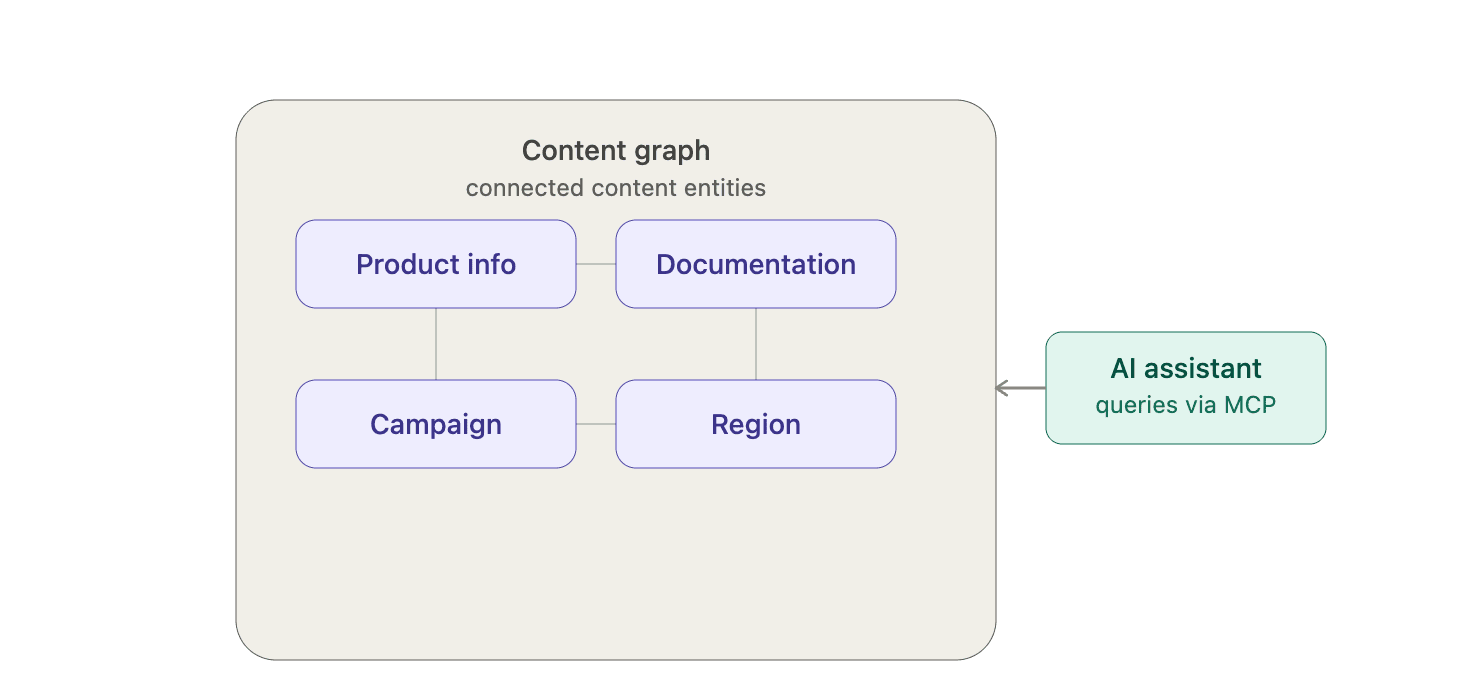
AI assistants need more than isolated content entries. They need relationships, metadata, and context that help them understand how products, documentation, campaigns, regions, and other entities connect. Without that structure, AI retrieval becomes less precise and generated responses are more likely to rely on incomplete or irrelevant information.
What to Look For
Evaluate whether the CMS creates a connected content graph rather than storing information as unrelated pages or entries. It should support structured metadata, taxonomies, relationships between content types, and controlled access to approved information. Also consider whether AI assistants can interact with that content through emerging standards such as the Model Context Protocol.
Hygraph is one example of this approach. Its structured content graph gives AI systems machine-readable context, while its MCP Server connects AI assistants to that graph within established governance boundaries. This allows organizations to make content available to AI tools without separating it from the permissions and controls already applied inside the CMS.
8. Flexibility to Support Future AI Workflows
AI is evolving rapidly, and the tools your team uses today may look very different a year from now. Choosing a CMS that can adapt to new models, workflows, and integrations is just as important as the AI features it offers today.
Why It Matters
Building your content operations around a single AI provider or proprietary feature can limit future flexibility. As new AI assistants, automation platforms, and retrieval technologies emerge, your CMS should be able to integrate with them without requiring major architectural changes.
Analysts increasingly treat this kind of composability as standard practice rather than an emerging bet: Gartner has projected that organizations using composable digital modules will improve the speed of digital innovation by 60% relative to a 2022 baseline, and separate industry research puts composable architecture adoption among US brands at 92%, with roughly 9 in 10 of those organizations reporting that it meets or exceeds their ROI expectations. An adaptable platform helps future-proof your content strategy while reducing the cost of adopting new AI capabilities.
What to Look For
Choose a CMS with an API-first, composable architecture that integrates easily with evolving AI ecosystems. Support for modern standards, extensible APIs, webhooks, and developer-friendly tooling makes it easier to connect new AI services as they become available. A flexible architecture ensures your content remains accessible and reusable, regardless of how AI technologies continue to evolve.
Questions to Ask Every CMS Vendor
A vendor may describe its platform as “AI-ready,” but the label means little without understanding the content architecture behind it. These questions can help you distinguish between a CMS with a few AI add-ons and one that can support reliable AI-driven content operations over time.
How is content structured inside the platform?
Ask whether content is stored as reusable, relational entities or as complete pages and large text blocks. The answer will reveal how easily AI systems can retrieve specific facts, understand context, and reuse information across experiences.
How can AI systems access the content?
Find out whether the CMS provides stable, well-documented APIs and supports modern integration standards. You should also understand whether AI tools can retrieve only the fields they need without relying on custom middleware or repeated data transformations.
Can the CMS connect content from external systems without copying it?
Ask how the platform works with information stored in PIMs, DAMs, ecommerce systems, CRMs, databases, and documentation tools. A strong solution should reduce duplication while preserving the original source of truth.
How does the platform prevent AI from using outdated or unapproved content?
Review its permissions, publishing stages, approval workflows, version history, and audit capabilities. AI applications should be able to access governed content without bypassing the controls already used by your organization.
Can the same content support websites, apps, search, and AI assistants?
Confirm that content can be reused across channels without creating separate copies for every destination. The CMS should keep content independent from presentation so new interfaces can consume it without re-authoring.
How does the CMS handle multiple brands, markets, and languages?
Ask whether teams can share selected content while maintaining separate schemas, workflows, permissions, and localized variants. This becomes especially important when AI experiences need to deliver the correct information for a specific brand or region.
Does the content model provide enough context for accurate retrieval?
Look beyond metadata fields alone. Ask whether the platform supports taxonomies, references, semantic relationships, and connected content models that help AI understand how different entities relate.
How easily can the platform support new AI tools and standards?
Ask what happens when your organization changes model providers, introduces a new assistant, or adopts an emerging protocol. An API-first, extensible platform should allow those changes without forcing a major content migration or architectural rebuild.
Conclusion
AI is reshaping content operations, but the success of your AI initiatives depends on more than built-in AI features. It starts with a CMS that can organize, govern, and deliver content in a way that both people and machines can understand.
As you evaluate CMS platforms, look beyond AI writing assistants and chatbots. Prioritize structured content, reliable APIs, strong governance, reusable content models, and an architecture that can evolve alongside new AI technologies. These capabilities will have a far greater impact on the long-term value of your content than any single AI feature.
Ultimately, the best AI-ready CMS is one that gives your organization a flexible foundation for whatever comes next. By choosing a platform designed for scalable, structured, and connected content, you’ll be better equipped to support future AI workflows, improve content quality, and adapt as the AI landscape continues to evolve.