
The way we find information online is simply not the same anymore. Traditional search engines with their familiar blue links are being rapidly supplemented (and in some cases, replaced) by AI answer engines that deliver direct, personalized responses to user queries.
ChatGPT now serves over 900 million weekly active users, Perplexity handles more than 100 million queries weekly, and Google’s AI Overviews and AI Mode are used by over two billion users and are increasingly dominant in search results.
Research from Bain shows that approximately 80% of consumers now rely on “zero-click” results (where the answer is provided directly on the search results page) for at least 40% of their searches. This is primarily due to AI summaries (like Google AI Overviews) and LLM-powered chatbots (like ChatGPT and Perplexity).
In some cases, such as Google AI Mode searches, as many as 93% of queries end without a click to a website. These shifts in search behaviour have reduced organic web traffic for many sites by an estimated 15% to 25%.

This behavioural shift from conventional search engines to answer engines means that marketing disciplines must (and did) evolve with it, too. While traditional SEO remains important (start with the foundations first), the discipline is evolving to heavily prioritize what’s now referred to Answer Engine Optimization (AEO) or Generative Engine Optimization (GEO).
Understanding and implementing AEO strategies is now essential for maintaining visibility as AI increasingly mediates the information discovery process.
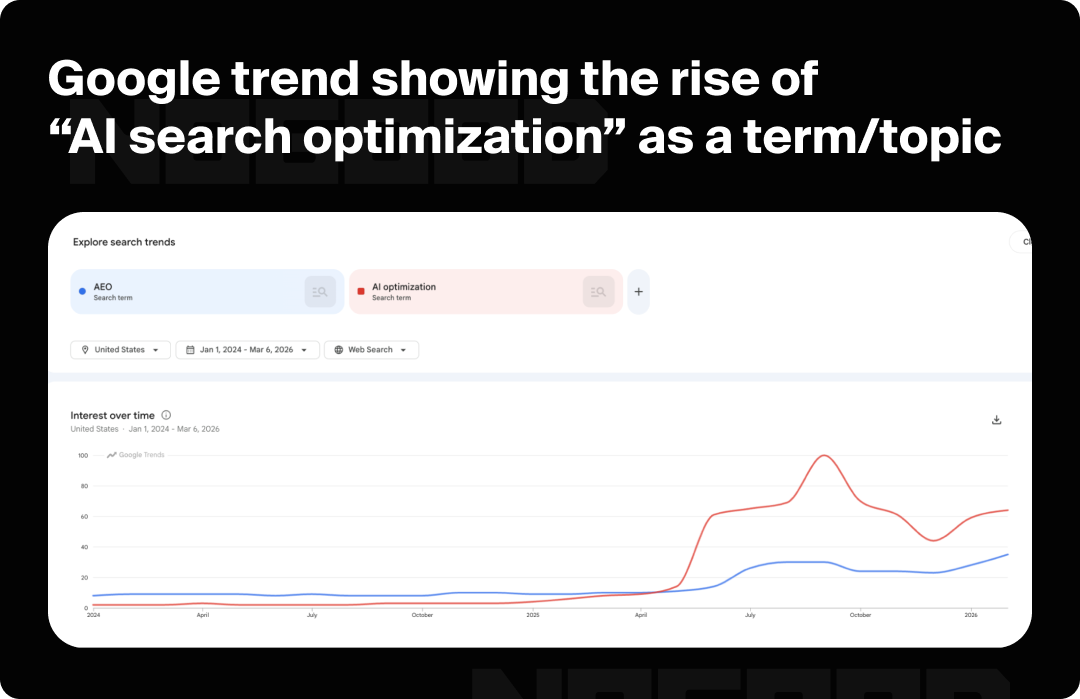
This comprehensive guide will walk you through everything you need to know about AEO, from understanding the fundamentals to implementing practical strategies that ensure your brand and content remains visible and valuable amidst the current ubiquity of zero-click AI searches.
What you’ll learn:
- The basics of Answer Engine Optimization (AEO) and how it differs from SEO
- Techniques to optimize content for AI systems like ChatGPT, Claude, and Google AI Overviews with an emphasis on clarity and authority
- Steps to implement an AEO strategy, covering research, content creation, and distribution
- The role of schema markup and technical SEO in improving AI access and ranking
- How to measure AEO success and build authority across AI platforms
What Is AEO?
Answer Engine Optimization (AEO) refers to strategies and techniques for optimizing content to be effectively extracted, cited, and featured by LLMs and answer engines like ChatGPT, Claude, Perplexity, Gemini, Google’s AI Overview, and more.
The terminology in this space can be confusing, with several overlapping concepts. Let’s break it down:
- AEO (Answer Engine Optimization): Focuses on creating content that’s easily extracted and cited by AI systems, emphasizing clarity, conciseness, and direct answers to specific questions.
- GEO (Generative Engine Optimization): Techniques for creating high-quality, information-rich content designed to serve as reliable source material for generative AI.
- LLM SEO: Optimization strategies specifically targeting search engines powered by large language models, prioritizing semantic relevance and comprehensive coverage.
- LLMO (Large Language Model Optimization): A broader, holistic approach to optimizing content, structure, and metadata for discoverability, interpretability, and influence within AI outputs across various platforms (not just search).
- AIO (AI Overviews): Techniques specifically tailored for Google’s AI-powered search algorithms and features appearing at the top of search results.
For simplicity, we’ll use “AEO” throughout this guide, as the core principles remain consistent regardless of terminology.
The TL;DR is, AEO is about structuring your content in a way that optimizes it to be surfaced by AI answer engines. For example, if someone asks ChatGPT, “what’s the best moisturizer for dry skin,” AEO ensures that your brand is surfaced in the answers AI provides.
|
Goal |
Rank in search engine results pages |
Get cited in AI answers |
Be used as source material for generative AI |
|
Retrieval |
Crawled and indexed by search bots |
Extracted and synthesized by AI models |
Ingested into training data or RAG pipelines |
|
Ranking Signals |
Backlinks, keywords, technical health, E-E-A-T |
Clarity, structure, authority, schema markup |
Content depth, factual density, source credibility |
|
Output |
A ranked list of blue links |
A direct answer, often with citations |
A generated response built from multiple sources |
|
Consumer |
Human clicking through results |
Human reading an AI response |
The AI model itself |
How AEO Differs From SEO
SEO is the practice of improving website rankings in search engine results pages (SERPs) through keywords, backlinks, and technical enhancements. AEO, on the other hand, focuses on optimizing content so that your brand maintains visibility in AI search results.
Many of the fundamental principles of content clarity, helpfulness, and authority are important for both SEO and AEO, but the fundamental goals are different. Simply put, SEO optimizes for search engines, AEO optimizes for AI answer engines.
How Does AEO Work?
At its core, AEO works by making your content legible to AI. Search engines crawl links; answer engines extract meaning. The distinction matters because the optimization logic is fundamentally different. Instead of signaling relevance through backlinks and keyword density, AEO signals authority through clarity, structure, and the quality of the information itself.
When someone asks ChatGPT or Perplexity a question, the model synthesizes an answer from content it’s been trained on or is actively retrieving through RAG (Retrieval Augmented Generation). Your job is to be the source it reaches for: clear enough to extract, authoritative enough to trust, and structured well enough to cite.
The Core Principles of AEO
- Directness: AI models reward content that answers the question immediately. Burying your answer under three paragraphs of context is an SEO habit worth breaking. Lead with the answer, then support it.
- Structure: Headers, bullet points, numbered lists, and comparison tables are formatting choices, yes, but they’re also important signals. Well-structured content is easier for AI systems to parse, extract, and attribute. Think of your H2s and H3s as the architecture that makes your content machine-readable.
- Authority: AI models are trained to surface credible sources. That means original research, cited statistics, and consistent expertise across your content ecosystem all carry weight. A single well-optimized page sitting on a thin domain won’t cut through.
- Completeness: Answer engines favor content that covers a topic comprehensively. Narrow, shallow content gets passed over in favor of sources that address the full scope of a question, including adjacent questions the user hasn’t asked yet.
- Consistency: Your brand needs to appear across multiple platforms and sources saying the same things. If ChatGPT encounters your brand in one Reddit thread, one LinkedIn article, and one well-structured blog post all reinforcing the same expertise signals, that repetition builds recognizability in the model’s understanding of who you are and what you know.
Key Variables That Affect AEO Performance
To understand what actually moves the needle, Goodie conducted the largest AI search visibility study to date, analyzing thousands of prompts across models to rank the variables that most influence brand visibility in AI answers.

Content Relevance leads with an average impact score of 93.0 across all six models, followed by Content Quality and Depth at 90.0, and Credibility and Trust at 88.2. What’s notable is what ranks at the bottom: Social Signals sits last at 55.7, and SERP Ranking comes in just above it at 61.8. The implication is the same as it’s always been: technical and off-page signals matter, but they won’t carry you if the substance isn’t there.
Not all models weight these factors identically, which matters for how you prioritize. Claude applies the strictest quality and credibility threshold of any model in the table. Perplexity is most sensitive to citation frequency and content freshness. Grok is the only model where Social Signals approaches meaningful weight. Building an AEO strategy that accounts for these differences, rather than optimizing for one model in isolation, is what separates surface-level implementation from a durable visibility advantage.
Organic Social Content Is Now an AEO Variable
Most AEO strategies start and end with the brand’s own website. Optimize the page, add schema markup, and hope the model retrieves it. That playbook is now proving to be incomplete, as another one of Goodie’s research studies across 45.2 million citations found that social content generates roughly 2.5 times as many AI citations as owned brand pages.
If your visibility strategy is built entirely around your own site, you are, in their words, “optimizing the smallest slice of the pie.” Social citations currently represent about 4.2% of total AI citations across major models, but that number is moving fast: social citation growth compounded at more than double the rate of overall citation growth through late 2025, and AI Overview’s social citation share climbed from 3.46% in October 2025 to 7.88% by February 2026.
The distribution isn’t even across platforms. YouTube and Reddit dominate, accounting for roughly 32% and 28% of all social citations respectively, but which platform gets cited depends heavily on which AI model is answering the question. Google’s surfaces pull primarily from YouTube. ChatGPT leans on Reddit. DeepSeek and Copilot skew toward LinkedIn Articles. There’s no universal social platform strategy for AEO; the right platforms depend on where your audience searches.

How to Implement an AEO Strategy
Based on insights from leading experts across the industry, we’ve developed a comprehensive five-step framework for effective Answer Engine Optimization:

Step 1: Audit How AI Currently Sees Your Brand
Before optimizing anything, understand where you actually stand. Run your brand name through ChatGPT, Perplexity, Gemini, or whatever LLM your audience uses most. Note what gets said, what gets cited, and whether competitors are appearing in answers where you should be. This is your baseline.
More systematic auditing requires dedicated tooling:
- AEO platforms like Goodie can give you a visibility score, sentiment analysis, and competitive benchmarking across AI surfaces so you’re working from data rather than spot-checking. AI models answer questions, so your research also needs to reflect how people actually ask them.
- Tools like AlsoAsked, AnswerThePublic, and the “People Also Ask” boxes in Google surface the conversational queries your content needs to address. Remember to focus on long-tail, intent-specific questions rather than short keyword strings.
Action Items:
- Run your brand name through ChatGPT, Perplexity, Google AI Overview, and Gemini; note what’s said, what’s cited, and where competitors appear
- Install the Google AI Overview Impact Analysis Chrome extension to track which queries trigger AI Overviews
- Use AlsoAsked or AnswerThePublic to map the conversational questions your audience is asking around your core topics
- Build a tracking spreadsheet: target queries, whether they trigger AI Overviews, sources cited, content format used, your visibility vs. competitors
- Run a competitor audit: identify which competitors appear consistently in AI answers for your target queries and examine their content structure
Quick Win: Paste your brand name into three different AI models and screenshot the responses. You’ll immediately see gaps in how you’re being described, what sources are being cited, and whether the sentiment is accurate.
The content formats that get cited by AI models share three properties: they answer the question immediately, they’re structured so machines can parse them, and they carry enough depth to be treated as authoritative.
In practice, this means leading with a direct answer in the first 50 words, using H2s and H3s formatted as questions, breaking information into numbered lists and comparison tables, and building out FAQ sections for every major topic. The 40-50 word paragraph is the sweet spot for Featured Snippet and AI Overview extraction.
H-E-E-A-T signals matter here too. Original research, cited statistics, and named author expertise all increase the likelihood that AI models treat your content as a reliable source rather than passing it over.
Action Items:
- Audit your top 10 pages: does each one lead with a direct answer in the first 50 words?
- Reformat H2s and H3s as questions where the content is addressing a specific query
- Add comparison tables to any “vs” or “best of” content
- Add a dedicated FAQ section to every major content page, addressing the most common “People Also Ask” questions for that topic
- Ensure every piece cites at least one authoritative external source and includes original data or expert perspective where possible
- Review content against H-E-E-A-T criteria: is there a named author with demonstrated expertise? Is the content current?
Quick Win: Take your highest-traffic page and rewrite the opening paragraph to answer the primary question directly in under 50 words. Move the context and background further down.
Step 3: Implement Technical AEO
Technical implementation is table stakes. Without it, well-written content still gets overlooked.
Schema markup is the most direct technical lever. FAQ schema, HowTo schema, and QAPage schema each help AI systems understand the structure and intent of your content. Here’s a basic FAQ schema in JSON-LD:

Beyond schema, the standard technical foundations apply: page load under 2.5 seconds, mobile responsiveness, semantic HTML with clean heading structure, HTTPS, and descriptive URLs. The emerging LLMs.txt standard is also worth watching as a way to signal AI-friendly content directly.
Action Items:
- Implement FAQ schema on every page with a dedicated FAQ section
- Add HowTo schema to any step-by-step guide content
- Apply QAPage schema to community-style Q&A content
- Validate all schema implementation using Google’s Rich Results Test before publishing
- Run your key pages through PageSpeed Insights and address the highest-impact load time issues
- Audit heading structure across key pages to ensure clean H1 > H2 > H3 hierarchy
- Confirm all pages are mobile responsive and served over HTTPS
- Explore implementing /llms.txt to directly signal AI-crawlable content
Quick Win: If you have FAQ sections with no schema attached, adding FAQ schema is a one-hour implementation that immediately makes that content more parseable by AI systems.
Step 4: Build Authority Across the Source Graph
AI models synthesize answers from across the web, which means your visibility is a function of how broadly and consistently your brand appears in sources they trust. Your own site is the smallest piece of that picture.
Earned media is still the dominant citation type at 72% of all AI citations, which makes digital PR and third-party coverage the highest-leverage authority-building activity. Getting cited in industry publications, referenced in original research, and mentioned in community discussions (Reddit, Quora, LinkedIn) all expand the source graph that AI models draw from when your brand is relevant to a query.
Distribution should follow the platform-to-model logic:
- YouTube long-form for Google surfaces
- Reddit threads for ChatGPT
- LinkedIn Articles for DeepSeek and Copilot
Consistent entity language across all of it matters; use the same brand name, product names, and category terms everywhere so models build a coherent picture of who you are.
|
Gemini |
YouTube Long Video |
75.2% |
Reddit Post |
18.9% |
|
Perplexity |
YouTube Long Video |
75.0% |
Reddit Post |
8.1% |
|
Grok |
X Post |
72.2% |
Reddit Post |
23.8% |
|
DeepSeek |
LinkedIn Article |
64.1% |
Reddit Post |
30.8% |
|
ChatGPT |
Reddit Post |
61.1% |
LinkedIn Article |
22.3% |
|
Meta AI |
LinkedIn Article |
55.3% |
Reddit Post |
36.6% |
|
Copilot |
LinkedIn Article |
52.8% |
Reddit Post |
37.2% |
|
AI Overview |
YouTube Long Video |
50.2% |
Reddit Post |
19.3% |
|
AI Mode |
YouTube Long Video |
49.9% |
Reddit Post |
22.8% |
|
Claude |
Medium Article |
44.9% |
TikTok Profile |
26.8% |
Action Items:
- Identify 3-5 authoritative industry publications where your competitors are getting bylines and pitch your own contributions
- Audit your brand’s Reddit presence: are you participating in the subreddits where your audience asks questions? Are those threads structured for extractability?
- Publish LinkedIn Articles on your core topics rather than relying on feed posts; these generate nearly 6x more AI citations on the same platform
- If YouTube is a channel you’re investing in, prioritize long-form over Shorts; the citation ratio is 51:1 in favor of long-form
- Standardize entity language across all platforms: your brand name, product names, and category terms should be identical everywhere
- Build a backlink acquisition strategy focused on authoritative domains in your category, not just volume
- Create at least one piece of original research or proprietary data per quarter; cited statistics are a high-signal authority indicator for AI models
Step 5: Measure & Iterate
AEO measurement is still maturing, but the core metrics worth tracking are:
- AI visibility rate (the percentage of your target queries where your brand appears in AI responses)
- Citation position
- Brand sentiment in AI answers
- Downstream conversion from AI mentions to site visits
We can start with the out-of-the-box AI Search platforms that are natively built for AEO. Here is a breakdown of the leading AEO tools in the space and which one would make the most sense for your business and use case.
Tracking AI visibility allows you to measure the real impact of your content in an increasingly AI-forward search landscape. By monitoring when, where, and how your brand is featured in AI responses, you gain insight into which strategies are working (and which need refinement).
This data-driven approach helps identify high-performing content formats, optimize for better placements, and ensure your brand stays top-of-mind (and top-of-result) as AI evolves. Consistent tracking also supports smarter iteration cycles, allowing you to adapt your content and SEO efforts to stay aligned with how AI systems surface and rank information.
Action Items:
- Set up a weekly tracking system for AI visibility across your target queries; note which queries you appear in, at what position, and what sources are cited alongside you
- Monitor brand sentiment in AI responses: is the language accurate? Are there consistent gaps or mischaracterizations worth addressing through content?
- Track downstream impact using UTM parameters to measure traffic arriving from AI-cited sources
- After each content update, re-run the affected queries through major AI models to observe whether citation behavior changes
- Review your 10 highest-performing pages monthly and update with new data, statistics, or examples to maintain freshness signals
- Conduct a full content and citation audit quarterly: what’s working, what’s dropped out of AI responses, and what competitive shifts have occurred
Iteration Schedule:
- Weekly: Check AI visibility metrics across target queries
- Monthly: Refresh top-performing content with updated data and examples
- Quarterly: Full content audit and strategy adjustment based on citation patterns
- Ongoing: Monitor AI model updates and new platform partnership announcements that could shift citation behavior
Quick Win: Set a recurring monthly calendar reminder to update the statistics and examples in your three highest-traffic pages. Content freshness is a meaningful signal for AI models, and it’s the lowest-effort, highest-return maintenance task in your AEO workflow.
Common AEO Pitfalls to Avoid
Most AEO mistakes don’t come from ignoring best practices. They come from applying the right instincts to the wrong mental model of how AI citation actually works. Here are some common AEO pitfalls and how to avoid them:
- Optimizing for visibility without optimizing for accuracy: Getting cited by an AI model is only valuable if what it says about you is correct. Brands that focus entirely on appearing in AI responses without auditing the content of those responses end up with a wide distribution of inaccurate or incomplete information.
- A mischaracterized product description or outdated positioning, repeated across millions of AI answers, compounds faster than any correction can travel. Monitor what AI models are actually saying about your brand, not just whether they’re saying anything at all.
- Building for one model: A brand that invests exclusively in Google AI Overview optimization while neglecting Reddit and LinkedIn is invisible to ChatGPT and Copilot users asking the same questions. Diversifying your source graph across platforms ensures that you’re optimizing visibility across all of the different answer engines your consumers are using.
- Conflating entity consistency with repetition: Using consistent brand language across platforms is essential for AI models to build a coherent picture of who you are, but keyword stuffing is the wrong application of that principle. AI models are trained on natural language and are increasingly good at identifying content written to manipulate rather than inform. The goal is recognizable, consistent entity signals, not density.
- Treating AEO as a one-time implementation: AI models update continuously. Citation patterns shift as new platform partnerships form, model architectures change, and the competitive content landscape evolves. Brands that run a one-time AEO audit and consider the job done will find their visibility eroding within a single quarter.
The Future of AEO
The citation landscape that exists today looks nothing like it did 18 months ago, and there’s no reason to expect that pace to slow. A few structural shifts are worth watching.
- Social media’s role as an AI source is still in its early innings. The data showing Reddit and YouTube as dominant citation platforms reflects where AI models are drawing from right now, but that distribution is actively shifting. TikTok and Instagram are beginning to climb in citation volume as AI systems get better at parsing video transcripts, captions, and structured visual content
- Multimodal content is the next frontier. AI models are increasingly capable of interpreting images, video, and audio in addition to text. What that means in practice is that optimization will eventually extend beyond written structure into how you caption video, how you label visual assets, and how you structure spoken content for transcription and extraction.
At the end of the day, AEO isn’t necessarily an entirely new discipline… it’s more so a recalibration of what it means to stay visible now that the human reader arrives only after the machine has already decided you’re worth citing.
Answer Engine Optimization FAQs
What does AEO mean?
AEO stands for Answer Engine Optimization. It is the practice of structuring and distributing content so it gets cited by AI answer engines like ChatGPT, Perplexity, Gemini, Claude, and others.
Where traditional SEO optimizes for search ranking positions, AEO optimizes for being the source an AI model draws from when synthesizing a response.
What is AEO and how does it work?
AEO works by making your content easy for AI models to find, parse, and trust. That happens across three layers:
- Content structure (direct answers, question-formatted headers, FAQ sections)
- Technical signals (schema markup, clean page architecture, fast load times)
- Authority distribution (earned media, platform presence, consistent entity language across channels)
AI models don’t rank pages the way search engines do; they pull from sources they’ve determined to be authoritative and extract the most relevant answer to a given query. AEO is the discipline of making sure your content qualifies as that source.
How do you do AEO and GEO?
- For AEO: structure content so AI models can extract it easily (direct answers in the first 50 words, question-formatted headers, FAQ sections, schema markup), then build authority across the platforms AI models pull from most: earned media, Reddit threads etc.
- For GEO: focus on depth and sourcing. Publish original research, cite authoritative data, and cover topics comprehensively enough that your content functions as reliable source material rather than just another page on the subject.
Where AEO is about being found and cited, GEO is about being worth citing in the first place. The two disciplines reinforce each other; the authority signals that drive AEO citations are built on the content quality that GEO demands.