

ATLANTA — A few days after Wake Forest returned from a road trip to California and settled into its mid-October bye week, athletic director John Currie and football coach Jake Dickert found a nice bench on campus to sit down and have a hot dog.
“We just kind of talked about things,” Currie told Yahoo Sports. “He didn’t want to distract from the team, but what we knew was going to happen was there was going to be stuff coming at us, coming at our players, our assistant coaches. And the only way for us to control the controllable and reduce that distraction was to go ahead and get a deal done.”
Advertisement
The “stuff,” of course, was about other jobs.
When you’ve come out of nowhere to get Wake Forest into playoff contention — and the No. 8 Demon Deacons are arguably the hottest team in college football at 10-1 with a spot secured in the ACC championship game — speculation about where the coach is headed next is inevitable.
Currie, a veteran of three power conference AD jobs, knew exactly what was coming. By late September, he had already started to engage school president Peter Rodriguez, the board of trustees and key donors about putting together an extension and securing the resources it would take to make Dickert spurn interest from other schools.
Though Wake Forest partisans will point out that it has only employed three football coaches since the turn of the century — Jim Grobe stayed for a largely successful 13 years and Dave Clawson had a strong run for most of his 11 seasons — this season represents a different level of winning at a place most people wouldn’t expect to be playoff-level good.
Advertisement
So Currie looked at a job market without a lot of successful, proven head coaches and a narrative that was going to be set by people who “don’t understand why someone wants to stay at Wake Forest,” he said. The only way to head off the approaching storm was getting a deal done.

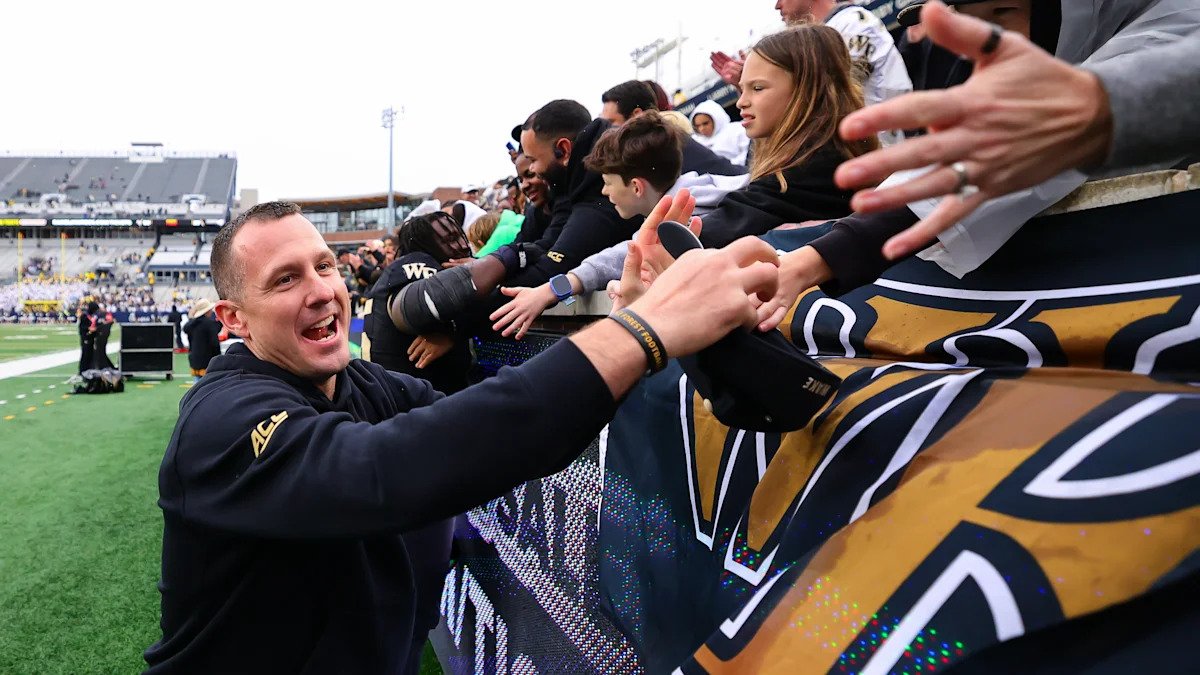
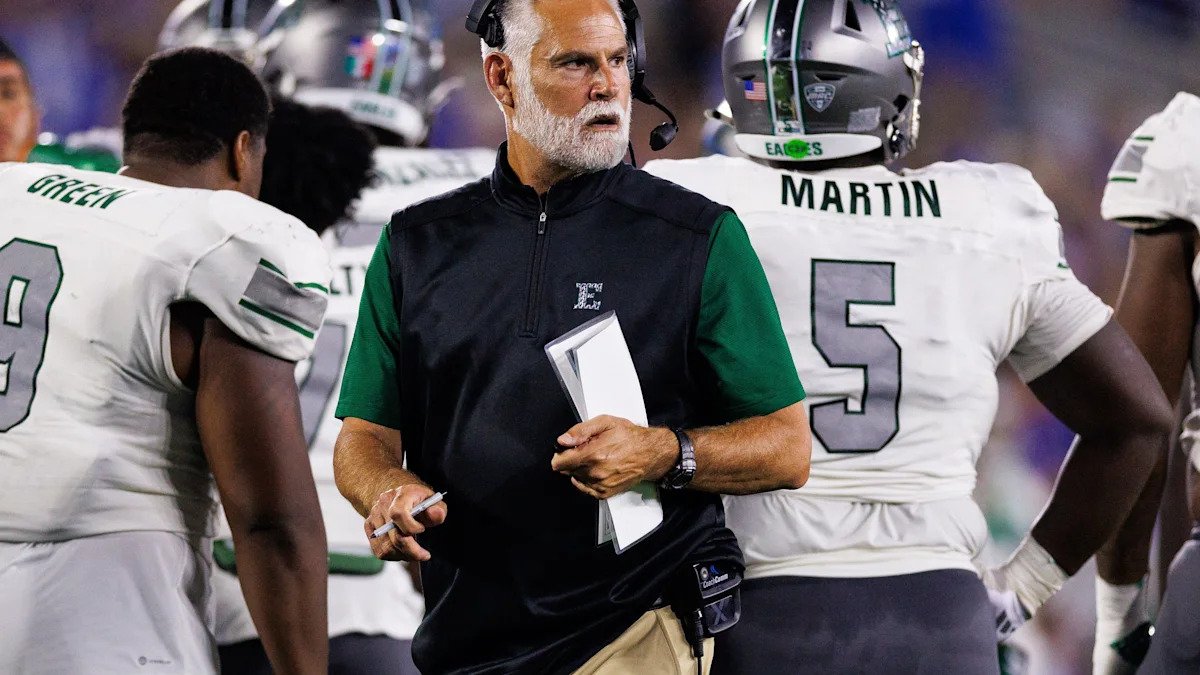
Wake Forest coach Jake Dickert high-fives fans after a win over Georgia Tech. (Colin Hubbard/Getty Images)
(Colin Hubbard via Getty Images)
Currie was prepared. Dickert, having moved around eight times in the last 15 years, was ready to settle and enjoy the fruits of his labor. And so earlier this month, they came to an agreement on an extension, clearing the path for Wake Forest to savor a season that, if anything, might be going a little too well. At this point, the only reason to doubt whether the Demon Deacons can do damage in the CFP is how easily they’ve handled everyone since late September.
Wake Forest has blown out so many teams the past couple months, the question of how they’ll respond to adversity simply hasn’t come up.
Advertisement
“If I didn’t have the type of leadership we have on this team, I probably would [worry about that],” Dickert said. “The intensity with which we have taken the field and prepared has been really strong. As a coach, you always worry about different things, but at the end of the day, our team’s playing at a really elite level.”
How did Jake Dickert land at Wake Forest?
Dickert is musing about such a first-world problem after yet another rout, this time 50-29 over Georgia Tech in Atlanta. It was Wake Forest’s sixth true road win of the year (all against power conference opponents) and its seventh straight game that was over before the fourth quarter.
Early in the season, before we really knew what Wake Forest was going to become, this was a team that needed overtime to squeak by Purdue and was in a long battle with Louisville before finally prevailing, 30-27. Since then, Wake Forest has operated with machine-like efficiency, winning its last six games ACC games by an average of 36.5 points.
Advertisement
You can certainly question the competition, but the level of dominance has been unambiguous.
“We knew we had a special group all the way back in January,” senior defensive end Langston Hardy said. “We knew we had a deep team and throughout spring ball, we could really see how explosive this offense was. We just always kind of had that taste in our mouth that this is what we wanted to achieve and that’s just the mission to keep going.”
But how did this happen in the first place?
It all comes back to Dickert, a 43-year-old from Wisconsin who played D-III ball and then started his way up the coaching ladder at off-brand programs in the Midwest: North Dakota State, Minnesota State, South Dakota and South Dakota State just to name a few. At a couple stops along the way, Dickert was on the same staff as Jason Eck, whose work at New Mexico has made him one of the hottest names in coaching.
Dickert’s big break came after the 2019 season when he was the defensive coordinator at Wyoming, which had gone 8-5. That led to Nick Rolovich hiring him as Washington State’s defensive coordinator, and a year later, Dickert was unexpectedly thrust into the interim head coaching role when Rolovich and four other assistants were fired for refusing to comply with a mandate for state employees to take the COVID vaccine.
Advertisement
After a blowout win over Washington, Dickert was named the Cougars’ permanent coach and did enough over the next three seasons to become a candidate for power conference jobs. In particular, administrators were impressed with his work in 2024 to get Washington State to 8-4 despite no conference affiliation, having been left behind by the 10 schools in the old Pac-12 that had scattered to other leagues.
That’s when Currie took notice.
In 2024, Clawson had given Currie a heads up that he might be ready to step away from coaching, but it was an awkward spot for an athletic director to start talking with candidates for a job that might not be open.
As Currie started looking at the landscape, he did not know Dickert personally but knew vaguely what qualities he was looking for. He leaned heavily on former Washington State athletic director Pat Chun (now at Washington) and Ben Sutton, a Wake graduate and former president of IMG College, to figure out how many of those boxes Dickert would check.
Advertisement
When Clawson officially pulled the trigger after the season, Currie was ready to act on a coach from the other side of the country that had the right attributes, even if his résumé was unconventional.
“No. 1, they’ve got to be smart,” Currie said. “Our athletes are really smart, and if you’re not smart, they’ll see right through you. No. 2, they have to have character and integrity. And No. 3, they have to have been through something hard. You’ve got to have some scar tissue to do this job. And No. 4, you have to have accomplished something, and they had. And then you’ve got to have great energy.”
At this point, it’s worth noting that Currie might be known best across college football for controversy over his hiring acumen. At Tennessee in 2017, Currie fired Butch Jones and was set to hire Greg Schiano, who was Ohio State’s defensive coordinator at the time.
Once the impending hire became public, the backlash from Tennessee fans became so intense that the school backed out of the deal by day’s end. Currie, suddenly in scramble mode, criss-crossed the country to talk with others including Mike Leach, but the damage was done. Currie was fired five days later.
Advertisement
Though it was a gutting professional setback — Currie was essentially on the sidelines for a year and a half before getting the Wake Forest job — history has a way of correcting the narrative. Tennessee has certainly righted the ship now, but its decision to dump Currie was disastrous in the short term, as former football coach Philip Fulmer finagled his way into the AD chair and hired Jeremy Pruitt, who was neither good on the field or off it, getting the program into significant trouble with the NCAA.
Though Schiano might have crashed and burned, too — we’ll never really know — the irony of it all is that Currie’s hiring track record points to a pretty strong eye for what a program needs. At Kansas State, he brought in Bruce Weber, who led the Wildcats men’s basketball team to the NCAA tournament in five of his first seven years, including an Elite Eight appearance. Though he was at Tennessee for less than a year, Currie identified Tony Vitello for baseball, a decision that eventually led to a national championship. And at Wake Forest, the Dickert hire and subsequent extension has changed the perception of what they’re capable of.

Wake Forest head coach Jake Dickert walks off with athletic director John Currie after a win over No. 7. (AP Photo/Scott Kinser)
(AP Photo/Scott Kinser)
A lot of athletic directors get caught up in geographic ties to the region (which Dickert did not have) or how familiar fans will be with a hire. Currie instead looked at the job Dickert did at Washington State and tried to figure out what skill sets would be translatable — like how he won eight games the year after quarterback Cam Ward transferred to Miami.
Advertisement
In the current environment of college football, it was a notable achievement.
“Similar to Wake Forest, they had to be disciplined in their approach,” Currie said. “They’re not picking off the top of the menu every year in recruiting, so they’re identifying players they can develop.”
And even though Wake Forest has never been considered a powerhouse football program, those kinds of players are everywhere in North Carolina, which has one of the fastest-growing populations in the U.S.
Wake Forest set up for the future
It has all added up to a narrative-busting conclusion: In the upcoming 24-team playoff era, there is a pathway for a program in Wake’s category to regularly get a look at the postseason. As Currie points out, Wake would have been in a 24-team playoff in 2021 at 10-3 and would have been close in 2022 when they reached No. 10 before a late-season slide.
Advertisement
In other words, this isn’t an Indiana-type story. This has been a solid program for a while, elevated by a combination of an elite head coach and institutional belief that it could break through. And all without the type of crazed, win-every-game-or-get-fired pressure that consumes so many power conference jobs.
When you consider all that, maybe it’s not so surprising that Currie and Dickert came to an agreement pretty quickly to get a deal done and eliminate all the noise while they’re bearing down on a CFP bid this year.
“I think for our people and our fans to have this moment in time, it shows once again that we can play in this mix,” Currie said. “This makes it more real. We can be in it. It’s going to be hard to be in this mix, but we can be in it. This will be the third time we’ve played in the ACC championship game. North Carolina and Duke played in it twice. NC State was never in it. So we’re the best program in North Carolina and that’s a huge advantage for us.”
Now, with all the backstory out of the way, we get to another interesting question: How good is Wake Forest really? Good enough to win a first-round game? Put a scare into a team like Texas or Notre Dame in a quarterfinal? Get to a national championship game?
Advertisement
The beauty of it is, nobody knows.
Some analytical models like ESPN’s SP+ have Wake at No. 6, ahead of unbeaten Utah and Tennessee. Until this week, the committee was tepid because Wake Forest had not logged a win over a top-25 team. From a playoff perspective, the only great measuring stick we have was a 33-20 loss to Miami early in the season. Wake Forest fell behind 31-7 in that one but had the ball down just 13 points inside Miami’s 15-yard line with plenty of time left.
Had Wake Forest scored there instead of an incompletion on fourth down, that game might have turned out differently.
Advertisement
Instead, a lot of eyeballs will be on Charlotte in a couple Saturdays when Wake gets its second shot at Miami in the ACC title game. Despite the tough news this week that running back Ty Clark is out of the season with an an upper body injury, all the evidence suggests the Demon Deacons are a much different team now.
“Our guys are well aware of where we’re at, what we need to do, and the best part is we control our own destiny,” Dickert said. “I don’t really care about [doubters] if I’m being honest. Like, are they watching us? Are they really studying our players? Do they understand what [quarterback] Gio Lopez is doing? We have NFL players at every level on defense. Carlos Hernandez is one of the top three receivers in the country. Our offensive line peaking at the right time. Those are the facts when you watch the tape. Those are the only things we can control.”
When you watch Wake Forest, there is an undeniable effortlessness in the way they’re making this happen. It looks devastatingly physical up front, quick on the perimeter on both sides of the ball and very much under control offensively with Lopez completely rewriting his reputation after a lost 2025 season at North Carolina.
Everything about Wake Forest’s play looks buttoned up and sustainable, but how do you put all these lopsided scores into context when they’re beating teams that simply aren’t capable of pushing back?
Advertisement
Maybe that isn’t even the point.
“If you’re a Demon Deacon fan long enough, you know how hard this is,” Dickert said. “What our team is doing is hard. I don’t want people to miss that because I know sometimes we’re making things look easy but this isn’t easy. All the credit to the players. Our coaching staff is elite, and we’ve got the right magic right now as a team. But we need to continue to play a certain way.”
Thanks to that conversation over a hot dog last month, Wake will have an opportunity to do it without distraction the rest of this season and perhaps well into the future.
“Our people are smart investors,” Currie said. “So they see something that has validated the investment and trust that they have and then they see that we’re not done. It’s really hard to be in this position, but it’s also not something that should just happen once and never happens again.”





Leave a Reply