


Listen to this article
Estimated 4 minutes
The audio version of this article is generated by AI-based technology. Mispronunciations can occur. We are working with our partners to continually review and improve the results.
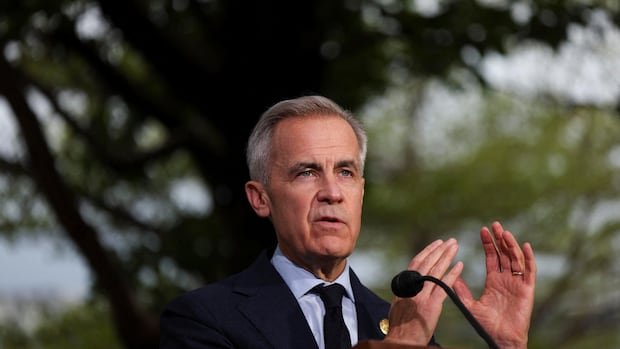
Prime Minister Mark Carney said Wednesday that Canada is willing to sign a mutually beneficial deal with the Americans, but if U.S. President Donald Trump can’t agree to those terms, then Ottawa will continue on its current trajectory: Aggressively diversifying away from the United States.
Speaking virtually to the Dealbook summit from China as he wound down his nine-day trade mission to Europe and Asia, Carney said Canada continues “to have a series of issues” when it comes to trade with the U.S.
While there has been some progress, “we’re not there yet” on putting pen to paper on an agreement, Carney said.
Canada is trying to get the Trump administration to lift or reduce its punishing Section 232 tariffs on autos, steel, aluminum, softwood lumber and other products.
These tariffs have caused job losses and shuttered plants, imperilling what was once one of the closest bilateral relationships in the world.
Canada is also driving for Trump to lift the 50 per cent tariffs he levied on a grab bag of Canadian products, apparently retaliating for Canada’s countermeasures on some U.S. goods that were imposed after the president first launched his trade war last year.
Carney met with Trump in China on the sidelines of the Asia-Pacific Economic Cooperation (APEC) summit — a conversation he described as “reasonably direct” but one that didn’t produce a trade breakthrough.
With the prospect of a U.S. trade deal uncertain, Carney said Canada’s talks with China have gone “exceptionally well” and are “very rational,” and he has secured meaningful market access for Canadian commodities in return for allowing a relatively small number of Chinese EVs to be imported at lower tariff rates.
As part of his Asian tour, Carney also brokered two free trade deals in a single day with the Philippines and the 11-nation ASEAN bloc, which combined represent a $6-trillion market.
Canada is also on the cusp of a free trade deal with India within the next three months, Carney said.

Prime Minister Mark Carney brokered two free trade agreements — slated to be signed next year — that will dramatically slash high tariffs on Canadian exports to the Philippines and the 11-member ASEAN bloc in a continued attempt to diversify trade away from the U.S.
Altogether, Canada currently has free trade access to economies with some two billion people, he said, and that number will soon reach three billion.
“We’d like to do a deal. If the U.S. doesn’t want to do a deal, we’re busy,” Carney said.
Asked if the U.S. midterm results changed anything for Canada — the Democrats won both houses of U.S. Congress in a landslide — Carney said, “No, is the short answer.”

Carney arrives at the Shenzhen Bao’an International Airport on Monday, ahead of the APEC summit in Shenzhen, China. (Pedro Pardo/Getty Images)
Carney said the only thing that will improve relations between the two countries is a U.S. reversal of anti-Canada trade actions that are designed to destroy key sectors of the economy.
“What will change views is policy decisions that are taken and that will stick,” he said. “It will take action as opposed to intent.”
But even then, Carney said the government doesn’t want to slide into an old pattern of ever-deeper economic integration with the U.S.
Canada doesn’t want to be “coerced” or “subjugated” by the U.S., or any other major power, anymore, he said.
The overarching goal of his trade policy — brokering associate membership with the European Union and thawing relations with China — is to secure Canada’s long-term sovereignty, Carney said.

Prime Minister Mark Carney, speaking from China on Nov. 18, said Canada and the U.S. have different types of trade relationships with Beijing, adding that in the ‘hierarchy of issues’ between Canada and the U.S., China is not ‘the top issue at all.’
Asked about Trump’s October assertion that the U.S. “holds all the cards” in its dealings with Canada, Carney was dismissive.
“Our cards are that everyone else in the world wants to deal with us,” Carney said, relaying his commitment to double non-U.S. trade in 10 years.
“I’m not saying the transition is easy. It’s not — there are challenges there.”
Conservative MP Adam Chambers, the party’s industry critic, meanwhile criticized Carney’s decision to draw closer to China and pitch warmer relations with the Asian economic superpower as an alternative to securing a U.S. deal.
“If the prime minister thinks it’s smart to play chicken with a U.S. administration that has a lot of leverage and harm it may choose to impose on Canada — the government should be very careful about doing that,” he told reporters on Parliament Hill.












Leave a Reply