
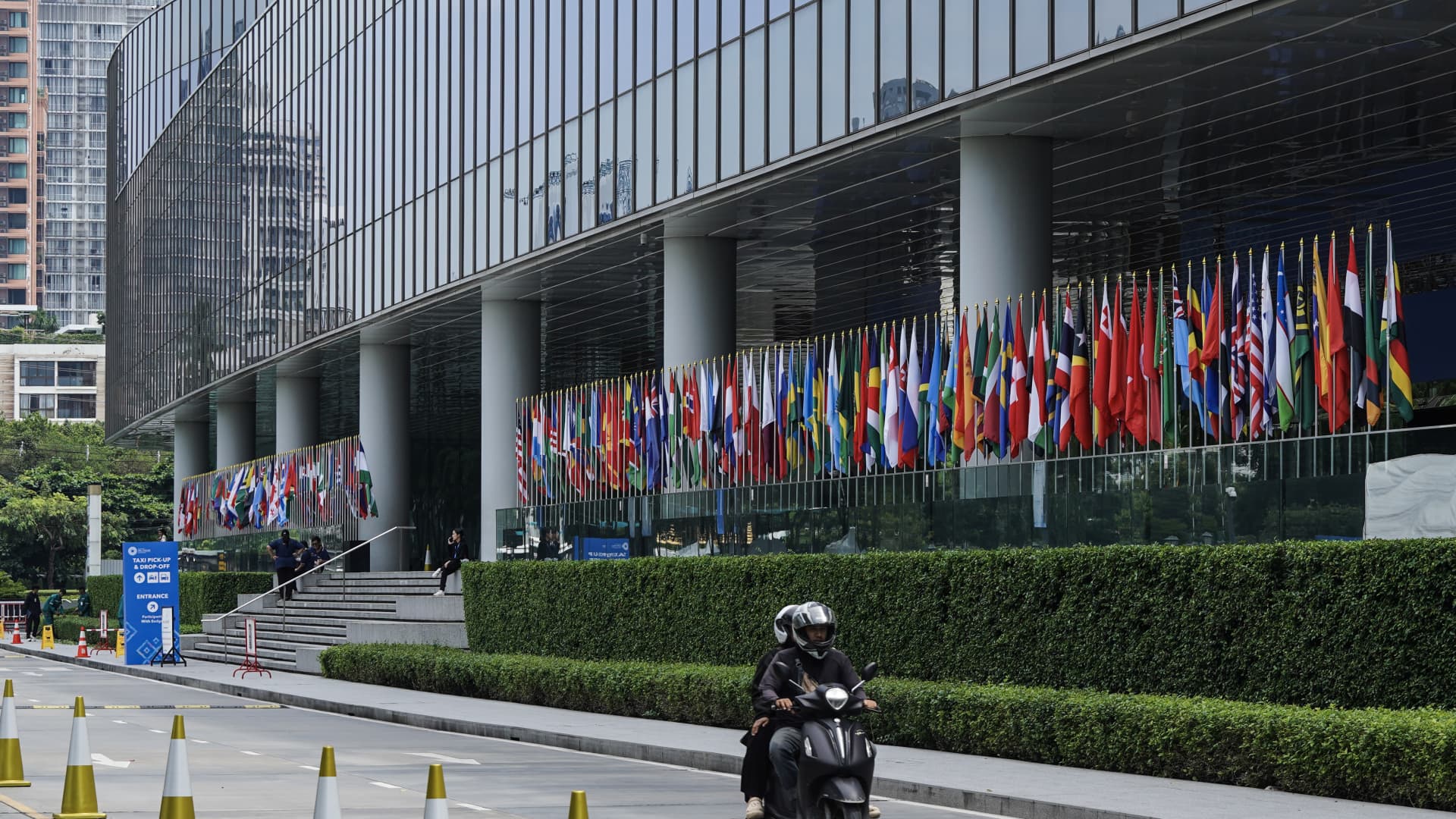
A motorcycle rides past a banner ahead of the annual meetings of the International Monetary Fund (IMF) and the World Bank Group at the Queen Sirikit National Convention Center in Bangkok, Thailand, on October 10, 2026.
Nurphoto | Getty Images
BANGKOK — The International Monetary Fund has raised its forecast for global economic growth this year as the AI-driven investment boom helps offset some of the impact from surging energy costs.
The IMF expects the global economy to grow at 3.1% in 2026, up from the 3% projected in July, but slower than the 3.5% rate last year. For 2027, it kept the forecast unchanged at 3.4%.
The UN agency expects inflation at 4.1% in 2027, above the 3.9% it projected in July – when it estimated the Strait of Hormuz would reopen by mid-July, with conditions broadly returning to pre-war levels by March 2027. For the current year, it maintained its 4.7% outlook.
The IMF now estimates that the Strait of Hormuz will reopen in March next year and return to pre-war state by October. Gulf crude exports averaged 88% of pre-conflict levels in September as traffic picked up, the international body said.
The report was released at the IMF and World Bank annual meetings in Bangkok this week, where finance ministers and central bank governors from the fund’s 191 members are meeting to discuss geopolitical tensions, mounting public debt and artificial intelligence.
AI-related investment gave the global economy a “demand impulse” that helped activity in the first half of the year hold up better than expected, despite the Middle East war and trade tensions, the IMF said. Financial markets also stayed largely calm, which the fund said may partly reflect “AI-related exuberance.”

For now, “use of buffers and adaptability have helped economies weather the negative shocks,” the IMF said, citing measures such as diversifying fuel sources, tapping strategic reserves that have contained the energy-market turmoil unleashed by the Middle East war.
But that cushion is “rapidly narrowing” in the near term, it said. Global oil reserves are being drawn down by about 2.7 million barrels a day, nearing levels that could trigger sharp price moves, and energy constraints could impair the AI-led momentum. The growing unease over governments’ fiscal health also adds to the headwinds.
Skewed growth
Overall growth is also becoming increasingly uneven. Thirty-two economies now account for 95% of global growth, down from 54 in April.
Countries that have limited exposure to the war-led supply shock and are catering to the AI-led demand are holding up or strengthening. Taiwan is forecast to grow 10.7% this year and South Korea 3.3%, up from 1.1% in 2025 on semiconductor demand. The U.S. is projected to expand 2.3% in both 2026 and 2027, supported by private consumption, fiscal policy and tech investment.
SUWON, SOUTH KOREA: An employee checks a server room in the Samsung Networks’ Telco Data Center at the Samsung Electronics HQ, Samsung Digital City, on June 13, 2023 in Suwon, South Korea. (Photo by Chung Sung-Jun/Getty Images)
Chung Sung-jun | Getty Images News | Getty Images
Energy importers outside that tech supply chain face higher import bills, weaker real incomes and less fiscal room. The euro zone is estimated to eke out just 1.1% growth this year amid higher energy costs and weak consumer confidence. The Middle East and Central Asia is projected to contract 0.3% this year, with Bahrain, Iraq, Kuwait and Qatar facing double-digit declines before double-digit rebounds in 2027.
China is forecast to grow 4.5% this year and 4.0% in 2027, with higher oil prices and structural headwinds weighing on activity. Second-quarter growth of 4.3% was weaker than expected as sluggish consumption and property strains outweighed robust exports.
“The global economy is not simply slowing or accelerating; rather, growth is being reallocated across countries according to their exposure to the war-induced supply shock and AI-related demand strength,” the IMF said.
AI-related risks
While AI has underpinned resilience, the investment boom is also adding to inflationary pressures and financial fragility, the IMF said.
“This is a large, front-loaded demand shock” that sees massive investment pouring into sectors such as semiconductors, data centers, and power generation, before any broad productivity gains have materialized, it said in the report.
A potential reassessment of AI-related profitability and productivity prospects could see excessive investment pull back and force a sharp correction in equities. The IMF warned that in a scenario where AI productivity gains fail to materialize, U.S. equities could fall 20% and global growth could end up 1.1% below its baseline estimates by 2028, with Asia 1.7% lower.
Fiscal constraints
Advanced-economy benchmark yields have climbed to multidecade highs as resurgent inflation, the expected path of policy rates and fiscal concerns push up borrowing costs, the IMF said. Technology firms borrowing to finance AI investment are adding to the pressure.
Public debt in advanced economies is projected to reach 115% of GDP by 2031, from 108% in 2025. In emerging and developing economies, it is forecast to climb to 84% from 74%. Primary deficits in the largest economies remain substantially larger than before the pandemic, and governments face higher real interest rates and shorter debt maturities as defense spending pressures mount.

U.S. 10 Year Treasury
Rebuilding fiscal space is “increasingly urgent,” it said, urging governments to keep support for households facing higher energy and food costs “temporary, targeted, and nondistortionary.”
Its models put the probability that global inflation exceeds 5% in 2027 at about 35%, up from 30% in April. Risks remain “tilted to the downside,” the fund said.












Leave a Reply