On a warm evening in Northern California, a line of people snakes along the curb outside a performing arts center. Nearby, a blue bus reads: “All aboard for a California you can afford.” It belongs to Tom Steyer, who’s here making his pitch to voters in the final days before California’s June 2 gubernatorial primary.
It’s been an unusual – and for many voters, anticlimactic – campaign, in a state that’s more accustomed to candidates with high name recognition and often literal star power. Past California governors have included Arnold Schwarzenegger and Ronald Reagan, both straight out of Hollywood.
This year, with only days to go, most polls show Xavier Becerra, the state’s former attorney general and health secretary under President Joe Biden, with a lead but hardly an insurmountable one. Close behind are fellow Democrat Mr. Steyer, a billionaire who unsuccessfully ran for president in 2020, and Republican Steve Hilton, a British-born businessman and former Fox News host, who has President Donald Trump’s endorsement. The top two candidates, regardless of party, will move on to November’s election.
Why We Wrote This
California’s next governor will face significant challenges, including high housing costs and economic fallout from AI in the tech and entertainment industries. The June 2 primary will elevate two candidates from a crowded field that has lacked a dominant frontrunner.
Several prominent Democrats took a pass on the race to succeed the term-limited Gov. Gavin Newsom – including former Vice President Kamala Harris, as well as California Sen. Alex Padilla. The state’s current lieutenant governor and attorney general also opted not to run. Strategists say lingering uncertainty about whether Ms. Harris, in particular, might jump in effectively kept the field frozen for months, and may have deterred other strong candidates from entering the race.
“The most memorable thing about this race will be who didn’t run,” says Rob Stutzman, a Republican strategist.
Some may also have been put off by the complexities of the job itself: California’s next governor will face significant challenges, including some of the nation’s highest housing costs, and rising utility, food, and gas prices. The economic fallout from AI is already hitting the state’s tech sector, while another California industry – Hollywood – has seen much of its production migrate to lower-cost locales. Drought and wildfires are an ongoing concern.
“There are no easy victories on the horizon,” says Matt Lesenyie, a political science professor at California State University, Long Beach. “That’s a bit of a deterrence on candidate entry.”
Despite the lack of star power, the race has featured a number of twists and turns. It was rocked in mid-April when news outlets reported that former Rep. Eric Swalwell, who had been gathering steam in the race, faced allegations of sexual assault and misconduct. Mr. Swalwell resigned from Congress and ended his gubernatorial campaign.
At one point, with an unusually crowded field of Democrats and no obvious frontrunner, polls suggested two Republicans might actually emerge from the primary in this deep-blue state as the top-two vote-getters. Other Democrats on the ballot include former Rep. Katie Porter, former Los Angeles Mayor Antonio Villaraigosa, California State Superintendent of Public Instruction Tony Thurmond, and San Jose Mayor Matt Mahan. The possibility of two Republicans winning became far less likely once President Trump endorsed Mr. Hilton, effectively stranding the other Republican in the race, Riverside County Sheriff Chad Bianco.
Nevertheless, many Democratic voters remain highly aware of the potential for unintended consequences, and are thinking strategically about their vote.
“It’s hard to consider voting for anyone other than the top two,” says Will Abrams, an energy public policy consultant waiting outside the Steyer event. If supporting one of the lower-polling Democrats could somehow result in no Democrat making the ballot this fall, it’s just not worth it, he adds.
Mr. Abrams is leaning toward casting his vote for Mr. Steyer, saying he likes Mr. Steyer’s pledge to reduce energy rates. “I want to see someone who can lead,” he says.
The top two Democratic campaigns have tended to downplay policy differences between them, focusing more on questions of identity and background. Mr. Becerra, who would be the state’s first Latino governor since the 19th century, talks up his working-class roots and his government experience. Mr. Steyer casts himself as an outsider who won’t be beholden to corporate donors or special interests.
Running on a progressive platform that includes support for single-payer healthcare, Mr. Steyer presents a sort of cognitive dissonance to Democratic voters accustomed to years of party messaging about the dangers of billionaires influencing elections. He’s poured around $200 million of his own money into this campaign.

“I’m the only billionaire on the ballot, but there are billionaires all over this race,” he says to reporters before his Santa Rosa event. “They’re spending tens of millions of dollars to stop me.”
He argues that what matters isn’t his personal fortune but what he would do to help average Californians if he wins.
He supports a proposed wealth tax on the ballot this fall that would impose a one-time, 5% tax on California billionaires like himself. He also backs a commercial property tax increase. As he walks onstage to the Tom Petty song “I Won’t Back Down,” a man in the crowd waves a sign reading “Tax Millionaires.”
Mr. Steyer’s lack of political experience may actually prove to be a positive for many voters, in a year in which there’s widespread unhappiness with the status quo.
Democratic voter and former teacher Julie Sherman says she arrived at the event undecided, but by the end was leaning towards Mr. Steyer. She had been considering Mr. Becerra, but worries he won’t bring enough change.
“I think he has worked within the system,” she says, wondering if Mr. Becerra would be too “afraid to rock the boat.”
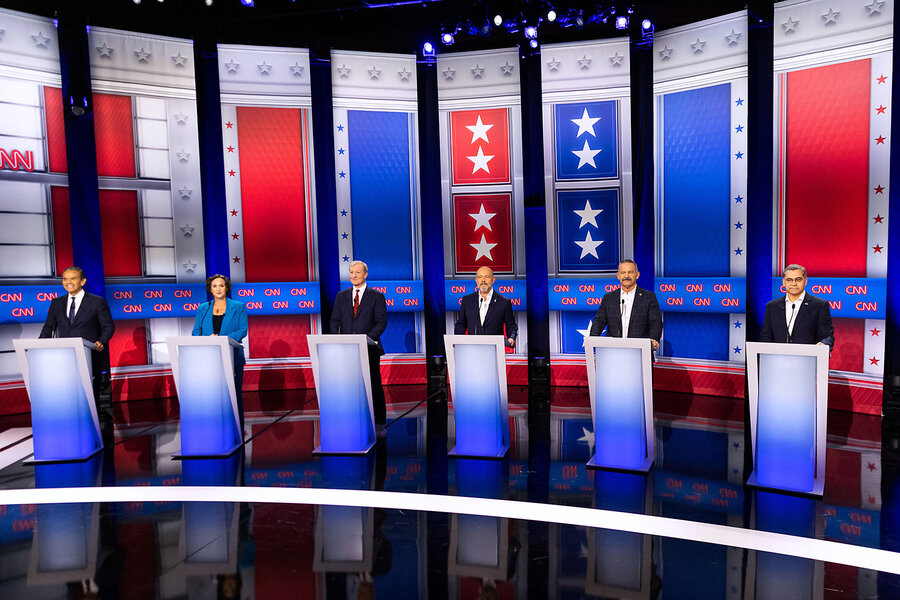
At a debate last month at East Los Angeles College, Mr. Hilton tried to cast himself as the true change agent in the race, blaming Democrats – who control the legislature and the governorship in California – for the high cost of living.
“We need some fresh thinking after 16 years of one-party rule,” said Mr. Hilton, who says he would eliminate state income taxes on the first $100,000 of earned income and encourage the construction of more affordable housing through tax breaks, eliminating red tape, and establishing a state loan program for first-time buyers.
Still, it’s a tough sell in a deep-blue state where President Trump is deeply unpopular.

Mr. Becerra puts the blame for high prices squarely on the White House. “Let’s focus on who’s raising the cost of living in California the most,” he said at the debate. “The price of gas has gone up … because of Donald Trump and his war in Iran. The price of goods, groceries have gone up in California because of Donald Trump’s illegal tariffs.”
His experience at the U.S. Department of Health and Human Services has prepared him for the role of governor, Mr. Becerra says on the trail, adding that he expanded healthcare subsidies, and lowered out-of-pocket costs.
Polls show most Californians see the race through the lens of the cost of living and threats to democracy, both of which rank high for voters.
There’s also a clear enthusiasm gap between Democratic and Republican voters, says Mark Baldassare, survey director at the Public Policy Institute of California. He expects high turnout from Democratic voters on Tuesday, describing them as highly energized. Democrats and Democratic-leaning independents, he says, seem to be saying, “‘We have a message to send. We don’t like the way things are going.’”