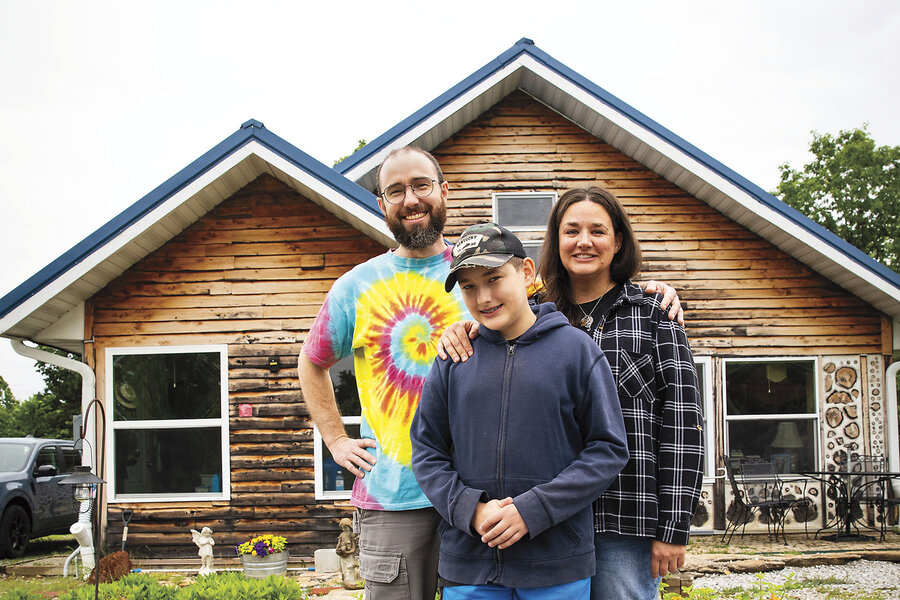
Mark and Emily McCafferty aren’t exactly the kind of people that bring to mind Daniel Boone. He’s a percussionist and music professor at a small Midwestern liberal arts college. She writes a blog called “Accidental Hippies.” Her latest post begins, “I hate mattress shopping.” Their vibe is far more Northern California than California, Kentucky.
And yet, it is there, on a wooded hilltop in a close-knit community less than 25 miles up the Ohio River from Cincinnati, where they have made their stand. They cleared their own land, built a house from the cedars they felled, scratched out a vegetable garden, and planted some roots. A new shed holds the control systems and batteries that harness an array of solar panels.
“Nothing is more wonderful than the art of being free, but nothing is harder to learn how to use than freedom,” wrote traveling French philosopher Alexis de Tocqueville after passing through this region nearly 200 years ago – and to glimpse northern Kentucky today is to see that same promise and paradox at work.
Why We Wrote This
The Declaration of Independence set forth an assertion of freedom that still inspires and challenges Americans in all their diversity. In Kentucky, a strain of independent-mindedness can defeat efforts to put people in a political box.
“We’ve got that revolutionary spirit,” Emily says. “I feel like there is a continuity, but we don’t necessarily recognize it as such. It’s just how we are.”
One of the first states to enter the Union after the Revolution, Kentucky has a reputation that shaped how many Americans saw their country: sturdy, self-reliant, and resilient. To some extent, this region still lives with the echoes of 1776. Local politicians hark back to the earliest frontiersmen: “They could tame a rugged wilderness, they could prosper where others could not,” wrote Kentucky Secretary of State Michael Adams in an annual report on the state’s civic health a few years ago.
As in many pockets of America, however, the region’s character today is rooted in a deep sense of place. Many here felt politicians nationally had become too invested in polarized debates over culture-war issues such as affirmative action and gender fluidity as opposed to being focused on local concerns. Yet they speak almost reverently about the right to disagree with each other and, like the McCaffertys and others interviewed for this story, their independent-mindedness defies attempts to neatly assign them political labels. Less a contradiction, these attitudes capture a continuity – a linkage between past and present that helps explain the shape of American democracy on its 250th anniversary.
“There’s a strain, I think, of individualism going back to Kentucky’s earliest history,” says Melanie Beals Goan, a historian at the University of Kentucky. Today, “particularly in a region like Northern Kentucky, here you see this political identity is very much one of rural individualism: God, country, family-forward, and seeing their political opponents or opposing political parties as the antithesis and a threat to those values.”

Melanie Stetson Freeman/Staff
Emily sums up the independent spirit she sees in Kentucky with a smile. “You won’t tell me what to do. We still care very much about our neighbors, and it’s just a question of whose policy do you think is going to enable you to do that the best.”
Ours by choice
Following the Revolution, Kentucky became an early symbol of this American spirit. Even before the war began, settlers such as Daniel Boone had begun exploring what was then known as America’s northwest territories, generally an area north of Kentucky, for opportunity.
Waves of migration – primarily German Catholics arriving in the mid-to-late 19th century – and Ronald Reagan’s transformation of the Republican Party in the 1980s might have done more to shape the state’s current mindset than some 18th- and 19th-century pioneers, says Professor Goan.

When Republicans in this part of Kentucky voted to unseat incumbent Rep. Thomas Massie in the May 19 primary, the meaning in the narrative wasn’t wholly clear. A seven-term congressman with a reputation for challenging his own party’s president, he appeared to personify his constituents’ penchant for going their own way.
Were feisty voters pragmatically replacing a politician who had lost touch with his district? Or were they responding to pressure from President Donald Trump to jettison one of the few House Republicans independent enough to oppose him on key issues?
One thing, however, might have felt very familiar to Tocqueville: The individuals in line to vote, whether for or against Mr. Massie, were confident of their own choice – and of their right to be doing the choosing.

Melanie Stetson Freeman/Staff
Deanna Kiernan, a campaign volunteer, stood outside the Kenton Public Library in Erlanger on primary day, waving as people went by. “We are not all going to agree about everything, but we have to respect each other’s opinions, but also try to get our point across.”
What Kentuckians want
The southern bank of the Ohio River connects by bridge to Cincinnati. That economic hub is where the jobs are, so commuters from Covington, Erlanger, Newport, and other northern Kentucky towns inch their way northward in the mornings and southward back home in the afternoons.
Cincinnati is also a big city with big-city problems, including higher crime rates, aging streets, and surging homelessness. Many northern Kentuckians are grateful they live in the quieter suburbs.
Tracy Stanley, a retired employee for the IRS, showed up at the polls wearing a Pink Floyd hat and an American flag T-shirt. She says she never voted before the 2016 election, but with the arrival of then-candidate Donald Trump, “now, I’m all in.”
“There’s too much going on right now,” she says. “I just want to go back to the 70s, when I was growing up.”
Shane Noem, the chairman of the Kenton County Republican Party, assesses the election results a few days after the primary at a swanky Covington hotel on the banks of the Ohio River, with lovely views of the Cincinnati skyline.
Northern Kentucky is not like other parts of the state, he says, and its citizens are not so easy to define. Six northern counties that make up part of the 4th Congressional District are a mixture of urban, suburban, and rural, each with its own list of priorities.

Melanie Stetson Freeman/Staff
“We’re traditional Republicans, some moderate, some very conservative,” Mr. Noem says. “I have pro-LGBTQ Republicans that vote in Covington, I have suburban voters that are purple and they swing back and forth. And then I’ve got [conservative] rural voters in the southern part that say, ‘Get off my lawn.’”
A sense of responsibility
The city of Dry Ridge, in the rolling agricultural lands of Grant County, is well outside the economic pull of Cincinnati. Here, the closest major attraction is the Ark Encounter, a life-size, timber-constructed replica of Noah’s Ark 10 minutes away in Williamstown.
In Beans Cafe & Bakery, a popular destination in Dry Ridge, Christian contemporary music plays on the sound system, and the café’s owner, Richard Hayhoe, sponsors monthly gatherings for Christians interested in public policy and local government.
For a time during the COVID-19 pandemic, Mr. Hayhoe attracted national attention during his legal battles with the state over its business restrictions for restaurants such as his.
Mr. Hayhoe defied orders for businesses to close, and he says that Representative Massie posted his support of the café on X and Facebook. Between early November 2020 and Christmas that year, Mr. Hayhoe lost and regained his food license as pandemic restrictions were imposed and lifted. Throughout, customers flocked to the café to show support, and Mr. Hayhoe says their support largely reflected shared values.
Those values are based on what Mr. Hayhoe calls a “biblical worldview.”

Melanie Stetson Freeman/Staff
With that, he says, “comes responsibility of ownership, of looking after yourself, of responsibility towards my staff, towards my vendors, and towards the economy at large,” he says. “Maybe [the customers] lived vicariously through what we did to the government, by staying open. People were tired of being told what they could do.”
Back on the homestead
In the McCafferty’s living room, 16-inch cordwood walls keep out the early morning chill of a cloudy Kentucky hilltop morning. Mark says his family’s motives for moving out into the countryside and living off the grid were mainly ecological, reducing their carbon footprint and unnecessary consumerism. Emily says their lives are more modern than one might think.
“We get water from the rain, and it goes into a cistern. But I have an electric pump that brings it up into the house,” she says.
The family has an Xbox gaming console that their son, Anthony, uses to play Fortnite with his friends. And Mark – a professor at Mount St. Joseph, a Catholic university in Cincinnati – uses a large Apple computer with big speakers to compose music. “I feel very spoiled by what we do have.”
Being independent-minded and having hostility toward government are two different things, of course, and Emily says she avoids politics in her blog about off-grid life, choosing it to be a safe place for all perspectives.

Melanie Stetson Freeman/Staff
“I’ll have everybody from, like, people on the far left who want to start a hippie commune with their friends and be totally off the grid,” she says. “And then I’ve got super right-wing people who are burying their ammo in the yard, and preparing for World War III.”
As Mark leaves for his 40-minute commute to work, Emily says she has found a strong sense of community with other families who have adopted a rural lifestyle.
She says she feels blessed to live in her corner of Kentucky. She can give her son all the important amenities and advantages of 21st-century life, while grasping for something that feels two centuries older.
“You know, the settlers who came in the 1800s had that independence mindset,” she says. “And we’ve still got that revolutionary spirit.”