The first time Joplin called out to Charles Timothy Peay, it called from the ruins.
He, like so many Americans, saw the reports of the mile-wide tornado that tore through this southwest Missouri city on Sunday, May 22, 2011. It was one of the most devastating tornadoes in American history, killing 161 people and leaving a scar of splintered neighborhoods, wrecked schools, a hospital jolted off its foundation. He was stunned.
Mr. Peay – people call him Tim – is a veteran of Operation Desert Storm, a soldier who came home from war carrying memories that made civilian life difficult. Yet he is drawn to service. “I grew up a preacher’s kid,” he says. “You get more out of helping people than you do standing by looking.”
Why We Wrote This
In Joplin, Missouri, 15 years ago, the task of rebuilding from a devastating tornado appeared too much to contemplate at first. But by drawing on the strength of its civic bonds, and figuring out what kind of rebuilding was needed, the city has created a path forward.
So, he saw the television images and answered Joplin’s call, driving down from St. Louis to put his hands on the wreckage. He was one of more than 100,000 volunteers who would come to Joplin and join people already working to mend their own wounded city, together creating a legacy of community building that reverberates 15 years later. Some of them stayed for years. Some came for a week, a day, an afternoon. Mr. Peay came for as long as he could.
So much of the city seemed to him erased. People were moving debris and still trying to find survivors. He remembers hearing animals that were trapped or injured somewhere in the wreckage.
The scene was like the urban battlefields he knew too well. Perhaps worse. “Other than going to war, I hadn’t seen that kind of devastation on a city,” he says.
He had to leave earlier than planned, after just two days.
■ ■ ■
The second time Joplin called out to Mr. Peay, it was through his own need to be restored.
In the Marine Corps, he was an anti-tank assaultman, “a tank killer,” he says. He served in the heart of front-line combat. After the war, he could not quite get himself together. He could not go places. He could not talk to people. It was hard to hold down jobs.
“I got off into alcohol and drug use,” he says. He kept spiraling after his experience in Joplin. “That kept me out for a while.”
By 2013, two years after the tornado, he was trying to find a way back into his life. He got help in St. Louis. An organization directed him to Joplin, this time for sober living at The H.O.U.S.E., Inc. and HVAC training at Franklin Technology Center. The arrangement, as he remembers it, was simple: He could live there for a modest rent, go to school, and refrain from drinking and taking drugs.
“I said, well, I can do that,” he says.
He didn’t choose to come to the city where he had volunteered, and it felt a bit confining. But he stayed sober, and he graduated a few months later. Then he quickly left. And he was glad to. “Joplin looked so good in my rearview mirror when I was leaving after HVAC school,” he says. But the place still carried bad memories. “Get away, get away!” he thought as he drove off.
■ ■ ■
The third time Joplin called out to Mr. Peay, it was through a newborn child.
After his recovery, he lived and worked in the Chicago area for a while. After a relationship there did not work out, he went back to St. Louis by way of Springfield, Missouri, where he spent some time with a friend. There, he met the woman who would later become his wife. By 2018, he had a son, “Little Tim.”
“Well, I guess he’s not that little,” he says of his 8-year-old, holding up a palm to show his height. “I have to call him ‘Medium Tim’ now.”
Back then, he was thinking about the best place to start a new life with a family, about schools for Medium Tim. He considered the Chicago area. He considered St. Louis. Then it struck him: Move to Joplin, the city that had first looked to him like war and then given him a place to recover from his own.
Joplin was quieter. It felt safer. The schools and ball fields were new. “Everything’s state of the art there,” he says of the rebuilt city. And it sits right in the middle of four states, close enough to Kansas, Oklahoma, Arkansas, and the rest of Missouri. A person could be somewhere else quickly.
“So I said, ‘OK, well, I’ll just plant it here,’” he says. Still, he struggled at first.
“When I first got here, I couldn’t go to Walmart – I couldn’t be around a lot of people,” he says. “But the first time I talked myself into going, I had a big basket of groceries, and somebody tapped me on the shoulder – you a veteran? I had my veteran hat on. She said, ‘Let me get in front of you.’ And she paid for my groceries. It’s happened maybe four times since.”
He went to work for The H.O.U.S.E., Inc., serving as a substance abuse counselor for the organization that helped him restore his life. In a different way, it was happening again. “It’s worked out really well for me, just being able to help and give back, especially to those who went through what I did,” he says.
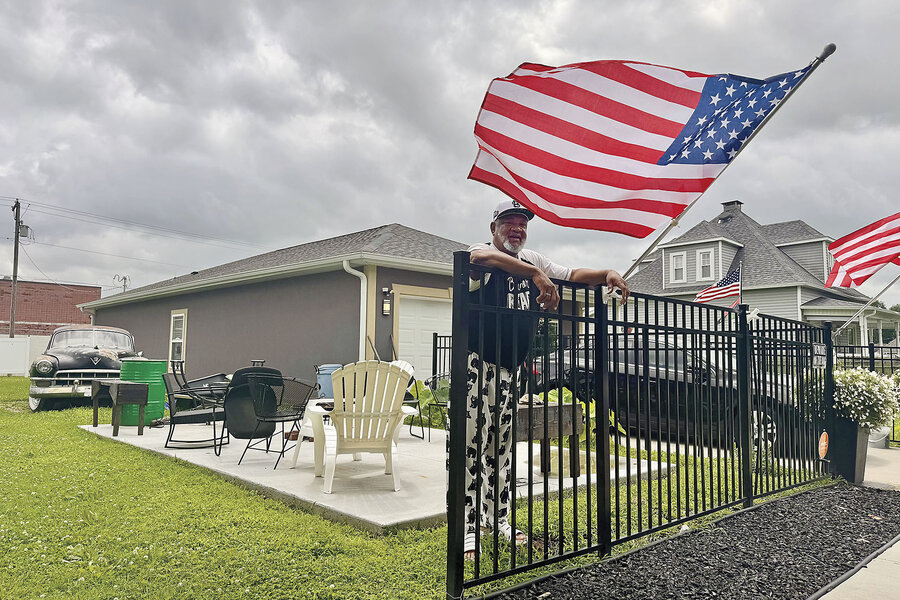
He was encouraged to apply for a house through Habitat for Humanity. He was skeptical, but his family was approved to purchase a new home – one that was being made with specially designed concrete forms on a lot that had been in the tornado’s path.
During construction, neighbors came around to watch. The concrete walls were something of an experiment, part of a grant partnership with the National Ready Mixed Concrete Association and Habitat for Humanity to build structurally resilient housing.
Today Mr. Peay surrounds his home with patriotic flags – the Stars and Stripes and the Marine Corps’ scarlet and gold – a perimeter of red, white, and blue around a house he says he’s so proud to own. “It’s the 250th birthday of the U.S. of A., and we can thank veterans for that,” he says, standing on his front lawn, an outspoken patriot in his neighborhood.
A few years ago, there was another tornado scare. A woman came first, walking toward his door with a baby in her arms.
“She said, ‘Did you say this was a concrete house?’” Mr. Peay recalls. “I said, ‘Yes, it’s OK.’”
Then, five more neighbors came over.
The man who had once found it so difficult to be around people opened his door so that his home, sitting on Joplin’s erstwhile scar, became a safe house on the block.

Harry Brunius/The Christian Science Monitor
■ ■ ■
Mr. Peay’s house is one answer to what Joplin became after the tornado: a city where recovery was measured not only in what rose again, but in who found shelter there. That shelter did not appear by accident. It came from volunteers, churches, private donors, and federal aid. Local institutions, too, were suddenly tasked to do more than they ever had. Leaders had to look at the ruins and imagine the machinery of repair.
On May 23, 2011, the day after the tornado destroyed a third of the city, Scott Clayton was one of those leaders, standing on a hill on 22nd Street, disoriented and beset with self-doubt.
He had been born and raised just outside Joplin in a small town called Oronogo, and for the past year and a half, he had been the director of the local Habitat for Humanity affiliate. The office he took over had built one, maybe two, houses a year since its founding in 1989, for a total of 29 in 22 years.
He was at a friend’s house, or what was left of it, on high ground that should have been hemmed in by rooflines, oak canopy, and the ordinary scenes of a city he had long lived and worked within. Instead, it lay open to the horizon. In the one tree still standing beside him hung a Habitat for Humanity trailer, carried whole into the branches.
“It wasn’t just one simple thing,” Mr. Clayton says, describing the questions swirling in his mind: the loss of life, the people he knew, and, mostly, what he and Habitat for Humanity, as a housing nonprofit, needed to be doing – right now.
“I think the main thing I thought personally at the beginning was, ‘Am I the right person for this?’” he says.
For several months he felt overwhelmed, as many did. The need was too large to fit the old Habitat rhythms. The tornado damaged nearly 7,500 residences and 553 business structures. More than 3,000 residences were heavily damaged or completely destroyed. As Mr. Clayton surveyed his city, it was a place where thousands of families had lost not only roofs and walls, but their familiar landmarks by which they had known where they were.
But he went to work, and took it one day at a time. Most of the initial work was simply slow and steady cleanup. Mr. Clayton was scheduled for meetings he did not feel up to, but he went anyway. He worked 60- and 70-hour weeks, took calls on Sundays, and tried to turn grief into structure – creating schedules for volunteers, lists of donated funds, and plans to build new houses. The hours took their toll, until his oldest son, then a child, told him plainly that he needed to be home more.

As he struggled to find balance, however, what came next still astonishes him. His Habitat affiliate became something of a clearinghouse for the kindness of the whole country. Joplin was beginning to rebuild in many ways, with hundreds of millions of dollars in federal aid arriving through multiple streams. But for private donors, corporate partners, and thousands of volunteers eager to contribute, too, Habitat for Humanity – and Mr. Clayton – became a focus of their efforts to help the city rebuild the housing that was lost.
“I was Scott, the Habitat tornado guy,” he says.
His job, really, became being “a professional volunteer workday coordinator” for the next three years. He worked with local churches, which turned themselves into supply depots and volunteer centers. Habitat’s affiliate in Tulsa, Oklahoma, came to town and made news with a plan to raise 10 houses for 10 families in 10 days, which ended up being 16 days.
Then the rest of the country arrived with its sleeves rolled up: State Farm, Home Depot, and the Salvation Army helped fund or build homes. Baseball players from the Kansas City Royals and St. Louis Cardinals framed houses alongside retirees. A work crew arrived from the United Arab Emirates. Mr. Clayton and his staff were running crews of a hundred across five build sites at once.
Mr. Clayton’s small affiliate built 36 houses in 2012. Thirty-two the year after. By October 2015, it had built 100 after the storm.
Reporters came, too. They wanted to talk about devastation. Mr. Clayton understood why. But he wanted them to see the story from the other side of the storm.
“To us, it wasn’t the devastation that was important,” he says. “It wasn’t a story of, everything’s gone. It’s everything we’re doing to rebuild. It’s everything we do that’s positive.”
“It wasn’t about May 22nd,” he adds. “It was about May 23rd and everything that followed.”

Scott Blanchard/The Christian Science Monitor
■ ■ ■
But rebuilding Joplin was not the same as restoring it.
The tornado did not merely knock down houses. It changed the city’s housing math. Official recovery documents counted 3,422 units completely damaged or destroyed. The Department of Housing and Urban Development later estimated that the storm destroyed about 1,800 rental units and damaged another 1,500, leaving Joplin’s rental vacancy rate below 1%.
Many of those homes were not grand. Some were old, imperfect, and easy to overlook. But they were also part of the city’s lower-cost housing stock.
Mr. Clayton saw that from the builder’s side. “Before the tornado, pretty much half of the town was in a rental situation,” he says. “So you have a lot of aging housing stock that maybe had cost-effective rental that was taken away.”
In the years since, costs have only climbed. When he first started at Habitat, a housing lot might have cost them $4,000. Later, $10,000 began to feel like the edge of the budget. Now, he says, lots can run $20,000 or more. A recent Habitat home cost $165,000 to build and appraised for $250,000.
The work is still necessary. But it is no longer the same work.
“We’re trying to do affordable housing in an increasingly unaffordable world,” he says.
Which is why, 15 years after the tornado, Mr. Clayton is asking what kind of shelter people actually need.
At a new Habitat project in town, he walks past the frame of a 10-unit rental complex for veterans: six one-bedroom apartments, four two-bedrooms, all low-cost rents. Habitat has built houses for veterans – including Mr. Peay’s concrete home on a lot once crossed by the tornado. But homeownership is not always what veterans ask for.
They listened, Mr. Clayton says, and what they heard was specific: Veterans wanted smaller units, rent instead of a mortgage, a place in town. The new project is meant to give veterans not only lower rents, but a little of the camaraderie that can be hard to carry from military life into civilian life.
Mr. Peay’s concrete house was one answer to what shelter could mean in the Joplin that came after the storm. The veterans complex is another. At first, Joplin had to build quickly. Over time, it had to learn to build more carefully – around the lives people were trying to rebuild inside the walls.
■ ■ ■
Twenty years ago, just as Joplin had once called to Mr. Peay and Mr. Clayton, it had beckoned Nicole Brown, too.
She and her husband were riding the professional rodeo circuit then, a part-time passion as both pursued careers in education.
Joplin made practical sense for the couple. It was close enough to Oklahoma, Kansas, Arkansas, and Texas to follow the rodeo circuit, while still offering a lovely place to build a life. “It’s kind of the same reason like why you have trucking and things here,” she says. “You can be anywhere relatively quickly.”

Harry Brunius/The Christian Science Monitor
That has always been part of Joplin’s claim on the American map. Before it was a Route 66 town, it was a mining boomtown in the traditions of American capitalism after the Civil War, drawing thousands to mine the massive lead and zinc fields of the Tri-State district. Later, the old road made it a working crossroads: a place to stop, repair, refuel, and regroup.
Ms. Brown, who has a Ph.D. in higher education administration, began working for a local university, building a career helping students find their next step. Joplin fit a habit of mind she already had.
On May 22, 2011, Ms. Brown and her husband were in the basement of their century-old house in Duenweg. The tornado was flattening Joplin and heading their way. Acquaintances from her husband’s workplace were returning from the Joplin High School graduation when raining debris sent them to the Browns’ house.
“You’ve just never heard a house groan like that in your life,” she says. “The entire house is over 100 years old and it was very well built – you could hear the pressure coming in on the house.”
Her house survived with minor damage.
That left her, like many, in a strange emotional category.
“There was a lot of trauma in our community,” she says. “People fell in one of two camps: You either were directly impacted and you were working your way through that, or you had survivor’s guilt because you weren’t.”
But nearly everyone in Joplin agrees: The tornado left a legacy of commitment to one another, a profound experience of organizing volunteers and coordinating civic services.
One Joplin, the organization Ms. Brown now leads, emerged from that legacy and now preserves the collaboration the disaster had forced into being. It does not run a shelter or build houses. It connects people who do.
“The magic of One Joplin a lot of times happens in the hallway conversations,” says Ms. Brown, executive director of the organization for the past five years – a career change as she begins to raise two young children. “It gets people out of their offices, gets them in together, and it builds trust across those organizations.”
That may be the less visible story of Joplin’s recovery. The city did not merely replace buildings. It learned, under pressure, how to connect churches, nonprofits, businesses, and civic leaders around shared needs.
But Ms. Brown is careful with the language of recovery. Some losses, she says, were hidden inside what outsiders might have called improvement.
It can be easy, from a distance, to say the tornado cleared away old houses and that newer, better homes rose in their place. But she asks: “Who lived in those houses?”
For families with insurance or savings, recovery could mean rebuilding. For those who lost a cheap rental and perhaps the job that paid for it, recovery could mean displacement.
“The tornado created a dividing line of what their reality was for recovery for many families,” she says.
■ ■ ■
Ned Mayes, a lifelong Joplin native, a Navy veteran who served more than two decades, and the designer of some of the city’s Route 66 exhibit materials, marks not only what returned, but what did not.
He’ll never forget how the people of Joplin responded after the tornado. “I don’t know that there’s been much of a change in that spirit of the city today,” says Mr. Mayes, retired but still a part-time assistant at the Joplin History & Mineral Museum. “Because so many people got together and helped each other, and still do.”
But the map of memory changed.
“The thing that really hurts is the things you remember, like your grade school, your junior high, your high school, the neighborhood you grew up in, the store you first worked at,” he says. “You know, when you were a teenager. All that’s gone.”
At the museum, he helps arrange the fragments Joplin has kept: Route 66 artifacts, Bonnie and Clyde exhibits, memories of native son Langston Hughes, the writer, as well as the ore that made fortunes and left scars.
The work is nostalgic, but not only nostalgic. It is a way of saying that change does not have to erase a place entirely, as long as someone is still willing to name what used to be there.
That is the harder meaning of recovery in Joplin. A city can come back, but it cannot return unchanged. It can build stronger walls and still lose affordable rooms to rent. It can remember the volunteers, the houses, the days after, and yet still carry voids where private histories used to stand.
Along Route 66, America has long told stories about motion: leaving, arriving, and starting over somewhere down the road. Joplin’s tornado story asks a slower question: What makes people stay? What calls them back? And when they return, what kind of shelter is waiting?
For Mr. Peay, it was a concrete house in the tornado’s old path, a door he could open when neighbors came. For Mr. Clayton, it became a lifetime of building homes around new needs. For Ms. Brown, it is the patient work of keeping people in the same room long enough to hear what the city needs next.
Fifteen years after the storm, they and others still hear the call that came first from the ruins. They can’t solve all challenges at once, nor for everyone equally. But door by door, meeting by meeting, wall by wall – they are still asking, and answering, how to make a place strong enough for those looking for a way back.