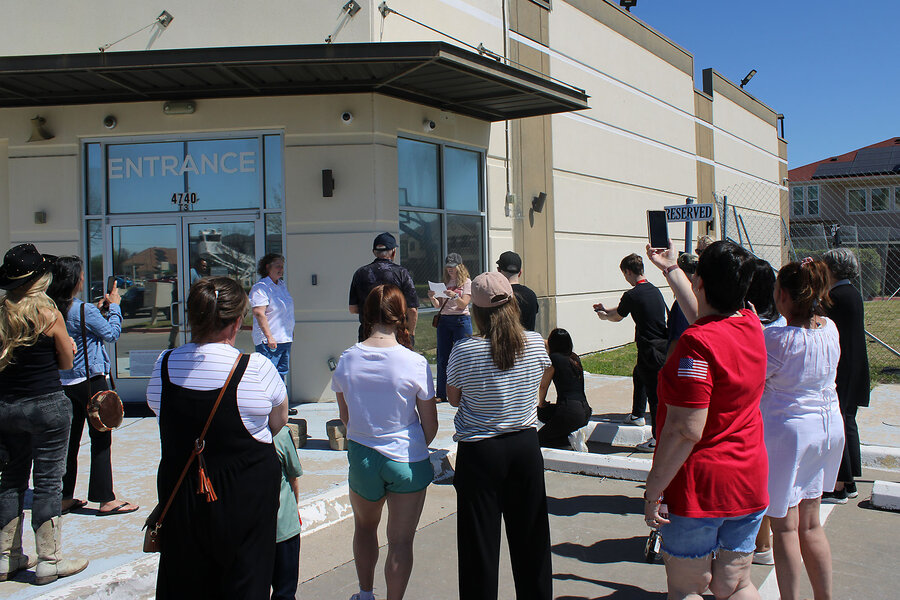
Under a baking Texas sun, hundreds of Muslim worshippers park their cars in a gravel lot the size of a football field and make their way to a green-domed mosque. Most don’t glance over at the dozen or so people gathered outside an office on the East Plano Islamic Center’s grounds.
These conservative activists are protesting a real estate project – a 400-acre planned community with more than 1,000 homes, a mosque, a faith-based K-12 school, and commercial spaces – being developed by the mosque in this suburb north of Dallas.
Since its announcement more than two years ago, the project has been dogged by controversy. Republican state officials have launched investigations and lawsuits to halt construction of the development, originally named EPIC City and now rebranded as The Meadow. The departments of Justice and Housing and Urban Development opened separate civil rights inquiries into possible violations of the Fair Housing Act. (Justice closed its investigation last year with no charges filed; HUD’s investigation is ongoing.)
Why We Wrote This
In a case echoing far beyond this North Texas city, critics say a planned Islamic group housing development is exclusionary, while supporters call the opposition political targeting, sparking a heated legal and civil rights debate.
Much of the opposition has centered around accusations of exclusionary practices, with critics saying it will be a “no-go zone” for non-Muslims, something the project’s developers deny.
Republicans have warned about “sharia cities” for years, with legislators at the state and federal levels introducing legislation to prevent sharia, or Islamic law, from superseding U.S. laws and customs, though there is no evidence that this is occurring. Nowhere has the issue been more prominent than in Texas, where opposition to The Meadow has become a rallying cry for GOP officials.
This month, the state Republican Party added to its official platform a demand that the “advocacy or implementation” of sharia law be declared “a seditious criminal act, worthy of criminal punishment, disqualification for public, military, and law enforcement service, denaturalization, and [deportation].”
Last fall, Republican Gov. Greg Abbott signed into law a bill he said would stop housing developments in Texas from using religion “as a form of segregation.” State Attorney General Ken Paxton, who is running for the U.S. Senate, has launched multiple probes and lawsuits against The Meadow. The GOP nominee to replace Mr. Paxton as attorney general has vowed to “stop sharia law in Texas.”
“Sharia law won’t be operating in this compound,” says Ashley Loudon, one of the conservative activists gathered at the mosque in Plano. “Sharia law is not compatible with Western civilization.”
Muslim groups call the opposition to The Meadow an Islamophobic “witch hunt” and accuse Republican politicians of fearmongering for electoral gain. They note that Muslims are entitled to the same First Amendment protections as other religious groups in the United States, and say the development will follow the same laws and regulations as any other planned community in Texas. Supporters were heartened by a district court ruling in May in the developers’ favor, though that decision is under appeal.
When size matters
Texas has one of the largest Muslim populations in the country, at more than 300,000. Still, in a state of some 31 million people, that’s only about 1% of the total population, and the proportion hasn’t been growing – despite claims about the “Islamification” of Texas. In the Dallas-Fort Worth metroplex, the number of Muslims actually decreased between 2010 and 2020, according to the Association of Religion Data Archives.
But the Muslim population grew in Collin County – home to the East Plano Islamic Center and The Meadow.
Khalid Hamideh, a spokesperson for the Islamic Association of North Texas, says that The Meadow never intended to be a closed community. “They never filed any kind of, like, deed restriction record saying, ‘Only Muslims can live here.’”
“Anybody’s welcome,” he adds. “They did want to build a mosque and a Muslim school,” he adds. “What’s wrong with that? Nothing. Is it illegal? It definitely is not. And the Justice Department investigated, and they came to the same conclusion.”
Sameer Siddiqui, the president of the East Plano Islamic Center, says he would welcome an honest dialogue with critics. “I would like them to learn about us, and about Muslim people,” he says.
But that kind of conversation has been hard to come by in Texas. Residents have flooded city council and county commissioner meetings about The Meadow, raising concerns about everything from the strain on utilities to noise complaints about early morning calls to prayer.
At one such meeting, in neighboring Hunt County in March, a resident said he would not have moved to the area had he known that “land purchases were [already] being talked about, how we’re going to supply water to a 4,000- or 5,000-[person] community.”
“I don’t want Islam in my backyard,” he said, adding, “I don’t want to listen to a prayer tower call me to pray on a belief system I don’t believe in.”
Daniel Ray, general counsel Hunt County, told commissioners at the meeting that a map submitted by The Meadow’s developers had some problems – problems, he hastened to add, “based on technical, regulatory and legal deficiencies in the application itself. [They are] not based on race or religion.”
The commissioners went on to vote unanimously against The Meadow’s preliminary map. In response, the room burst into applause.
Resistance to Muslim immigrant communities
Earlier this year, amid tensions around the U.S.-Israeli war with Iran, several Republican lawmakers caused an online stir by posting pointedly intolerant statements about Muslim immigrants.
Rep. Andy Ogles of Tennessee wrote on X that “Muslims don’t belong in American society,” adding later, “America and Islam are incompatible.” Florida Rep. Randy Fine posted that “the choice between dogs and Muslims is not a difficult one.” Sen. Tommy Tuberville of Alabama, who is running for governor, reposted a picture of New York Mayor Zohran Mamdani, who is Muslim, next to a picture of the World Trade Center being hit by a plane on 9/11, and wrote: “The enemy is inside the gates.”

These comments drew widespread condemnation from Democrats, as well as some Republicans. They did not, however, draw a rebuke from President Donald Trump, who at the start of his first term in 2016 imposed a ban on immigration from several majority-Muslim countries. His current administration has imposed near-total travel bans on 39 countries, many of which have large Muslim populations.
In December, GOP lawmakers in the House created a “Sharia-Free America Caucus” that now boasts more than 50 members from 22 states. Caucus co-founder Chip Roy of Texas said at the group’s launch that “Sharia adherents masquerading as ‘refugees’ – and in many cases, sleeper cells connected to terrorist organizations – are threatening the American way of life.”
Some Republicans have been calling for stronger laws against admitting immigrants, Muslim or otherwise, who they say show little interest in assimilating, or in some cases express hostility to American values.
“Why do we continue to import people who hate us?” Mr. Roy asked this spring, when introducing a bill called the MAMDANI Act. The bill would deport, denaturalize, or deny entry to anyone belonging to a “socialist party, a communist party, the Chinese Communist Party, or Islamic fundamentalist party.”
It’s a far cry from the message put out by President George W. Bush in the tense aftermath of the 9/11 attacks. Visiting the Islamic Center in Washington, Mr. Bush declared “Islam is peace,” and that Muslims in the U.S. should not face hostility. “Those who feel like they can intimidate our fellow citizens to take out their anger don’t represent the best of America,” he said.

To some historians, the rhetoric on the right today bears a strong resemblance to other nativist movements that arose after big surges in immigration. In the early 1900s, some Americans worried that the nation’s ethnic stock – then predominantly English, German, and Nordic – was being diluted by Jews and Catholics from Southern and Eastern Europe. “The claims that [migrants] will prove unassimilable have been made in every anti-immigrant movement in American history,” says Rogers Smith, a professor emeritus of political science at the University of Pennsylvania who studies citizenship and race.
In a 2025 survey conducted for the Manhattan Institute, 57% of Trump voters said Arab and Muslim immigrants had “not done enough to assimilate [into] American culture and values.”
The Muslim community itself sees the matter differently: In one 2015 survey, 90% of Muslim respondents said they were “happy to be Americans.”
There’s no evidence that today’s immigrants, including Muslims, are less interested in assimilating than previous generations, Professor Smith says. What has changed, he adds, is that the U.S. has become “more celebratory of diversity and equality than ever before.”
And while the left has long celebrated diversity of all kinds as an American strength, some conservatives argue it has gone too far in recent years. They denounce an unchecked flood of illegal and legal immigration that they say has weakened societal cohesion by undermining a sense of shared American identity.
Adherents of National Conservatism, or NatCon, a faction that counts Vice President JD Vance among its allies, reject the idea that America is a nation bound solely by democratic ideals – such as the Declaration of Independence – to which anyone can accede. Instead, they emphasize that European Christian settlers founded the U.S. and say this Western heritage also should be specifically celebrated and preserved.

Too much diversity, they contend, can ultimately destabilize or dilute a nation to the point of its extinction. Yoram Hazony, the NatCon movement’s Israeli-born convener, argues that once a country surpasses 15% foreign-born residents – the current level in the U.S. – it “literally starts falling apart.”
A darker strain of thought on the right, extensively amplified by trillionaire Elon Musk on his social media platform X, posits that there has been a left-wing conspiracy to import non-white immigrants to replace white, native-born Americans, intentionally changing both the country’s demographics and its political loyalties to favor Democrats, as supposedly has happened in France and other European countries.
Questions of discrimination, assimilation, and respect
For Muslims in Texas, anti-Islam rhetoric is nothing new – but the recent surge has been unnerving nonetheless.
“It’s more extreme than we’ve ever seen it,” says Mr. Hamideh, the Islamic Association spokesperson. “You get politicians talking about, ‘How can we ban Islam? How can we get rid of Muslims?’”
Mr. Hamideh points to a political meeting held this spring at Light of the World Church, an evangelical megachurch in Fort Worth, where a Republican state lawmaker floated the idea of banning the practice of Islam in Texas by classifying it as a political system rather than a religion.
The event was hosted by For Liberty & Justice, the church’s political arm. Carlos Turcios, the group’s director of operations in Tarrant County, is among those opposed to The Meadow. He wants the project stopped because he believes it violates anti-discrimination laws.
Mr. Turcios says he doesn’t believe that being Muslim is inherently antithetical to being American. But it all comes down to assimilation, he says.
“You can be a Muslim, a practicing Muslim, and still assimilate in America and still respect American laws,” he adds. “Unfortunately, a lot of people that have come here from the Muslim world … don’t have the same mindset.”
The Meadow’s developers, a private company set up by EPIC, say that the residences will be open to people of all faiths, though the local school will be Islamic. The Justice Department said when it closed its 2025 investigation that the group had agreed to revise its marketing materials to comply with the Fair Housing Act. The developer, Community Capital Partners, did not respond to multiple requests for comment.
Authorities in Texas secured a legal victory in March, however, when a judge issued a restraining order against a municipal water utility, which the state accuses of helping the developers bypass regulations.
Mr. Turcios, a Republican local precinct chair, hopes the state will ultimately block the project entirely. “The governor and the attorney general, they’re doing their own investigations. So, I do think there’s more information that’s coming out,” he says.

Henry Gass/The Christian Science Monitor
As the son of an immigrant from what was then British-ruled Palestine, Mr. Hamideh of the Islamic Association says he considers himself “just as American as anybody else.” He hopes the current storm of anti-Muslim rhetoric roiling Texas will eventually pass.
“In the end, people in this country are people of good faith. They’re not people of hate,” he says. “These people that are pushing the hate agenda, eventually they’ll lose. They may gain some steam here and there, but they won’t win.”