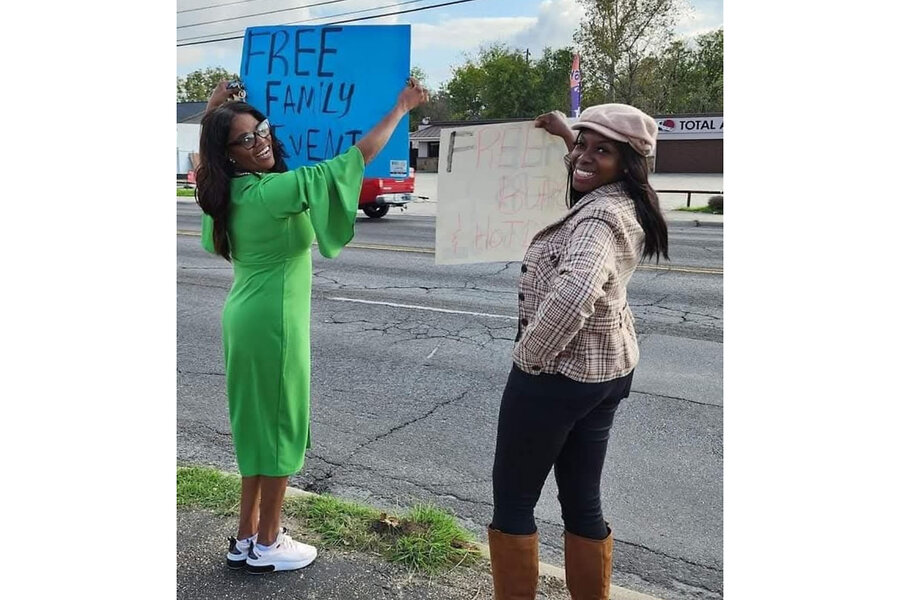
During working hours, Nicola Gardere is an educator in the public school system of her Central Texas town. But at 5 p.m., she heads home, jumps on a Zoom call, and her volunteer work begins.
As a founding board member of the Central Texas Area Alliance for Black School Educators, she helps create learning environments where students, particularly Black students, can thrive. As chief executive officer of the Myers Gardere International Foundation, she supports Texas families with education and nutrition needs. As executive board member of the Intelligent and Talented Girls branch in Killeen, Texas, she organizes activities to “help every girl find their voice, value, and vision for the future.”
Why does she do all this? The short answer is that she always has. Her grandmother founded a church. “We grew up serving in the church. We had to clean the church, go to the church, close the doors of the church, clean the benches, and then we traveled with her to the different conventions.”
Why We Wrote This
American communities thrive when people volunteer, donate, attend meetings, and participate in other civic activities. The way people engage is changing, though, and that presents challenges in places across the United States.
The health of America’s communities has long depended on volunteers like Ms. Gardere. In his 1835 book, “Democracy in America,” the French sociologist Alexis de Tocqueville observed that participation in associations made citizens better collaborators and leaders. “The only way opinions and ideas can be renewed, hearts enlarged, and human minds developed is through the reciprocal influence of men upon each other.”
A recent Pew Research Center study shows Americans’ spirit of engagement continues, though it faces severe challenges, such as declines in religious attendance, civic group membership, and attention to news. But the survey also offers windows into the changing – and fractured – ways in which Americans still participate in civic life. “There’s a whole bunch of different ways people can engage,” says Elisa Shearer, a senior researcher at Pew Research Center.
It shows an America both engaged and disengaged, divided by politics but united in habits. Both Republicans and Democrats can be found at weekend car-wash fundraisers or local public library potlucks, and members of both parties say they are exhausted by politics or too busy with multiple jobs to volunteer. Technology can make Americans better informed about current events, but it has also made youth more jaded and protective of their privacy. The ramifications for American democracy are uncertain, but potentially transformative.
Differences in ages
The study found 1 in 10 Americans are the most highly engaged across civic activities, including politics. About 1 in 4 are active in civic life, but not as active politically. About 31% participate less overall but follow news, and the same percentage reports low participation in most civic activities.
Ms. Shearer noted that age was also a big factor in how people engage. Young people, particularly Generation Z, are more likely to follow the news closely but less likely to volunteer; older people are most likely to volunteer time for charities, churches, and schools.
Young people might tend to chat privately about the news with friends, rather than posting on Facebook, but that doesn’t mean they are disengaged. The survey showed that among people who participate less in some ways, 49% voted in 2024. “That’s not huge, but it’s not nothing, right?” Ms. Shearer says.
Sara Suzuki, a senior researcher at Tufts University’s Center for Information & Research on Civic Learning and Engagement, says that young people are hardwired to find a “civic home” where they can connect with others forming their political voices around similar issues and challenges. But for Generation Z (ages 14 to 29), many of whom came of age during the COVID-19 pandemic, finding one’s civic home has been difficult.
“The word social media to me is a misnomer because we know that young people have a crisis of loneliness, a crisis of social disconnection,” Ms. Suzuki says.
She says if young people “have this investment in our political life, and if they find somewhere where they belong, somewhere where that attention can be translated into action, I think [that] would be really powerful.”
Another challenge that pushes people to the margins of engagement is the polarization of discussion of public topics, says Joseph Kahne, director of the Civic Engagement Research Group at the University of California, Riverside.
Political parties and “conflict entrepreneurs” use fear and misinformation to distract people from productive deliberation and action, Professor Kahne says. “There is a hunger for a less polarized world,’’ he adds.
“That doesn’t always mean people are willing to moderate on particular positions that are very important to them,” Professor Kahne says. But when his research team created forums with discussion topics framed in ways that allow for respectful discourse, people “talked productively with one another about potentially controversial issues, and they reported that they appreciated the opportunity.”
This skill set is necessary for a functioning democracy, he says.
“You can still have strong opinions, but you probably should be interested in what those who disagree with you believe,” he says. “How can we, as a society, come together to experiment with things, to move forward, to find the places where we agree?’’
Generation Z steps up
For Nate Reeves, a rising senior in Georgetown, Kentucky, volunteering as a student policy coordinator for the local chapter of the nonpartisan Kentucky Student Voice Team (KSVT) has been “the highlight of my high school career.”
In addition to organizing public meetings to discuss student concerns in the Scott County school system, Mr. Reeves spends five to 10 hours a week helping with a KSVT lawsuit against the state. The suit seeks to compel Kentucky to fulfill its legal obligation to provide equal educational opportunities for all communities, as required by a 1989 Kentucky Supreme Court decision.

“For me, my ‘why’ is that the schools in Scott County are inequitable, and tons of students would like to be involved in solving that problem, but they don’t know what to do,” Mr. Reeves says. “If we give students the ability to be involved, they will be involved. The key is making sure the avenues are as open as possible.”
Grady Amick is a high school senior from Louisville and a writer for KSVT’s student-run newsroom, New Edu. He says that students in his generation have a natural hunger for connection and for meaning, but too often technology gets in the way.
“Students show up to school, suffering from dopamine withdrawal because of social media, but eventually people want to connect with each other and learn as humans,” Mr. Amick says. They are social beings, he adds, and “once you can get people to understand that, you can get them to become connected to their communities.”
In Memphis, Tennessee, Darius Ford, a millennial and a local program director for Youth Advocate Programs, says that he and his wife volunteer once a week at St. Jude Children’s Research Hospital. They also devote time to Micah’s Walk for Autism, which supports families affected by autism.
“I try to make sure that I and my family will be there with bells on,” Mr. Ford says. “A lot of kids need some type of human interaction and physical activity. It makes them feel important when they know someone is there to see them.”
Meaningful work
In Killeen, Texas, Ms. Gardere says she has seen a decline in young people’s active participation in community projects.

The solution, she believes, is for adult leaders to intentionally create ways for young people to engage in meaningful work.
Ms. Gardere brings her 11-year-old granddaughter along during summer break to serve as her assistant when she gives presentations. She says she can see her granddaughter mouthing the words from her script as she speaks. “If something were to happen to me during a session, she could finish it,” she says.
The next generation needs to be involved early so that engagement becomes a habit, she says.
“If we don’t intentionally develop the next generation of volunteers and community leaders, we risk creating a society of spectators,” she says. “Engagement is a skill, and like any skill, it must be taught, practiced, and reinforced over time.”