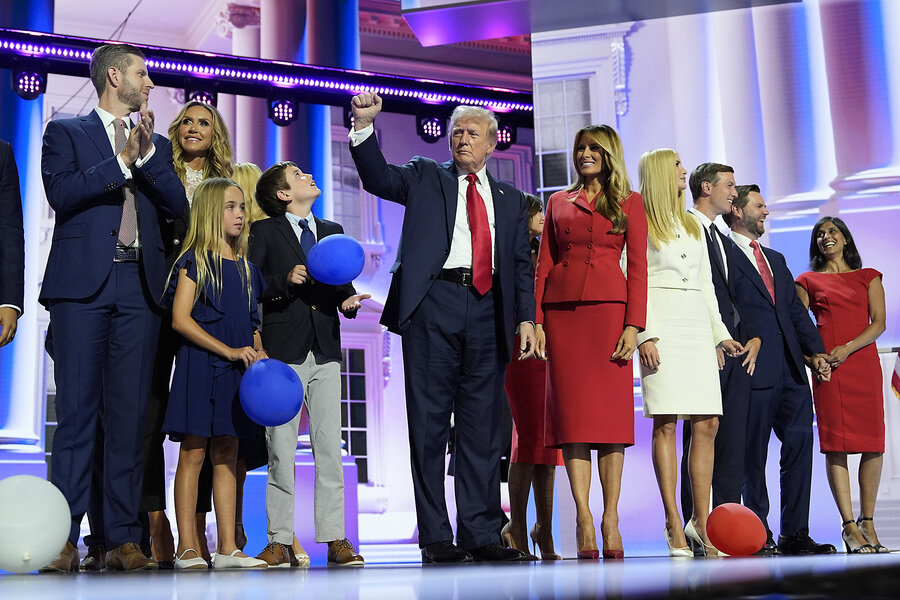
On matters of personal and family money, President Donald Trump appears to be playing by a different rulebook from other presidents – and even from his own first term in office. By his own admission, he feels little pressure to restrict family business dealings simply because of his role in government.
A tide of actions reflects the trend:
Investors have pumped vast sums into Trump family members’ business interests. Projects such as the White House ballroom are being funded by donors who have dealings with the government. Agencies have granted no-bid contracts to Trump-friendly firms. And in the 19 months since his election, the personal fortunes of the president and his family have soared.
Why We Wrote This
The Trump family’s wealth has surged over the 19 months since Donald Trump’s election. The circumstances are revealing how, on personal-finance matters, a president might be constrained less by laws than by norms that are vulnerable to testing.
To President Trump’s detractors, it’s unprecedented self-enrichment and corruption, or at the very least a failure to follow norms upheld by past occupants of the Oval Office. To defenders, including his Cabinet, staff, and base supporters, the criticism is politically motivated, aimed at punishing a president who they say is transparent in his dealings and follows all applicable laws.
While Mr. Trump’s first term had its share of headlines about conflict-of-interest questions, the amounts of money involved have surged in Term 2, notably in cryptocurrencies and other relatively new business interests for the Trump family. The voting public is more focused on issues affecting their own pocketbooks than on the president’s. But as the nation celebrates its 250th birthday, the tension over financial ethics represents a test for American democracy under a president like no other.
“The number of entanglements, the volume of money, it’s staggering,” says William Howell, dean of the Johns Hopkins University School of Government and Policy in Washington.
This week has also shown that Mr. Trump’s financial gambits still face some constraints. Under pressure from Congress – including a number of Republicans – as well as from courts, his administration appeared to back down Tuesday on the creation of a nearly $1.8 billion “anti-weaponization fund” designed to compensate those he says were mistreated by the federal government.
On Wednesday, though, when asked about the fund by a reporter, the president said, “I love it.” Asked to clarify whether it was dead or just on pause, he said, “I’d have to ask the lawyers,” suggesting he hasn’t given up on the fund altogether.
The administration rejects the view that the Trump presidency is rife with conflicts of interest, calling critics’ attacks unfair.
“This is the same, tired narrative that Democrats have pushed against President Trump, his family, and his administration for a decade,” says Anna Kelly, White House principal deputy press secretary, in a written statement to the Monitor. “President Trump only acts in the best interests of the American public – which is why they overwhelmingly re-elected him to this office, despite years of lies and false accusations against him and his businesses from the fake news media. There are no conflicts of interest.”
Net worth over $6 billion
Across a range of activities, the Trump family has been expanding business ventures with profitable connections to the government – all in plain sight.
One eye-popping headline is the spike in Mr. Trump’s net worth since seeking and winning reelection: from $2.3 billion early in 2024 to $6.2 billion today, according to Forbes. The extraordinary gains come primarily from his business interests, which include vast real estate holdings, licensing deals, merchandise such as Trump watches, Bibles, and sneakers – but also, increasingly, cryptocurrency. The Trump Organization says the president handed control of the family business to his sons when he retook office.
Trump family members, too, have seen their net worths soar in the second term.

By last September, the family – including wife Melania, his children, and son-in-law Jared Kushner, a private equity investor – was worth some $10 billion, nearly doubling since the 2024 election, Forbes reports. By December 2025, eldest son Donald Trump Jr. was worth some $300 million, up from $50 million in November 2024, and son Eric Trump’s net worth was up tenfold, to about $400 million, also per Forbes.
“I got absolutely no credit for it”
This rapid spike in family wealth represents a marked departure from the first term, when Mr. Trump said he prohibited family members from engaging in international business activity. In the second term, he told The New York Times in January, there are no such restraints.
“I prohibited them from doing business in my first term, and I got absolutely no credit for it,” Mr. Trump said. “I didn’t have to do that. And it’s really unfair to them.”
Presidential family members have a long history of apparent trading on the family name for financial gain, including former President Joe Biden’s son Hunter Biden and brothers James and Frank Biden. But scholars and ethics watchdogs say such examples pale in scope compared with the Trump era.
“He is sui generis in that we have not had an American president with a business enterprise of this scale and scope,” writes historian Julian Zelizer of Princeton University in an email.
That Latin phrase means unique. He is the first U.S. president never to have served in prior public office or the military. He is only the second to serve nonconsecutive terms – with an interregnum that allowed him and his allies to plan for a second term centered on an aggressive interpretation of executive branch powers.
What’s more, Mr. Trump’s background as both a brash businessman and reality TV performer – operating on gut and instinct and always on the lookout for leverage – set the president up for a second term that has pushed constitutional and legal boundaries, as well as norms of governance. And unlike in the first term, he has surrounded himself with advisers and staff known for not much pushback.
But there’s more to it than that, Professor Zelizer adds – including a sense of acceptance or resignation within the populace regarding “enormous presidential power.”

“The collapse of efforts to constrain the role of money in politics, the thin rules that exist on ethics for the president, the reliance on informal norms, and the normalization of corporate lobbying all create a culture that numbs many Americans to what is happening,” he writes.
Family business deals
Last week, investigative news outlet ProPublica reported that the White House had intervened last year to get a $620 million deal for an obscure rare earth magnet company with ties to Donald Trump Jr. The president’s son denied involvement, according to the report, which cites an unnamed Pentagon official as saying it was White House trade adviser Peter Navarro who intervened on behalf of the company.
A drone company in which Mr. Trump’s older sons had an investment stake also received a Pentagon contract. Donald Trump Jr. and Eric Trump have also announced a variety of lucrative real-estate and cryptocurrency deals in the U.S. and places such as the Middle East that stand to benefit both them and their father.
“Don does not interface with the Federal Government as part of his role with any company that he invests in or advises,” Andy Surabian, a spokesman for Donald Trump Jr., writes in an email to the Monitor.
The president himself drew attention last month when his latest federal financial disclosure form revealed more than 3,700 stock trades in just the first three months of this year – transactions totaling tens of millions of dollars.
His company, the Trump Organization, has stated that his investment holdings are managed by an independent third party.
Even so, such trading in individual stocks by a sitting president is unheard of in the modern era. And the news stirred a host of new questions about apparent conflicts of interest.
One example: Mr. Trump bought more than $1 million in Dell Technologies stock early this year, around the same time that he also urged Americans to “go out and buy a Dell.” This also came after company founder Michael Dell and his wife announced a $6.25 billion donation to fund U.S. government “Trump Accounts” for children. Last week, the Pentagon announced a $9.7 billion contract with the company.
In March, about a month into the Iran war, Mr. Trump announced “productive” conversations with Iran, causing oil stocks and futures to plummet. His brokerage account then spent the day buying oil stocks.
Pushback in Congress
When it comes to public money, there are limits both legally and politically as to what the president can do – as seen with his now-scuttled “anti-weaponization fund.”
Bipartisan groups in both houses of Congress, including some senior Trump allies, had worked to kill the fund. Watchdogs called it unlawful, since it was created as part of an unusual “settlement” with the IRS (over a leak of Mr. Trump’s tax returns) in which the president was both plaintiff and defendant, as head of the executive branch. The fund also lacked congressional authorization. Also stirring concern: Among potential beneficiaries were Trump supporters who stormed the U.S. Capitol on Jan. 6, 2021.
Still in place, though, is a settlement provision that would bar the IRS from auditing past tax returns filed by Mr. Trump or his family. That part alone could save him a reported $100 million if he were found guilty of fraudulent tax practices. On May 29, a federal judge in Florida reopened the Trump lawsuit against the IRS to determine whether it was an abuse of the court system.
Whether all these Trump actions constitute corruption is in the eye of the beholder. Some presidential conduct is more a matter of norms and customs than law, say experts on American governance, and under the Constitution, the legislative and judicial branches of government are empowered to serve as a check on presidential power.
The court of public opinion
Public opinion is another potential check on presidential behavior, though less so now that Mr. Trump is in his second term and will not appear again on a ballot. After the midterm elections in November, seen in part as a referendum on the president, he might feel even less beholden to voters.
Over time, as Mr. Trump’s average job approval rating in polls has declined to 38%, negative characterizations have risen. A YouGov poll released in March found that majorities of Americans see him as arrogant (65%), opportunistic (57%), and corrupt (54%).
In the second Trump term, ethical oversight has diminished. He declined to issue the ethics pledge he took for his first term. And he rescinded the presidential ethics rules his predecessor, President Biden, had adopted. The U.S. Office of Government Ethics, which aims to prevent conflicts of interest within the executive branch, has been operating without a permanent leader after Mr. Trump fired the director early in 2025. (Though the president is largely exempt from OGE oversight.)

In addition, a 2024 Supreme Court ruling on presidential immunity – which shields the chief executive from prosecution for “official” acts – can be interpreted broadly, potentially adding to a sense of invincibility.
Also important is the decadeslong rise among conservative thought leaders of “unitary executive theory,” which holds that the U.S. president has sole authority over the executive branch. This theory was a driving force behind Project 2025, the blueprint for a second term drawn up by Trump allies, some of whom now occupy top roles in his administration.
At heart, though, the “moneymaking” aspect of Mr. Trump goes directly to his unique persona as president.
“He’s forever been wheeling and dealing before he entered public office,” with an “appetite for wealth and a certain kind of lifestyle,” says Professor Howell, co-author of the 2025 book “Trajectory of Power: The Rise of the Strongman Presidency.”
To truly make sense of Mr. Trump’s modus operandi, Professor Howell adds, one must consider “the incredible demands for loyalty that course through this administration.”
“The question is: How do you sustain those kinds of demands? Part of it is through threat,” he says. “Part of it, too, is the possibility of favor.”
Matthew Wilson, a political scientist at Southern Methodist University in Dallas, sees echoes of the late 19th-century Gilded Age in today’s wheeler-dealer atmosphere.
But for many Americans, struggling with the cost of living and other everyday matters, Mr. Trump’s finances aren’t a top concern. This is especially so in these polarized times, Professor Wilson says, when voters tend to forgive politicians on their own side accused of wrongdoing or see such accusations as a partisan witch hunt.
Professor Wilson lays out the thought process: “Whether Trump has shady cryptocurrency deals going on or not doesn’t really make any difference to the cost of my health insurance or to the level of crime in my community.”
In the end, he says, worrying about the appearance or reality of presidential self-enrichment is, to some voters, “a luxury for affluent people.”