
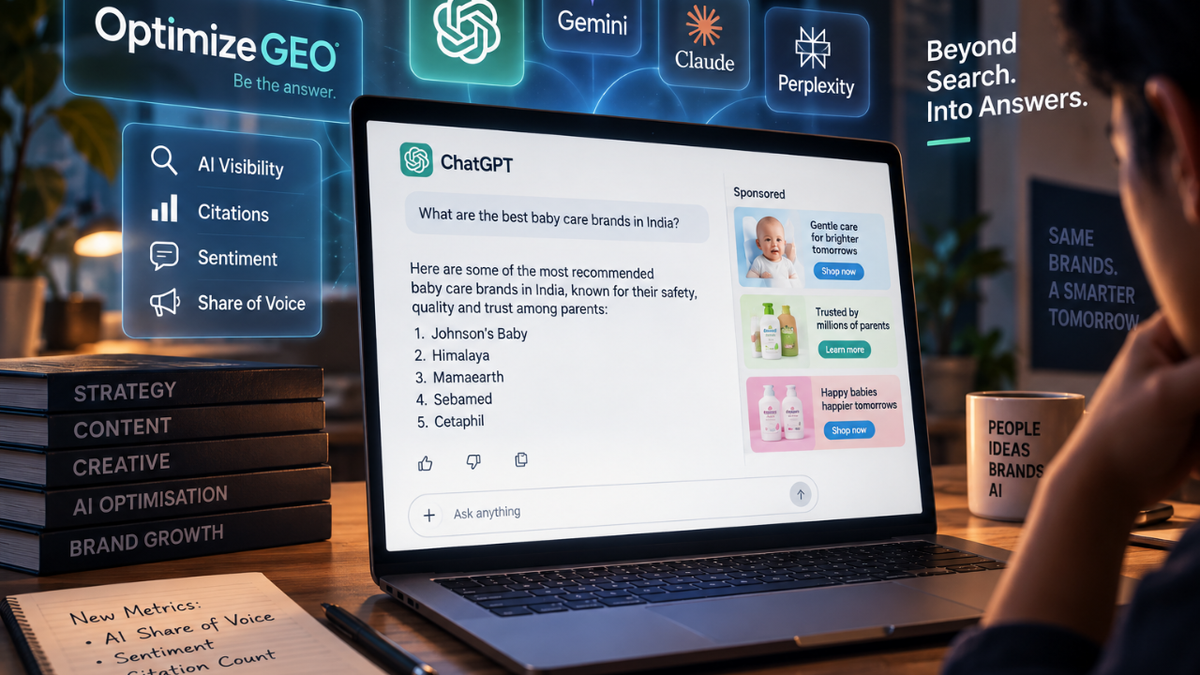
ChatGPT now shows ads below its answer to user prompts. But the answer preceding the ads remains organic and freely generated, and that is where OptimizeGEO helps brands gain visibility and authority.
Founded in 2025 by Kirthiga Reddy and Saurabh Doshi, the platform helps brands improve their visibility inside AI-driven search results, or Generative Engine Optimisation (GEO). The former Managing Director of Meta India is candid about where Indian brands are in the GEO race: “I would say we are in the first innings.”
She cites a baby care brand that allocated a healthy chunk of its marketing budget to media spend and enjoyed strong visibility on AI. But when OptimizeGEO broke down visibility by query type, the brand was almost absent from safety-related searches, with no machine-readable content on its own site, and no third-party or influencer conversation filling the gap.
“Just like there were ways for a brand to optimise to be part of the top links that showed up in a Google search, that is the equivalent in the generative engine optimisation space,” she says. “There is an AI graph now,” she adds, charting a parallel to the social graph brands have mapped for over a decade.
/filters:format(webp)/afaqs/media/media_files/2026/09/22/kirthigareddy-2026-09-22-02-21-55.jpg)
Months before ChatGPT rolled out ads in India, OptimizeGEO ran a study with Media & Marketing Alliance (MMA) around this year’s IPL, tracking a correlation between ad spend and AI visibility. Two brands with similar media spending performed differently in AI visibility, depending on whether they’d optimised for it. “Media spend does get you attention and reach,” Reddy says, “but it doesn’t buy you the answer in the answer engine.”
An algorithm change in Gemini midway through the tournament caused visibility across brands to dip. Brands that had optimised for multiple AI platforms saw “a slighter dip” and recovered faster than those “skewed towards one platform or the other.”
“It is a board-level conversation these days.”
Reddy on AI visibility discussions in companies.
The most prominent AI platforms in India include ChatGPT, Claude, Perplexity, and Gemini.
Reddy sees clicks, impressions and ROAS as indicators slowly making way for newer ones: AI share of voice, sentiment, and citation count.
On sentiment, she draws a distinction: “Are you mentioned, but is it positive, negative, or neutral? Are you just mentioned in a list with other products, or are you actually recommended for a specific user query?” Citations, she says, are the leading metric, the one that moves first, before share of voice and sentiment catch up.
She sees such conversations already having reached the highest echelons of a company. “It is a board-level conversation these days.”
The US remains OptimizeGEO’s largest market, but Reddy is bullish on India, pointing to it being ChatGPT’s second-biggest market. “Things just move so much faster here,” she says, recalling her time at Meta. “There were things that were done for the first time here, and then we exported it.”
Asked whether AI and GEO will hand over the reins of marketing to technologists rather than creative people, Reddy is clear: “I don’t think the tech side of things works without the creative side of things.” A machine cannot outperform human creative judgement.
Her favourite experience of her job so far is about a CEO who came to her because, when he asked ChatGPT what it thought of his brand, he got told it was not recommended. She told him, if a product is not the right fit for a use case, “We cannot magically make your product service come up in that answer.”



Leave a Reply