

Why the India payment gateway decision looks different this quarter
For most of the last six years, Indian merchants treated UPI as the free payment method. That changed on 15 October 2026. Under a framework the government announced in September, many person-to-merchant UPI payments above 2,000 now carry a merchant discount rate (MDR) of 0.4%, capped at 300 per transaction. Payments of 2,000 or less stay at zero MDR, and small merchants keep their exemption. For a business with a high average order value, though, the method that used to cost nothing at bank level now has a real cost.
The fee change sits on top of a regulatory reset that is already more than a year old. Since 15 September 2025, every payment aggregator in India has worked under one consolidated Reserve Bank of India (RBI) Master Direction covering online, physical point-of-sale and cross-border aggregation. RBI keeps that document under revision; the version on its website was updated on 11 November 2026. Any business that last reviewed its payment setup before these dates is working from out-of-date assumptions.
This guide is written for overseas sellers, platforms and fast-growing Indian companies who need to choose or re-check an India payment gateway now. It covers how the rails work, which setup fits which business, what compliance demands and what the pricing really looks like after the UPI change. Some teams need more than a plug-in checkout, for example a platform that must collect from Indian users and also pay out to them. For those teams, a specialist India Payment Gateway resource can help when comparing rented payment system infrastructure with a fully in-house build.
What an India payment gateway actually is in 2026
People often use “payment gateway” for two different things. Technically, a gateway is the software layer that takes the customer’s payment details at checkout, encrypts them and passes them to the processing network. A payment aggregator (PA) goes further: it receives customers’ money on the merchant’s behalf, holds it in an escrow account and settles it to the merchant later. In India, the aggregator is the regulated part. RBI authorises the payment aggregation activity, not a general “PSP licence”.
Under the 2025 Directions, aggregation falls into three categories:
- PA-Online (PA-O): e-commerce and in-app checkout, where the payment instrument and the acceptance device are not physically together.
- PA-Physical (PA-P): card and QR acceptance at a physical point of sale, brought inside the licensing perimeter for the first time by the 2025 Directions.
- PA-Cross Border (PA-CB): collecting export proceeds or paying overseas sellers for permitted current-account transactions such as e-commerce imports and exports of goods and services.
Each category is authorised on its own terms. A provider licensed for domestic online aggregation is not automatically covered for cross-border flows, and this is the most common mistake foreign merchants make when they sign their first Indian partner.
How an India payment gateway moves money: collections, settlement and payouts
A typical domestic transaction runs through five steps. Knowing them makes it easier to see where costs and failures come from.
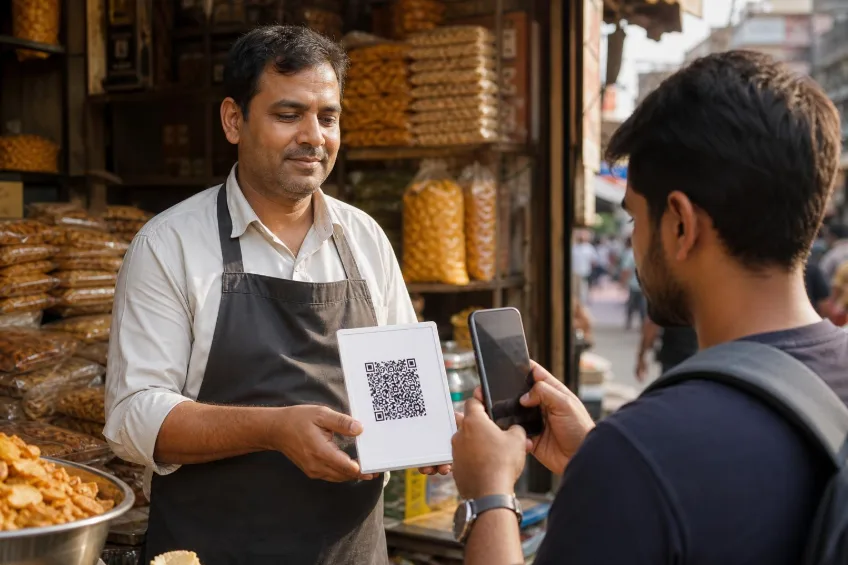
- Checkout and method selection. The customer chooses UPI (intent flow on mobile, QR on desktop), a card, netbanking or a wallet. UPI intent, which opens the customer’s UPI app directly, is now the default experience on Indian mobile checkouts.
- Authorisation. For UPI, the customer approves the payment with a PIN in their app. For cards, the issuer runs its authentication checks. Merchants are not allowed to store full card numbers, so repeat card payments depend on network tokens.
- Collection into escrow. Funds land in the aggregator’s escrow account at a scheduled commercial bank. The Directions require the day-end balance never to fall below the amount collected but not yet paid out to merchants.
- Settlement. The aggregator pays the merchant on the schedule set in their contract. RBI does not fix a single timeline, but the agreement must be transparent about it. Domestic gateways commonly quote T+1 or T+2.
- Payouts, refunds and reconciliation. Many businesses also need to send money out: refunds, seller payouts, cashbacks or withdrawals. Payout APIs, webhooks for status updates and daily settlement files close the loop.
Cross-border flows add an extra layer. Under PA-CB, inward money (foreign currency coming into India) and outward money (rupees leaving India) must sit in separate collection accounts with an Authorised Dealer Category-I bank, and the two may never be mixed or netted. The foreign-exchange leg can only be done with an AD bank, and each transaction is capped at 25 lakh.
Comparing India payment gateway setups
There is no single best option. The right choice depends on where the business is incorporated, whether money flows in one direction or two, and how much engineering and compliance capacity the team has.
– Standard domestic aggregator (PA-O)
- Best suited to: Indian entities selling online to Indian customers
- Main advantage: Fast self-serve onboarding, all local methods in one integration
- Main limitation: Pricing clusters around similar rates; limited control over routing
– Cross-border aggregator (PA-CB)
- Best suited to: Overseas sellers collecting from Indian buyers, or Indian exporters
- Main advantage: Legal route for current-account cross-border flows through an AD bank
- Main limitation: 25 lakh per-transaction cap, stricter documentation, FX costs
– Rented or white-label payment system
- Best suited to: Platforms needing collections and payouts across several providers
- Main advantage: Multi-channel routing, dashboards and payouts without building from scratch
- Main limitation: Licensed partners still carry the regulated activity; due diligence on the vendor is essential
– In-house orchestration layer
- Best suited to: Large merchants with high volumes and engineering teams
- Main advantage: Full control of routing, retries and data
- Main limitation: High build and maintenance cost; still depends on authorised PAs underneath
– Direct PA authorisation
- Best suited to: Well-capitalised firms wanting to become an aggregator
- Main advantage: Own licence, own merchant base
- Main limitation: 15 crore net worth at application, rising to 25 crore by year three, plus a full compliance programme
In practice, almost no foreign company applies for authorisation directly. The usual route is to work through one or more already-authorised Indian aggregators, often with an orchestration or rented system layer on top to manage several of them.
Getting started: a step-by-step checklist
- Map your money flows. Write down who pays whom, in which currency, and whether you also send money out. A one-way checkout and a two-way marketplace need very different setups.
- Pick the right PA category. Domestic Indian entity selling locally: PA-O. Foreign entity collecting from India, or Indian exporter collecting from abroad: PA-CB. Physical stores: PA-P.
- Confirm your partner’s authorisation. Ask which category the provider is authorised for and whether that covers your exact use case.
- Prepare KYC documents. Aggregators must run due diligence on every merchant, including checks that transactions match the declared business. A simplified route exists for smaller merchants, roughly those with domestic turnover up to 40 lakh or export turnover up to 5 lakh. Above that, full checks apply.
- Integrate and test. Build UPI intent and QR, card tokenisation, webhooks and refund handling in the sandbox. Test failure paths, not just successful payments.
- Re-price your checkout. Since 15 October 2026, check how UPI payments above 2,000 affect your margins. Remember that MDR cannot be passed on to customers as a surcharge.
- Set up reconciliation. Match settlement files to orders every day, and include GST invoices from the provider so input tax credit can be claimed.
The enterprise view: success rates, routing and cash flow
For larger merchants, the headline rate is rarely what decides the choice. Most domestic aggregators quote standard rates in a narrow band, so the real differences come from operations:
- Success rate. A provider that clears a slightly higher share of UPI and card payments can be worth more than a lower headline fee, because every failed payment is a lost order.
- Multi-provider routing. Routing traffic across two or more aggregators protects against downtime at a single bank or provider and allows payments to be sent wherever approval rates are best at that moment.
- Settlement speed. Faster settlement frees working capital. Compare T+1 and T+2 offers against your cash-flow needs.
- Payout capability. Marketplaces, gig platforms and lending apps need dependable bulk payouts with clear status callbacks, not just collections.
- Negotiated pricing. At high volumes, even a fraction of a percentage point adds up. A business processing 1 crore a month at 2% pays 2,00,000 in fees plus 36,000 GST, so cutting 0.2 points saves 20,000 a month before GST.
Security and compliance requirements
Compliance is the part of India payment gateway selection that foreign teams most often underestimate. Under the 2025 Directions, authorised aggregators must meet a set of ongoing obligations, and merchants inherit some of them through their contracts:
- AML registration and reporting: non-bank aggregators must register with FIU-IND, India’s financial intelligence unit.
- Merchant due diligence: KYC at onboarding, background checks and ongoing monitoring that activity matches the declared business profile.
- Escrow safeguards: rupee escrow accounts at scheduled commercial banks, with quarterly auditor certificates confirming compliance.
- Cyber security: an annual system and cyber security audit by a CERT-In empanelled auditor, a board-approved information security policy and alignment with RBI’s cyber resilience directions.
- Card data rules: no storage of full card numbers by merchants; card-on-file payments run on tokens.
- Cross-border controls: separate inward and outward collection accounts, FX only through AD banks and the 25 lakh per-transaction cap.
Merchants should also check that their business category is permitted under Indian law. Aggregators are required to monitor merchant activity and can freeze accounts when transactions do not match the declared business.
India payment gateway costs after the UPI MDR change
Total cost has two layers: the MDR that goes to banks and the payment network, and the gateway’s own platform or processing fee. GST at 18% applies to the gateway’s fee. The table below combines the current UPI MDR framework with indicative gateway pricing. Always confirm with a live quote.
– UPI, 2,000 or less
- Network MDR (since 15 October 2026): Zero
- Typical gateway fee (indicative): Often around 2% at major gateways
- Notes: Platform fee is separate from MDR
– UPI P2M, above 2,000
- Network MDR (since 15 October 2026): 0.4%, capped at 300 (cap reached at 75,000)
- Typical gateway fee (indicative): Check whether quote includes or adds MDR
- Notes: Cannot be passed on to the customer
– Small merchants via UPI QR (up to 1 lakh a month)
- Network MDR (since 15 October 2026): Zero
- Typical gateway fee (indicative): Not applicable for direct QR
- Notes: Moves to P2M after three consecutive months above the limit
– Railways, telecom, insurance, fuel
- Network MDR (since 15 October 2026): Flat 5 per transaction above 2,000
- Typical gateway fee (indicative): Varies
- Notes: Sector-specific concession
– Capital market payments
- Network MDR (since 15 October 2026): 0.02%, capped at 300
- Typical gateway fee (indicative): Varies
- Notes: Sector-specific rate
– Domestic cards and netbanking
- Network MDR (since 15 October 2026): Included in gateway rate
- Typical gateway fee (indicative): Around 2%; higher for some premium cards
- Notes: 18% GST on fee
– International cards
- Network MDR (since 15 October 2026): Included in gateway rate
- Typical gateway fee (indicative): Around 3%
- Notes: FX conversion costs may apply
– UPI P2P and AutoPay mandates
- Network MDR (since 15 October 2026): No MDR under the framework
- Typical gateway fee (indicative): Gateway fees may still apply to AutoPay
- Notes: Relevant for subscriptions
A worked example shows why the effective rate matters. On a 10,000 card order at a 2% gateway fee, the fee is 200 and GST adds 36. That is 236 in total, or an effective 2.36%. On a 5,000 UPI order that now falls under the new framework, the network MDR alone is 20, before any gateway fee. Businesses with many orders just above 2,000 should model both layers together.
What to watch next
The UPI MDR framework is barely a month old, and the details are still settling in practice. Aggregators are rewriting pricing pages, and some merchants are re-checking whether QR acceptance, gateway checkout or a mix gives the lowest effective cost. RBI’s habit of revising the consolidated PA Master Direction in place means compliance teams should check the current version on the regulator’s site rather than relying on summaries. Merchants should expect more scrutiny of merchant categorisation and cross-border flows, and should build their contracts so that pricing and compliance changes can be handled without a full re-integration.
Summary
Choosing an India payment gateway now means accounting for two changes: the September 2025 consolidation of aggregator regulation into three categories, and the October 2026 return of MDR on larger UPI payments. Domestic sellers can usually rely on a standard PA-O provider. Overseas businesses need a PA-CB partner and must work within AD-bank and per-transaction limits. Platforms that both collect and pay out benefit from a routing or rented system layer over several authorised aggregators. In every case, compare effective cost after GST, success rates and settlement speed rather than the headline rate.
India payment gateway FAQ
Is UPI still free for merchants in India?
UPI payments of 2,000 or less carry zero MDR, and small merchants receiving up to 1 lakh a month through UPI QR remain exempt. Since 15 October 2026, many person-to-merchant payments above 2,000 carry a 0.4% MDR capped at 300. Gateways may also charge their own platform fee.
Can a foreign company use an India payment gateway without an Indian entity?
Yes, through a cross-border aggregator (PA-CB) that collects from Indian customers for permitted current-account transactions. Funds move through an Authorised Dealer bank, and each transaction is capped at 25 lakh.
Do payment gateways need an RBI licence in India?
Entities that aggregate funds for merchants need RBI authorisation as a payment aggregator under the 2025 Directions. Pure technology providers that do not handle funds generally work alongside authorised aggregators.
How much does a payment gateway cost in India?
Domestic gateways commonly charge around 2% for cards, netbanking and wallets, often with a similar platform fee on UPI, plus 18% GST. International cards typically cost more, around 3%.
Can merchants add a surcharge to recover UPI MDR?
No. Under the framework, merchants cannot pass MDR on to customers as an added charge.
What is the minimum net worth to become a payment aggregator in India?
15 crore at the time of application, rising to 25 crore by the end of the third financial year after authorisation. The requirement applies to all three PA categories.
How fast do Indian payment gateways settle funds?
RBI leaves settlement timing to the contract between aggregator and merchant. T+1 and T+2 are the most common standard terms.
Source: Busines NewsWire
Start Selling Online with ShopOpen24
Are you a small business owner or entrepreneur? Discover seller opportunities and connect with customers through ShopOpen24.
Explore ShopOpen24 →ShopOpen24 | Local Products. Global Reach.












Leave a Reply