
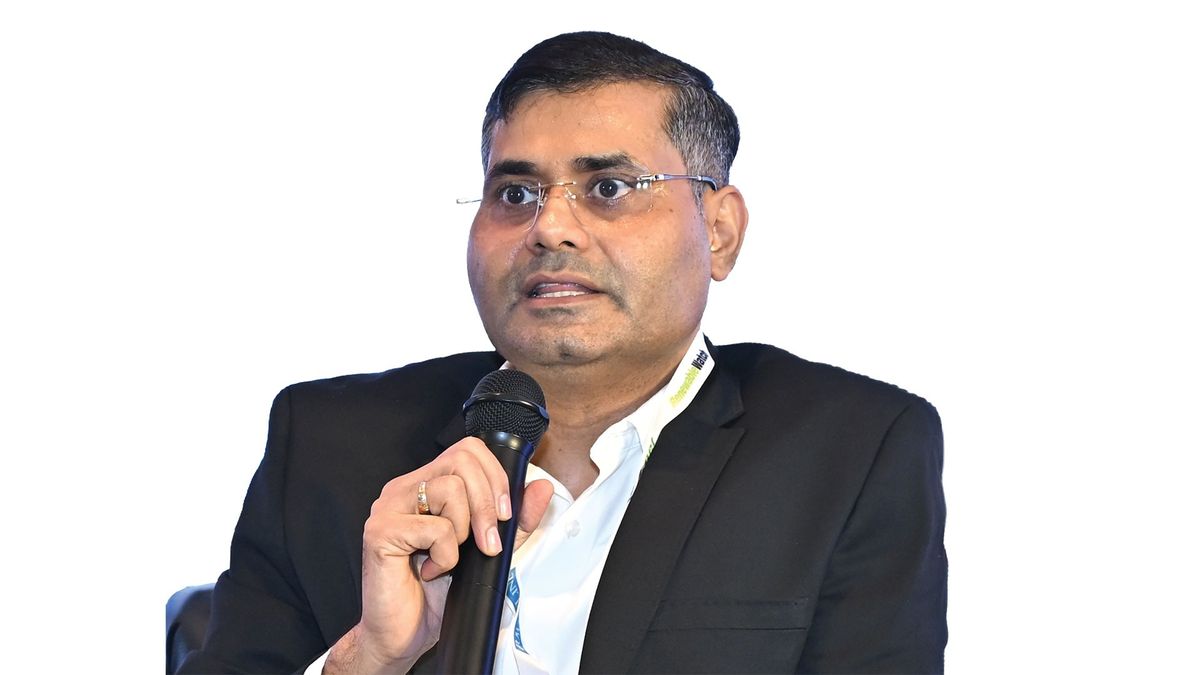
/filters:format(webp)/telenet/media/media_files/2026/10/06/68-2026-10-06-14-08-17.jpg)
The way the industry thinks about a data centre has changed dramatically over the past two decades. What was once largely a conversation about space, racks and redundancy has evolved into one about megawatts, rack density, cooling architecture, interconnection and, increasingly, whether infrastructure is genuinely AI-ready. The questions asked of a data centre today have changed entirely – how many megawatts a facility supports, what power density each rack can accommodate, how efficiently it can be cooled and whether it is actually artificial intelligence (AI)-ready.
The GPU is only the visible layer
The graphics processing unit (GPU) is the only visible layer in this picture, yet it depends entirely on everything around it. Without sufficient power, high-performance GPUs cannot operate at their intended capacity. Without adequate cooling, that compute cannot be sustained. Without a high-performance network, expensive accelerators can sit underutilised waiting for data. And without reliable operations, none of it translates into business value. AI performance, in other words, is increasingly an infrastructure outcome rather than simply a chip specification.
Power and cooling now have to be engineered rack by rack
Infrastructure has to be designed at a far more granular level than before. A conversation that used to happen in terms of 5, 10 or 15 MW at the facility level now has to happen in kilowatts at the rack level, since workloads genuinely differ – some need 10 kW, others 40 kW and others closer to 100 kW. Power itself has to be assessed across four dimensions: reliability, consistency, deliverability and scalability. Cooling has to evolve in step, since air alone cannot treat every rack in a room equally once density varies so widely between them, pushing the industry toward hybrid and direct liquid cooling architectures that can significantly reduce cooling overhead while supporting much higher rack densities.
The network has to work as one connected system
Network requirements follow a similar logic. Enterprise AI increasingly operates across interconnected environments rather than within a single facility. Data typically originates at the enterprise, moves through an AI data centre, may touch a cloud platform and edge compute along the way and is finally consumed by a user, with heavy east-west traffic between accelerators inside the cluster itself. There is no single latency number that defines AI readiness either – conversational AI, industrial vision, financial applications and autonomous systems each demand something different, so readiness is really about predictable end-to-end performance across compute location, data location, network design, jitter, congestion and routing, rather than the lowest theoretical latency on paper.
AI readiness is a system, not a checklist
AI itself is also changing what infrastructure has to deliver. Where it once simply generated an answer from a model that shaped user experience alone, AI is increasingly moving from data and a model to a decision and then an action; for instance, an industrial system analysing a process and actually executing on it. Once AI sits inside that kind of execution loop, latency, reliability and availability stop being purely IT metrics and become operational ones, since infrastructure performance now translates directly into operational performance. None of these pieces works in isolation, which is the point behind treating AI readiness as a system rather than a checklist.
India’s own path to AI readiness carries challenges specific to its geography and climate. Cooling architecture cannot simply be copied from another region and dropped into India’s own operating conditions. Not every workload needs to sit inside a hyperscale facility either. AI training typically benefits from concentrated compute at scale, while latency-sensitive inference can benefit from running closer to the business, data or user. This is why India will need both concentrated compute and distributed infrastructure working together, rather than one at the expense of the other.
Built on four decades of power engineering
Techno Digital, the digital infrastructure arm of Techno Electric & Engineering Co. Ltd., brings more than four decades of power infrastructure engineering and execution experience into the development of next-generation digital infrastructure. That heritage is particularly relevant in the AI era, where access to power, time to energisation and the ability to deliver power reliably at high rack densities are becoming fundamental infrastructure considerations.
Today, Techno Digital is building an integrated hyperscale-to-edge platform, with AI-ready data centre campuses across Chennai, Noida and Kolkata and, through its strategic partnership with RailTel, a distributed network of 102 edge data centres across 23 states. The architecture reflects where AI infrastructure itself is heading: concentrated high-density compute at the core, connected to distributed infrastructure closer to enterprises, data and users.










Leave a Reply