

Amna Nawaz:
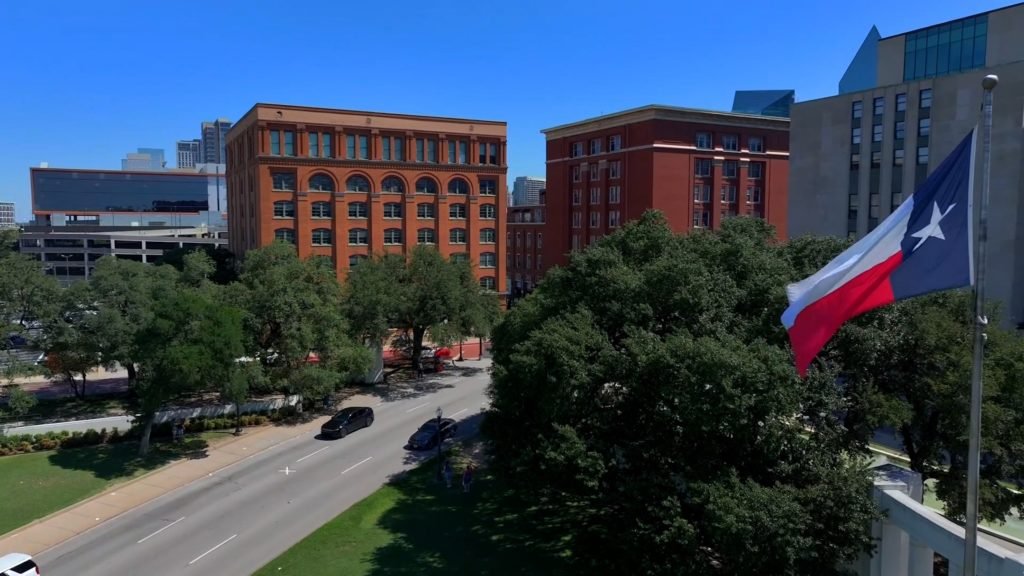
November 22, 1963, a date forever etched in American historical memory, when President John F. Kennedy was shot and killed in his motorcade crossing Dealey Plaza in downtown Dallas.
The story continues to be told and questioned. How those memories are preserved and displayed at the site itself is the subject of our report from senior arts correspondent Jeffrey Brown for our arts and culture series, Canvas.
Jeffrey Brown:
The setting is central to the experience, a former book depository in downtown Dallas, now the Sixth Floor Museum at Dealey Plaza.
Curatorial head Stephen Fagin …
Stephen Fagin:
I think our job is to provide our audiences with the tools to navigate this interpretive minefield of history and culture that is the life, death, and legacy of President Kennedy.
Jeffrey Brown:
The youthful president who inspired millions, the challenges at home and abroad he faced in his short time in office, and inevitably and here most hauntingly the assassination of John F. Kennedy from shots investigators determined were fired from the sixth floor of this building by Lee Harvey Oswald on November 22, 1963.
Museum CEO Nicola Longford …
Nicola Longford:
We presume that everybody has some idea of what happened here, and, actually, quite a lot of our younger generations have no idea what happened here. This is their entry point into this story of President Kennedy and his life and his death, and why are we still talking about it?
Donald Sutherland, Actor:
Well, that’s a real question, isn’t it? Why?
Jeffrey Brown:
It’s a fascination, even obsession that’s endured in popular culture with movies and novels.
Kevin Costner, Actor:
I never realized Kennedy was so dangerous to the establishment.
Jeffrey Brown:
In countless books examining the assassination, in the interest from people all over the world. You can see it in the memory books here, the different nationalities, the personal memories and connections, those who will never accept the official U.S. government determination.
Stephen Fagin:
Baby Boomers who have childhood memories of being in a classroom and their teacher or their principal telling them about the assassination, seeing an adult cry for the first time.
But for younger people, this is a murder mystery. This is a CSI crime scene.
Jeffrey Brown:
Conspiracy? Who did it? The museum carefully asks the questions that have never gone away.
Darwin Payne:
This is the imagined city desk.
Jeffrey Brown:
Yes.
One floor up, a special exhibition personalizes events in another way with a multimedia presentation following four local newspaper reporters who worked on the story in November 1963.
Darwin Payne:
This is the newsroom.
Jeffrey Brown:
Including now 89-year-old Darwin Payne, then 26 and on the rewrite desk at the now defunct Dallas Times Herald, was quickly sent into the streets. He was the first to talk to Abraham Zapruder, the clothing manufacturer who famously filmed the assassination.
You found yourself in the midst of history.
Darwin Payne:
And I knew that. I was very much aware of that.
Jeffrey Brown:
Many years later, he’s worried that history, that knowledge is being lost.
Does it sadden you that few people, especially young people, know?
Darwin Payne:
Young people should know the history of their city, of their nation, and of the world.
Jeffrey Brown:
Another young reporter featured of special interest to us, then 29-year-old Jim Lehrer, also with The Times Herald, who was at the airport Love Field when the president and first lady, Jackie Kennedy, arrived, and later at police headquarters where Oswald was being held.
In fact, Jim’s friend and “News Hour” co-founder Robert MacNeil was also in Dallas that day covering events for NBC News. Fifty years later, they spoke about it on our program.
Jim Lehrer:
And I was there when they brought in Oswald. And I wrote his name down. I still had the notebook. I was one of those people who asked, hey, did you shoot the president?
Robert MacNeil:
I was also in the police station that evening, and doing reports through NBC, and I saw Oswald paraded back and when he said, “I didn’t kill anybody, I’m just a patsy.”
Jim Lehrer:
And the guy standing next to me, who I did not know at the time, was Jack Ruby.
Jeffrey Brown:
The intrigue with that day lives on, outside on Dealey Plaza and the famous grassy knoll, another scene, tourists getting quick photos amid traffic on the X markings where JFK was shot, others encountering regulars at the site promoting their books and memorabilia, convinced the official story was a cover-up.
Robert Wilonsky:
This was never my profession. It was always my passion. Started calling witnesses out of the phone book when I was 16, and they talked to me.
Jeffrey Brown:
I was joined by Dallas Morning News columnist Robert Wilonsky, born and raised here, endlessly fascinated by the pull of a place, he says is still Dallas’ number one tourist destination.
Robert Wilonsky:
Whether or not we talk about it today, whether or not we think about it today, it defined Dallas. It made us grow up, it made us look inward, and it made us think differently about who we were.
Jeffrey Brown:
At one point, Wilonsky sidled up to a British visitor who said he used to teach American history in London.
Robert Wilonsky:
When you see the guys with the conspiracy theory magazines, what’s your take on that?
Man:
Lee Harvey Oswald doing it himself seems a little bit simplistic.
Robert Wilonsky:
Oh.
Man:
Was he involved with someone?
(LAUGHTER)
Robert Wilonsky:
See? You taught American history, but…
Man:
Well, yes, I know.
Jeffrey Brown:
Wilonsky wasn’t surprised at all. In fact, he takes it further.
You can in some ways tie today’s conspiracy theories of all kinds to this place?
Robert Wilonsky:
Oh, my God, absolutely.
Jeffrey Brown:
Yes.
Robert Wilonsky:
Once you go into one conspiracy, that rabbit hole is large and it is deep and it is wide and it is never-ending. Once you find one conspiracy, you are convinced that everything else that you have been taught and told is incorrect. That begins here for a lot of people, but it certainly doesn’t end here.
Jeffrey Brown:
Back inside, museum officials have something quite different on their minds. They recently received an enormous gift.
You have got the negative here of this very famous photograph, right?
Nicola Longford:
This is the original negative of Jack Ruby shooting Lee Harvey Oswald.
Jeffrey Brown:
The Pulitzer Prize-winning image by Dallas Times Herald photojournalist Bob Jackson captured a moment forever tied to the history of the JFK assassination. But Jackson has now given the museum his entire Dallas archive, more than 20,000 original images from the 1960s and ’70s, allowing the museum to tell a richer, more comprehensive story of the city itself.
And new funding from the Institute of Museum and Library Services, the federal agency known as the IMLS, will allow the museum to fully research and digitize the collection.
It’s part of a hoped-for expansion plan into other floors of the building to broaden the story it’s telling, the city then and now.
Nicola Longford:
We want to tell the story of what Dallas was like before the assassination, how it changed afterwards, and how it’s continuing to evolve. So, this is really made up the psyche, really, of Dallas, and who we are now and where we’re going.
Jeffrey Brown:
In the meantime, there’s the continuing image of JFK himself, the loss, says curatorStephen Fagin, inextricably bound up with the promise.
Stephen Fagin:
And he had this uncanny charisma and soaring rhetoric that inspired people around the world. And I do think people find that lacking in the world today.
And so, when they come here, when they write in our memory books, when they share oral histories with us, when they just speak to staff members, we get this sense that they miss what President Kennedy represented, that somehow he represented the best of us, the potential of America.
Jeffrey Brown:
For the “PBS News Hour,” I’m Jeffrey Brown in Dallas at the Sixth Floor Museum at Dealey Plaza.


Leave a Reply