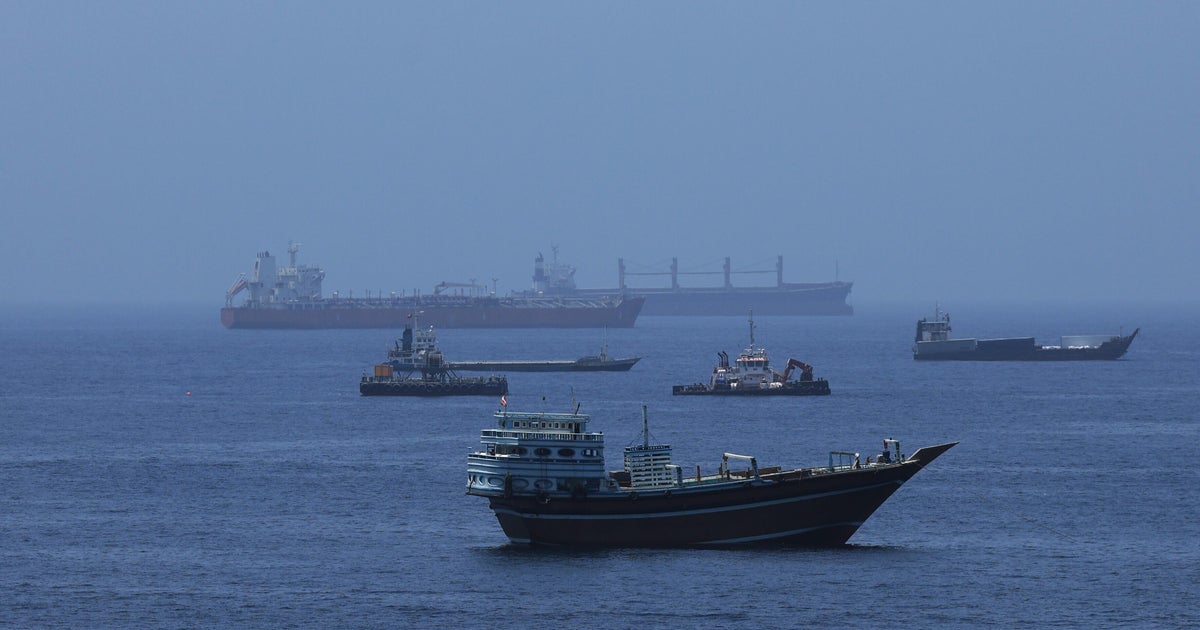
Iran’s Revolutionary Guards attacked a Singapore-flagged commercial vessel in the Strait of Hormuz on Thursday, a U.S. official confirmed to CBS News, posing a challenge to President Trump’s efforts to reopen the critical shipping corridor.
The ship’s bridge was damaged after it was struck on its starboard side by an “unknown projectile” off the coast of Dahit, Oman, according to an advisory from the U.K. Maritime Trade Operations Centre. The advisory said no casualties or environmental impact were reported.
After the strike, the United Nations’ International Maritime Organization temporarily paused a days-old plan to evacuate many of the vessels stranded in the Persian Gulf, pointing to Thursday’s strike. IMO Secretary-General Arsenio Dominguez said the halt is needed “in order to reconfirm that the necessary safety guarantees continue to be in place.”
The international organization said the vessel had passed through the Strait of Hormuz before it was struck, and it “did not transit under IMO’s evacuation framework.”
“I have always reiterated that the safety of the seafarers remains paramount,” Dominguez said in a statement. “Therefore, to ensure a coordinated approach and navigational safety, the evacuation plan will be paused until further clarity is obtained.”
The U.S. and Iran signed a memorandum of understanding last week that boosted hopes of shipping returning to the Strait of Hormuz, a chokepoint that normally carries one-fifth of the world’s oil but was largely closed to ships during months of war. Under the agreement, Iran is expected to arrange for toll-free safe passage “using its best efforts” for 60 days.
Since then, ship traffic has picked up significantly, with 70 vessels sailing through the strait on Tuesday, compared to just six a week earlier, according to data from analytics firm Kpler, which noted some of the uptick could be due to a “post-deal release of delayed traffic.” With shipping picking back up, global oil prices have plummeted.
The IMO also announced Tuesday it was launching a “large-scale” evacuation effort to help thousands of mariners scattered across hundreds of vessels exit the region. It said it was offering two routing options: One through Iranian waters in the northern portion of the Strait of Hormuz, and another through Omani waters in the south.
But disagreements over the Strait of Hormuz have persisted. The U.S.-favored route involves sailing close to the Omani coastline, while Iran has insisted that ships seek its permission before transiting the strait and use a route closer to its coast.
Iran’s Persian Strait Gulf Authority said Thursday: “Any passage through routes outside the framework designated by PGSA will not be covered by safe passage guarantees and will not be entitled to insurance coverage or related liabilities.”
Iran also hasn’t ruled out seeking tolls for ships that pass through the strait after the memorandum of understanding’s 60-day time limit ends. The Trump administration and U.S. allies in the region have called that idea unacceptable and a violation of international law. Oman has said it plans to jointly manage the strait with Iran but isn’t looking to charge tolls.
Secretary of State Marco Rubio told reporters early Thursday the Trump administration expects the strait to stay open, and is planning to judge Iran based on its actions rather than its “maximalist rhetoric.”
“If ships are moving as they should be moving, then that’s what we’re going to judge, and that’s what we’re going to react to,” he said while visiting Bahrain. “If, on the other hand, this rhetoric is backed up by actual ships being threatened and ships are not moving, that’s a violation of the agreement, and we’re going to have a problem with it.”