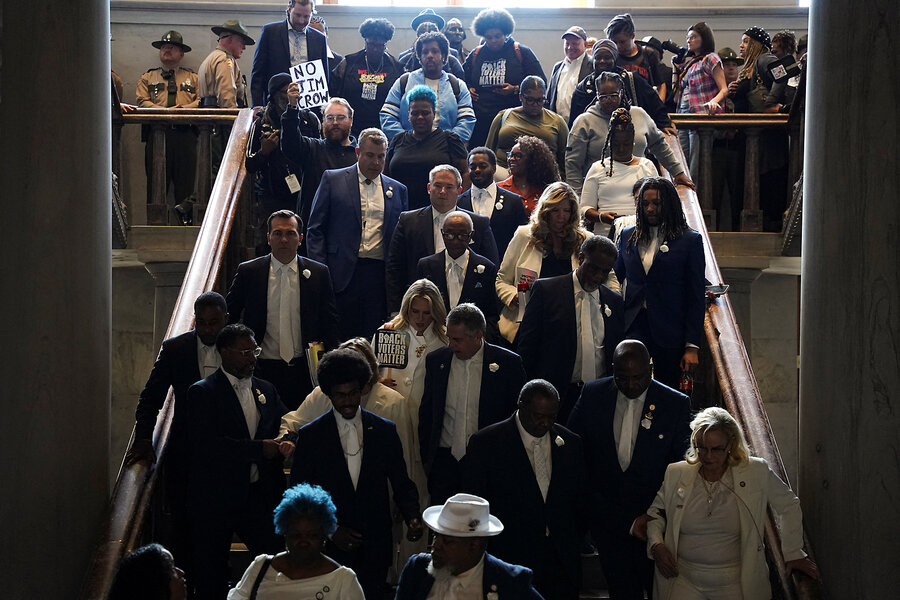
In the run-up to the U.S. Supreme Court’s ruling in Louisiana v. Callais, many political strategists on both sides of the aisle had predicted significant impacts on Black representation, as well as on the partisan balance in the U.S. House of Representatives. But with this year’s election season in full swing by the time the ruling came out, most thought the bulk of those changes would happen in future political cycles – 2028 or beyond.
The past two weeks, however, have featured a flurry of moves directly affecting this year’s elections.
Two court rulings have helped Republicans pull ahead in the mid-cycle redistricting fight, potentially netting the GOP six to seven House seats, according to the nonpartisan Cook Political Report. And despite primaries that are already in process or fast approaching, at least four southern states are pursuing new GOP-favorable maps in a post-Callais redrawing frenzy. In doing so, they are upending preconceived notions about how and when voting should take place, demonstrating that there is more fluidity than previously assumed around things like filing deadlines and primary dates – particularly when control of the House is on the line.
Why We Wrote This
This year’s partisan contest over redrawing political maps has been expanded after a Supreme Court ruling narrowed the scope of the Voting Rights Act. The last-minute rush is the latest sign that many election norms aren’t locked in stone.
Lawsuits have already been filed in several of these states, and legal questions abound.
“This is a more chaotic process than it needed to be,” says Kareem Crayton, vice president at the Brennan Center for Justice. “While we depend on the Supreme Court and the judiciary in general to give us standards to help limit the chaos, this court has done the opposite. How does anyone, even on the right, look at this and not see chaos? I don’t think that’s good for democracy.”
Asked on Tuesday about concerns that voters may be confused about all the changing maps and dates, President Donald Trump told reporters: “I think it’s been a wonderful process.”
“It looks like we’re going to pick up a lot of seats,” the president added. “That’s a good thing.”
Democrats are still favored to win control of the House, with the president’s approval ratings now down in the 30s, and the price of gas soaring. Polls show most voters are unhappy about the Iran war and the cost of living. But the new maps being adopted in many states could give Republicans some protection against these political headwinds, especially after the Virginia Supreme Court overturned that state’s redistricting referendum, which would have added four Democratic seats.
Just one month ago, Virginia Democrats’ redistricting referendum and Florida Republicans’ special legislative session were seen as the final rounds in the mid-cycle redistricting war that saw eight states redraw their maps. After months of political maneuvering, Washington pressure campaigns, and special elections, it had looked like the redistricting back-and-forth would end in a wash.
Then came the Supreme Court’s late April ruling that Louisiana’s congressional map was an unconstitutional racial gerrymander. The decision significantly narrowed Section 2 of the Voting Rights Act, and opened the door for states to eliminate many majority-minority districts.
And despite predictions that it was too late to be actionable this election cycle, many states have sprung into action.
“ATTENTION! NOTICE OF CANCELLATION,” reads a piece of white computer paper taped to the front door of the Acadia Parish Registrar of Voters office at the end of the main street in Crowley, Louisiana. The election for the U.S. Representative for the state’s 3rd Congressional District has been cancelled due to an executive order, the notice goes on to say, “and any votes cast for this race will not be counted.”
Louisiana had already received more than 42,000 absentee ballots, and early voting was set to begin in just two days when the governor abruptly cancelled the state’s congressional primaries. Now those absentee ballots are set to be discarded, with Louisiana’s House elections postponed to a tentative new date of July 15. The state legislature is expected to vote on new maps this week, with the expectation that one of the two majority Black districts will be eliminated.

Story Hinckley/The Christian Science Monitor
Not every state considering new maps has decided to go forward.
South Carolina’s legislature declined to move ahead on a new map Tuesday that would have eliminated the state’s lone Democratic seat. In the state senate, five Republicans joined all Democrats in defying the wishes of President Trump, who had issued a Truth Social post the day before encouraging South Carolina to “BE BOLD AND COURAGEOUS” and saying he would be “watching closely.”
But other states have moved ahead with remarkable speed. Last week, Tennessee’s governor signed a new map into law that eliminated the state’s sole Democratic seat.
On Monday, the Supreme Court cleared the way for Alabama to use a 2023 congressional map, which reduces the state’s majority-Black districts from two to one. Republican Gov. Kay Ivey announced a new special primary election for four of the state’s congressional districts on Aug. 11. All of Alabama’s other primary elections will proceed May 19.
On Tuesday, Missouri’s state Supreme Court upheld a new map that could help Republicans win an additional seat this fall.
With early voting already underway in Georgia for that state’s May 19 primary, GOP Gov. Brian Kemp has endorsed a redraw for 2028 – but a Republican pressure campaign to redraw for this year continues. And although Mississippi already held primary elections in March, Mr. Trump has urged officials there to redraw districts and eliminate the state’s single Democratic seat, according to Mississippi Today. That would require the unprecedented move of completely erasing the results of a primary election that has already been concluded.
“We’re in such uncharted territory, it’s important to express that a lot of moving pieces are happening and that doesn’t mean the pieces are put in place,” says Matthew Klein of Cook Political Report. “We are far from this being settled and knowing what it looks like for 2026.”
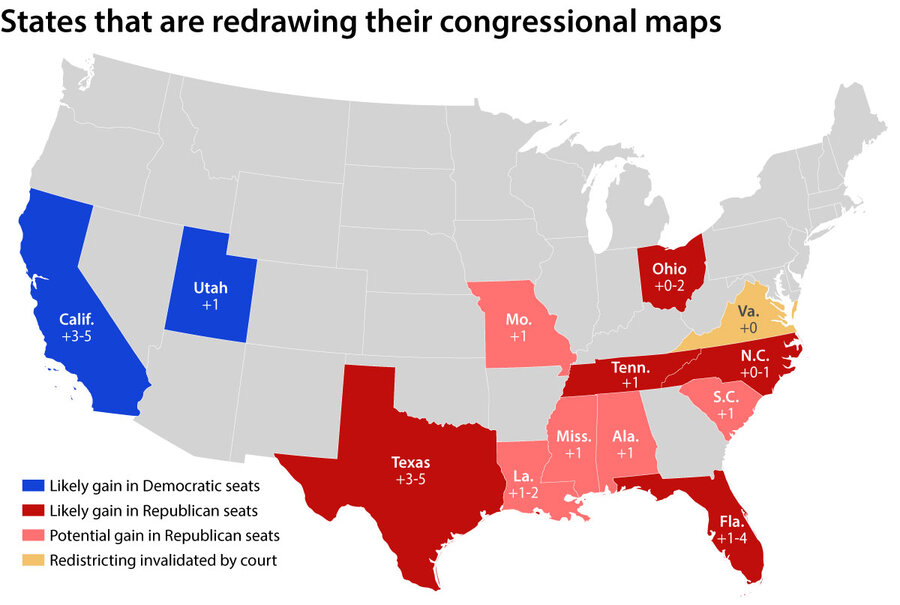
Cook Political Report
|
Jacob Turcotte/Staff
Despite the confusion and questions during this unprecedented moment in American history, several Louisiana clerks and registrars interviewed by the Monitor say they don’t anticipate any problems, describing a process that can adapt with relative ease. All say they first learned about their state’s postponement of its congressional primaries by watching the news. And in the weeks since, there hasn’t been much for them to do beyond printing and posting some notices.
Amy Patin, the Iberville Parish Clerk, says the protocol – posting signs on doors and voting machines – has been similar to instances when someone withdraws their candidacy too late, or there is a death before the election.
“There’s always a challenge,” says Laura Faul, the Acadia Parish clerk, in her Crowley, Louisiana, office. “In the grand scheme of things you just roll with it.”