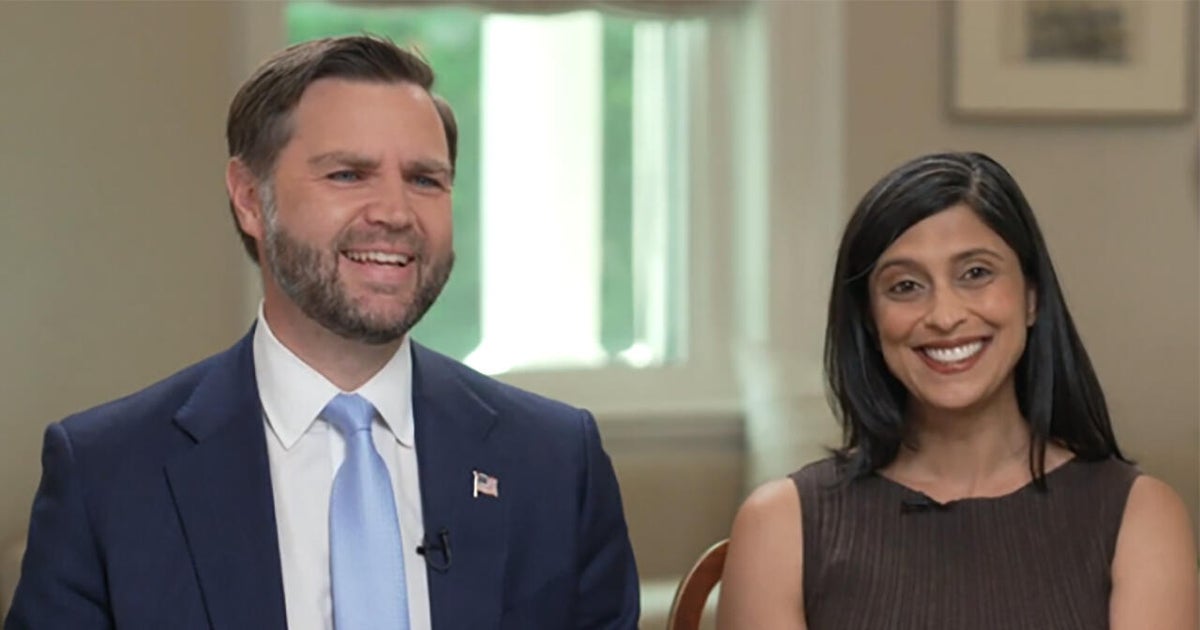
The vice president’s residence can feel like a world away from the rest of Washington, D.C. “The President actually will bust my chops sometimes, ’cause he’ll say, ‘You have a nicer house than I do,'” said Vice President JD Vance.
And it is now home to a family with young children: the vice president and his wife, second lady Usha Vance, have three (ages four, six and nine), with a fourth due in just a few weeks.
The Vances invited “Sunday Morning” national correspondent Robert Costa here to talk about the news of the day, as well as their family, and the vice president’s faith, the subject of his new book, “Communion: Finding My Way Back to Faith” (to be published Tuesday by HarperCollins). It’s the story of JD Vance’s 2019 conversion to Catholicism – how that’s affected his life, his politics, and their marriage.
Usha once remarked to her husband, “Therapy didn’t work for you; church does.”
And she explained to us she believes that to be true: “And it’s not that therapy doesn’t work for other people,” Usha said, “but JD just doesn’t have the right kind of trust in that process. He just didn’t feel at home in it, really exploring some of the feelings that he had and trying to figure out how he wanted to be the person that he wanted to be for the rest of his life.”
On seeking stability
A reading of “Communion” suggests that Vance had a desire not only for faith, but for the stability that he believed faith and organized religion would bring to his life. He writes that sometimes in his own life he was “permanently terrified that things will unravel” if he were not “rooted.”
“That’s exactly right,” Vance said.
When asked if that is how he views the world (and himself), the vice president replied, “Yeah, I think that’s very insightful. And, you know, I grew up in some ways a very nontraditional household, you know? A revolving door of people coming in, people coming out, raised by my grandparents at some points, raised by my parents at some points, my mom, my dad. So, there was a certain movement and chaos to my youth. And I do think that I was searching for something that, again, felt a little bit more rooted and felt a little bit more stable.”
For those familiar with Vance’s 2016 bestseller, “Hillbilly Elegy,” the story of his family’s struggles, it’s no surprise that Vance has sought order in his personal life. He has also sought combat in his political life, winning allies, and critics. He credits his wife with being a good barometer for whether he’s said anything that’s a little bit too far out there. “Well, she just texts me or calls me, or if we’re sitting in the house together, she’ll just tell me,” he said. “Usha’s very blunt. It’s one of the things I’ve always loved about Usha from the very beginning.”
CBS News 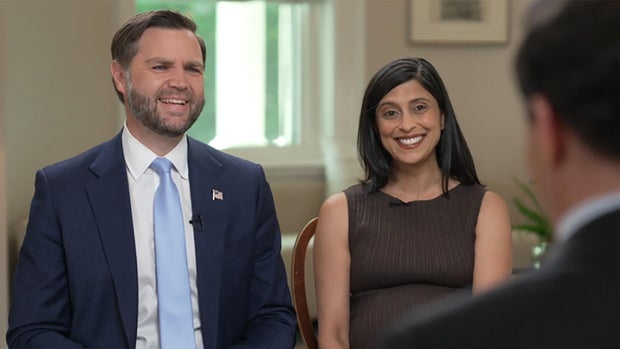
Usha Vance, an attorney who once clerked for Supreme Court Chief Justice John Roberts, is the daughter of immigrants from India. She was raised in the Hindu faith in Southern California. Asked if there is anything misunderstood about how they have lived as a couple and a family, Usha replied, “I think people have really cottoned onto the idea at one point that JD was interested in my conversion. And I think that that was misunderstood for the fundamental reason that he is Catholic; part of his faith is wanting to spread his faith. But it’s not like he’s proselytizing to me every day.”
In Vance’s book, he describes how his values are shaped by his religion, his politics, and by people, including on the most personal of family matters. After last year’s killing of conservative organizer Charlie Kirk, a conversation with Kirk’s widow, Erika, helped lead the Vances to have a fourth child.
“I think it really heightened JD’s sense that he’d been talking about this for a while, this sense that there was this possibility of having another kid whom he could love as much as the three that we had,” said Usha. “And it really did crystallize for [him], that sense that if you could have that other child, then you would have nothing to regret. And if we couldn’t have that other child, then we were very happy with the children that we had. So, it was very powerful, what [Erika] said about her own family, and certainly very moving to both of us. I think I had already started to open my mind to the possibility. I wouldn’t say that this was, for me in any way, the decisive factor. But it came in the middle of a conversation that we were already having.”
On the war in Iran
JD Vance is 41 years old, and his relative youth is especially notable today, as President Trump celebrates his 80th birthday this morning. While there seems to be very little daylight between their politics, the war with Iran has revealed differences in how Mr. Trump and Vance assessed the conflict at its start.
On March 9, less than two weeks after the president launched strikes against Iran, Mr. Trump said of Vance, “He was, I would say, philosophically a little bit different than me. I think he was maybe less enthusiastic about going, but he was still quite enthusiastic.”
Asked whether he was, or still is, a skeptic, Vance said, “First of all, I think the president is exactly right, that we cannot let one of the most dangerous and largest sponsors of terrorism in the world have a nuclear weapon. That is exactly right. And our policy is going to achieve that outcome. Of that I feel extremely confident.”
Asked whether his military experience made him skeptical of going to war in the Middle East, Vance replied, “I think the president’s like this, too. I think both of us are generally skeptical of foreign military entanglements. And I certainly was formed by my time in the Marine Corps to be very skeptical of some of these entanglements. But fundamentally that doesn’t mean you can never use military force. And I think the goal here, forbidding the Iranians from having a nuclear weapon, we’re going to be successful at that goal. And when we are, that’s going to be a very good outcome for the American people.”
Vance has defended the war with Iran against criticism from the head of the Catholic Church, Pope Leo XIV, who has stated, “There is no just war there.”
“One of the things I sometimes will hear people say is that Christian pastors, Christian leaders, whether it’s the pope or anybody else, they ought to stick to religion and let the politicians stick to politics,” said Vance. “But I actually think it’s important for Christian leaders to understand that, you know, yes, there are classically Christian concepts like, how does a husband treat a wife? What are the obligations that, you know, a father has to a son? Those are classic private matters that we think of as under the purview of Christian leaders.
“But I think it’s totally reasonable, and actually a good thing, even when I disagree. Like, I’ve disagreed a lot with what the pope has said about our immigration policy, for example. But I think it’s a good thing for Christian leaders to say what they think about the moral issues of the day. ‘Cause I’m a big believer that the way that we ultimately find God, the way that we ultimately find truth, is to discuss some of these important issues with one another.”
Asked about the sense of alarm expressed by some of his fellow Christians (including Catholics) about the Trump administration’s policies, Vance said, “Look, I think if you took ten random Catholics all across the United States of America, you’d get ten different perspectives on any particular policy. I think a lot of those Catholics, a lot of those Christians would support what we’re doing. Some would not.”
Asked if he is capable of listening to and respecting their points of view, Vance replied, “Yeah, of course I do. And I think that you have to, right? Part of my job as a political leader is to try to understand where the American people are coming from. It doesn’t mean that I always have to agree with this or that particular American. But you have to listen to people.”
On his future
For Vance, navigating the political and the personal has been a constant of his rapid rise to the Senate and the vice presidency. But when asked if he and the president ever discuss his future, Vance laughed. “I never bring it up. But sure, the president brings it up a lot, sometimes publicly, sometimes privately. You know, the president’s a political animal. He loves this stuff. He’s very fascinated by it.”
Is the president coy, or encouraging, about Vance seeking the nomination in 2028? “It’s not coy, or it’s not positive or negative,” Vance said. “It’s just, he kind of talks about it like, ‘What’s gonna happen?’ You know, ‘How do we make sure that we’re successful? What does that mean for the future?’ It’s more of a conversation like that.
“I have no doubt that the president of the United States is going to be very supportive of anything that I ultimately decide to do,” said Vance. “But we really just haven’t talked about what that thing will be.”
WEB EXCLUSIVE: Watch an extended interview with JD Vance and Usha Vance (Video)
WEB EXCLUSIVE: Watch an extended interview with JD Vance (Video)
For more info:
Story produced by Ed Forgotson and Jenna Gibson Riggins. Editor: Ed Givnish.