
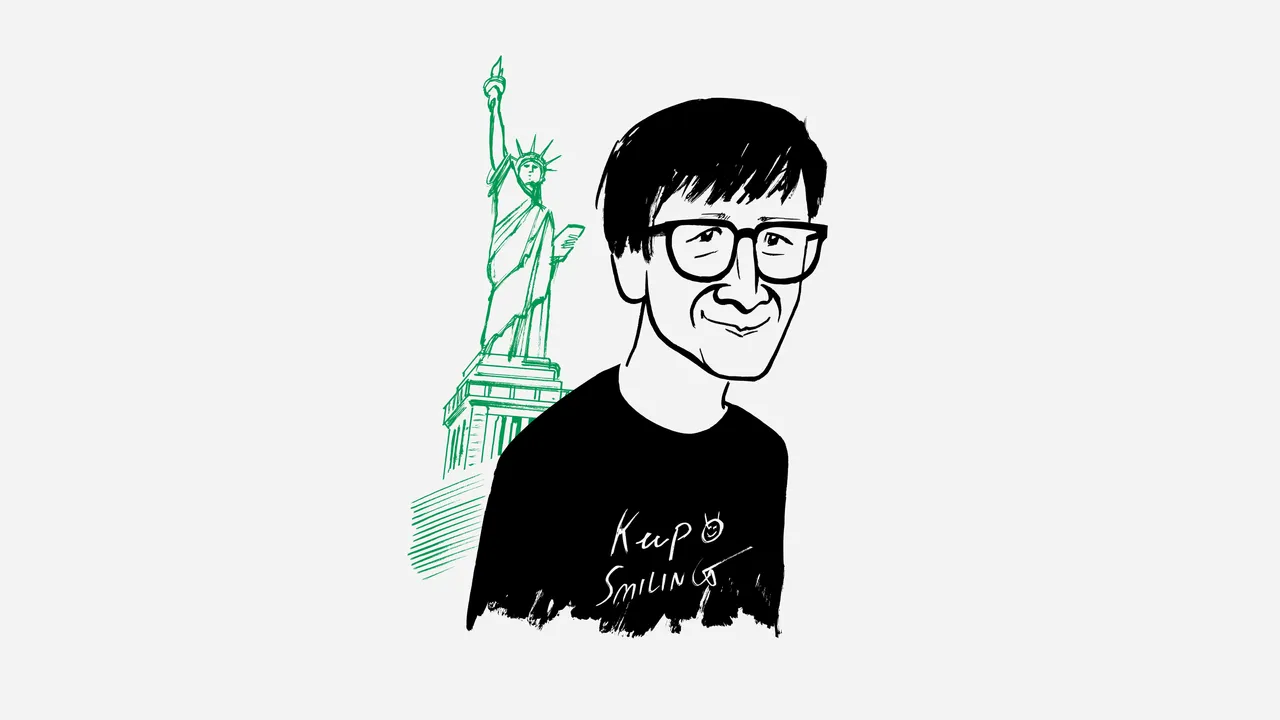
Before becoming a child movie star, in “Indiana Jones and the Temple of Doom” and “The Goonies,” the Oscar-winning actor Ke Huy Quan, born in Vietnam to ethnic-Chinese parents, lived with them and his eight siblings over his father’s plastic-bag factory, in Saigon. He emigrated with his father at age seven, starting with a harrowing boat trip to Hong Kong. He tells the boat story in a new memoir, “Never Say Die”—a “Goonies” reference—and thought of it again on a recent morning in lower Manhattan, as he boarded a ferry called the Miss Liberty. “This brings back memories of the Huey Fong, except that we were way more crowded,” Quan said, climbing the stairs. “And, instead of going up, we went down.” Tourists speaking several languages, some wearing foam Statue of Liberty crowns, filled the seats; Quan made his way to an upper-deck railing. He has kind eyes and a gently handsome face; his expressions tend toward earnest. As the ferry headed into the harbor, he gazed out at the Statue of Liberty, which he had never visited before. “I get a bit emotional thinking about this, and remembering some movie scenes that I’ve seen,” he said. “Especially ‘The Godfather Part II.’ ” He got quiet. “All the people coming here, hoping for an opportunity. I think if my dad was alive he’d be very proud.”
On Liberty Island, the path approaches the statue from behind, affording time to contemplate the folds of its enormous cloak. “I wonder what it was like transporting that across the ocean,” Quan said. Reaching the front, he beamed up at its majestic green head—“Ooh, look at that!”—and took a selfie, pointing, in a “Wow!” pose. He wore a black Uniqlo T-shirt of his own design, with yellow script that reads “Keep Smiling.” (Proceeds go to the U.N. Refugee Agency and the Displacement Film Fund.) “I’m going to post that to my I.G. later,” he said.
After arriving in the United States, Quan’s family reunited in Los Angeles’s Chinatown. One day in 1983, while he and his younger brother, David, were in E.S.L. class, they saw kids heading to an open-call movie audition at their school. David wanted to go, too, and Quan accompanied him, coaching him in Cantonese (“Bigger! Look at me—like this!”) and charming casting directors. Soon, Quan himself was at the Warner Bros. lot, auditioning before Harrison Ford, George Lucas, and Steven Spielberg, who cast him as the impishly heroic Short Round in “Temple of Doom.” (David was happy for him, Quan said.) “I didn’t know who they were,” Quan recalled, sitting on a wall. “I hadn’t seen ‘Star Wars’ or ‘Raiders of the Lost Ark.’ In fact, I’d never been to a movie theatre. The first time I went to a theatre and watched a movie with a live audience, I was in it.” In the memoir, he recalls the nurturing and kindness of Spielberg, and of Ford, who taught him how to swim. “ ‘Temple of Doom’ helped me kind of reshape what I went through as a kid in a positive way,” he said. “I was having fun and playing a character who was courageous and funny and really enjoying the ride, versus terrified and worried about surviving.” Behind him, tourists took photos with the statue; one happy teen posed like Lady Liberty, her arm raised, holding a novelty torch-shaped lemonade cup.

“I’ll help you bury your acorns, then you help me with my thing.”
Cartoon by Ellis Rosen
Seeing Quan, a young blond guy did a double take. “I literally was, like, Oh, my God, my favorite actor from ‘The Goonies’!” he said. Quan posed for some fan pictures, then headed to the lemonade stand. As a kid, he said, he’d loved being recognized, “but when my career went south”—subsequent roles were smaller, and he eventually worked as a creative consultant for Wong Kar-wai—he didn’t: “I thought I’d peaked at twelve.” (He did, however, meet his wife while working for Wong.) Since the release of “Everything Everywhere All at Once,” in 2022, for which he won the Oscar, “I am no longer uncomfortable,” he said. More good roles followed, including in last year’s “Zootopia 2.” “I play Gary De’Snake, a pit viper,” he said. “He may look intimidating, but he’s actually a kind and funny guy with a big heart.”
After a second ferry ride, Quan, sipping from his own torch-shaped lemonade cup, walked through the Ellis Island museum. “So this is the building where all the immigrants came through!” he said, in the sunny hall. He admired sepia-toned photos of immigrant kids holding American flags (“What an incredible thing America did”) and took in exhibits about restrictions and bigotry. He peered at some cartoons from 1882. “The first group of Chinese immigrants to this country were lied to—they ended up doing hard labor,” he said. “I would love to do a movie about that one day.” ♦








Leave a Reply