

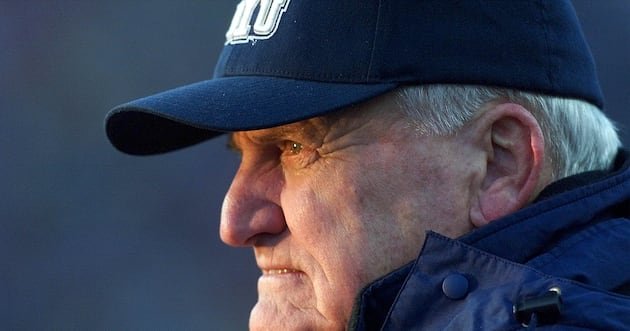
Editor’s note: Seventh in an occasional series exploring LaVell Edwards’ legacy of leadership.
In 1971, the average home price in America was $25,200, the hourly minimum wage was $1.60, a group of guys in Los Angeles formed a band called the Eagles, and LaVell Edwards was summoned to sit down with BYU President Dallin H. Oaks.
The only thing that stayed the same after that was the band. Everything else went up, including Edwards’ coaching career.
“(President) Oaks just called my dad into the room, just the two of them, and said, ‘They tell me you’re a pretty good coach and that you are easy to work with. So, do you want to be our head coach?’” recounted John Edwards, LaVell’s oldest son.
“My dad said, ‘Well, yeah.’ They sat there for a minute, and President Oaks says, ‘Well, don’t you think we ought to tell somebody I just hired you? There is the sports information office in the athletic department, go call them and tell them you just got hired.’ So, my dad literally had to tell the people in the office that he got hired as head coach.”
Fast-forward 29 years to another special visit — this time with President Gordon B. Hinckley of The Church of Jesus Christ of Latter-day Saints. Edwards’ Cougars had just defeated New Mexico in his final home game as head coach. Surrounded by his wife Patti and his family, the soon-to-be Hall of Famer stood at midfield and watched as President Hinckley announced that Cougar Stadium was being renamed in his honor: LaVell Edwards Stadium.

The shortest distance between two points is a straight line. For Edwards, the distance between his unceremonious hiring and his unprecedented retiring as the winningest coach in BYU history was a straight pass, or at least one that moved the ball upfield like no one had ever seen before.
Pioneering the forward pass
“Who knew that he was the pioneer, right? He’s a pioneer in the forward pass,” said former BYU Hall of Fame quarterback Steve Young (1980-83). “That wasn’t the first time anyone threw the ball, but it was the first time in college that people committed completely to it.
“Throwing on third-and-3 was an incredible statement. Throwing at the goal line? That’s insane. ‘No, we’re throwing it,’ and it was awesome. I can’t tell you how awesome it was to be doing something no one else was doing in a unique way — and the frustration that you could put defenses in.”
If becoming an innovator was easy to do, there would be more people doing it.
Edwards had a tactical vision that his coaches and players came to see as clear as day. The transformation from a running program, which featured the nation’s leading rusher in Pete Van Valkenburg, to a passing attack wasn’t easy — but as history has shown, it was worth it.
In a deep shade of royal blue irony, as former BYU offensive lineman, graduate assistant and veteran NFL coach Andy Reid explained, Edwards’ heralded offense was the brainchild of a guy who understood more about defense.
Why the change in philosophy?
“I asked him, ‘What made you go from the option where you are leading the nation in rushing to this pass game where you are throwing 90% of the time?’” Reid said. “He says, ‘Well, I was a defensive coordinator. The teams that threw the ball presented a problem. I understood that.
“We had guys that might not have been the fastest guys, but they were disciplined. They were disciplined route runners. They were quick,” he continued. “Sometimes quickness can counter speed. I knew we could get quarterbacks that could throw and we’re always going to have linemen. We’ll always have big guys.’ So, that’s how it went. He did it from a defensive perspective that this was tough to stop.”
Having decided what to do, Edwards’ next move was to figure out how to do it.
“Somebody had to have the courage to change, believing that there had to be a better way,” said Marc Wilson, BYU Hall of Fame quarterback (1977-79). “That’s really the crazy thing when you think about LaVell is that he had the foresight and the guts to go do it, because nobody was doing it and nobody really even knew how to do it.”
Among the offensively minded coaches Edwards hired were Dave Kragthorpe, Doug Scovil, Mike Holmgren and Norm Chow.
‘It kind of took off’
“A leader is somebody that can lay it out there and then allow people to go to work and do it,” said Ty Detmer (1987-92), a member of the BYU Hall of Fame and a Heisman Trophy-winning quarterback. “To me, (LaVell) would be a great CEO or boss of anything he did, because he would manage it.”
Robbie Bosco quarterbacked BYU to the 1984 national championship.

“He had a unique quality about himself that he could bring in the right people and let them do their job,” Bosco said. “He knew that we had to hire coaches to help the players learn how to be successful throwing the football and then it kind of took off.”
Part of the “taking off” had a lot to do with Edwards staying grounded in his plan but also staying out of the way of his experts.
“The truth is, the offensive genius, this is gonna sound bad, but I don’t mean it to, because the truth is, the offensive genius was Doug Scovil. It was Mike Holmgren. Then it became Norm Chow,” said Wilson. “Those were the guys that really understood the passing game. We were fortunate to have them at BYU and LaVell knew that.”
There were bumps along the way and plenty of different ideas, but Edwards stood in solidarity with his staff and that sent a strong message to his teams.
“They would get heated in some of their meetings, but none of the players knew that. He wouldn’t scold any of his coaches in front of the players. He was really, he was so far ahead of his time on how to be a leader,” said BYU receiver Glen Kozlowski (1981-1985).
“He knew how to elevate people with talent. He knew how to identify people with talent and then he would teach them to reach their full potential and be good citizens as well.”
‘The guy just didn’t have an ego’
“The guy just didn’t have an ego. He didn’t need this to feel that he was worth something to his wife and to his kids and to me and to you and the university,” said President Jeffrey R. Holland, president of BYU from 1980-89. “His highs weren’t too high, and his lows weren’t too low. He didn’t need to take credit for the passing game. He knew that other people had done that and could do it.”
With the plan and the staff, Edwards then needed the kinds of players that could pull it off. One by one, they came. Gary Sheide was the first throwing quarterback, followed by Gifford Nielsen, Marc Wilson, Jim McMahon, Steve Young, Robbie Bosco, Ty Detmer, John Walsh and Brandon Doman.
“He definitely had his way of knowing how to push your buttons and get the most out of you,” said Hall of Fame quarterback Jim McMahon (1977-81). “He could look at someone and say, ‘Oh this kid is gonna be good’ or ‘He’s gonna be a player’ or ‘This guy might have some trouble.’ But he understood, and his demeanor was very soft-spoken, but when he did say something, it was relevant.”

Another gift Edwards possessed was his ability to listen to his staff and players, even in some of the most intense moments in program history.
Seconds after Wilson connected with Clay Brown to pull BYU to 17-16 against No. 14 Texas A&M on Sept. 8, 1979, Edwards called a timeout. He had already decided that if the Cougars scored, they would go for a two-point conversion.
Wilson trotted over to the sideline and was surprised by what happened next.
“We only had a couple exchanges in all the years I played because I would go over to the sidelines and Scoville would come up and talk to me. LaVell would never really talk to me. Except on two occasions, one was against Texas A&M,” Wilson said. “I was on the sideline with Doug. We were talking and LaVell interrupted the conversation and said, ‘Marc, what play do you want to run?’”
Wilson suggested a pass they had barely practiced prior to the game.
“It wasn’t a great play, but LaVell’s philosophy was, ‘If my quarterback believes in a play then there is a good chance it will succeed. If I call a play that I like and he doesn’t, there is zero chance it’s gonna succeed,’” Wilson said.
The quarterback returned to the field completely empowered by his head coach.
“Marc came out to the huddle. We are all leaning in trying to hear him and he calls it and everybody turns to go to the ball,” said fullback Mike Lacey (1978, 78-81). “Then he comes to me and says, ‘Mike, this is coming to you!’ My knees started shaking. I’m fresh off a mission to Costa Rica and the rest is history.”
Wilson faked a handoff to Lacey and then hit him with a short pass for a 2-point conversion to stun the Aggies 18-17 in a victory that ranks among the most significant in BYU history.
Even while innovating a game that had already been around for more than a century, Edwards remained true to his core values.
Game changer
“He changed the game and the mindset of maturity and not just recruiting great athletes but recruiting athletes that could be great men — and great defined by that individual,” said Kozlowski. “He was all about honesty, integrity, choosing the right. I mean, those little principles go a long way in life.”
“I just had a lot of respect for the man, even though we did have our run-ins. He was always the same. He never changed and he kept his program the way he wanted it, and he kept it that way for, what, 40 years? I mean, that’s a pretty amazing stat,” said McMahon. “He was well liked all around the country, wherever we went — he’s very well respected and he did it his way, and you gotta respect that. I love people who do it their own way.”

Dave McCann collected the content for this article while researching and writing the book “The Leadership Legacy of LaVell Edwards,” which he co-authored with Dr. Mark D. Ogletree.



Leave a Reply