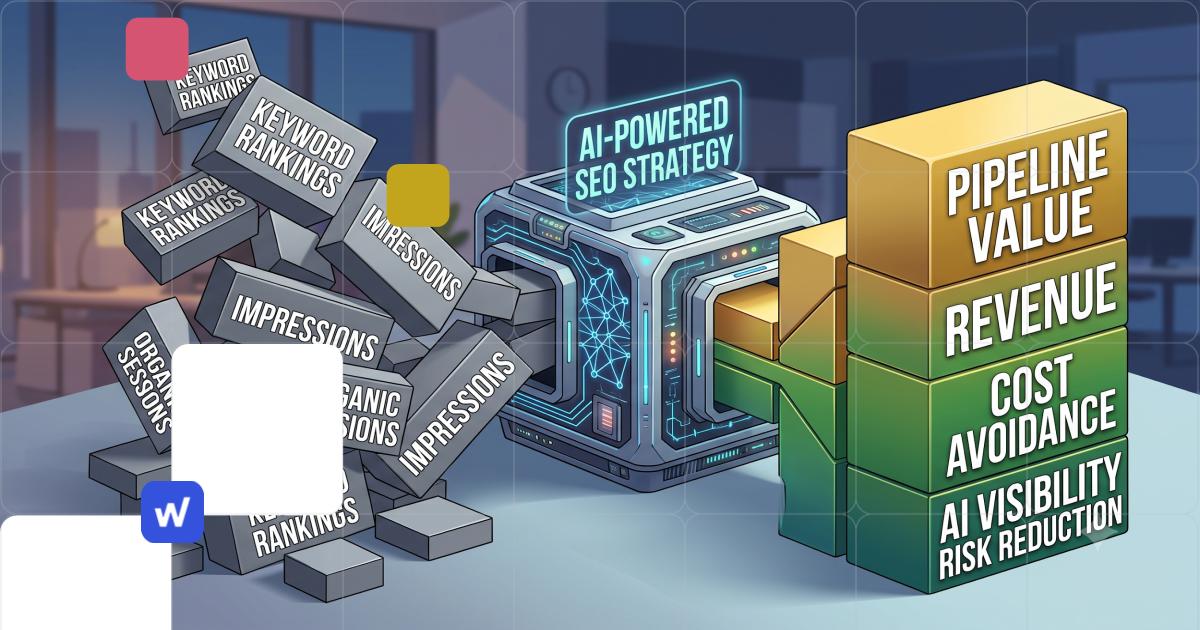
Your CEO doesn’t want to hear that you moved from position 6 to position 3. They want to know why the marketing budget deserves another quarter. That gap, between what practitioners measure and what leadership funds, is where most AI-visibility ROI reports fall apart before the meeting even starts.
Leadership doesn’t fund “SEO.” They fund outcomes. If your reporting still leads with rankings, impressions, or a list of AI platforms you now appear in, you’re answering a question nobody in the room asked. This is especially true at renewal or budget-review time, when the person across the table wants a two-minute case for continued investment, not a dashboard tour.
The good news: the data you’re already collecting can make that case. You’re just presenting it in the wrong language. Here’s how to translate AI-visibility tracking into a report a CEO, COO, or CMO will actually act on.
Why Rankings Talk Fails in the Boardroom
Practitioners think in visibility. Leadership thinks in risk and return. When you open a renewal conversation with “we’re now cited in three AI Overviews,” you’ve made a technical claim that requires the listener to trust an inference: visibility eventually becomes revenue. Most executives won’t make that leap for you.
The fix isn’t to stop tracking visibility. It’s to stop leading with it. Put the business outcome first, and use the visibility data as the evidence, not the headline. A leadership reporting structure that opens with “here’s what this program protected or generated this quarter” earns you the next thirty seconds to explain how you got there.
The Four Numbers Leadership Actually Wants
Every AI-visibility program produces dozens of metrics. Leadership needs four, translated into KPI language they already use to run the rest of the business:
- Coverage: the share of priority topics or products where your brand shows up in AI answers, framed as market share, not “impressions.”
- Attributed revenue, pipeline or leads: what touched an AI-influenced session before it converted, even directionally.
- Competitive share of voice: how often you appear versus the two or three competitors leadership already tracks by name.
- ROI: what the program costs against what it protected or produced, the same framing used for every other line item in the budget.
- Each of these is a performance indicator leadership can compare quarter over quarter, which is the entire point: a KPI only earns trust once it has a trend line. If you’re still deciding which numbers belong on that short list, it’s worth first benchmarking your SEO KPIs against your category so the four you pick actually mean something in context.
Turning AI-Visibility Signal Into a Renewal Story
Most teams already have more raw data than they use because it’s still sitting in the tool, not in the deck. Google Search Console is the underused asset here, not because it tracks AI citations directly, but because it shows you where a keyword or topic has zero impressions today, which is exactly the white-space argument leadership responds to: “we found the gap, and here’s the plan to close it.”
Start by pairing Search Console data with a clustering model to group the topics with no signal yet. That cluster becomes your forward-looking case, the argument for why the budget should continue, not just a receipt for what already happened.
The catch: pulling this together manually, GSC exports, AI Overview citation checks, a spreadsheet to tie it back to pipeline, is exactly the kind of “full-time job on top of your job” work that pushed you toward AI-visibility tracking in the first place.
How WordLift Builds the Report Instead of You
This is the part most teams skip, not because they don’t want the proof, but because assembling it by hand takes longer than the meeting it’s for. WordLift’s reporting engine closes that gap by pulling everything into one place automatically:
Google Search Console and GA4, combined. Impressions, clicks, and position sit next to sessions, engagement, and conversions, so a KPI like “attributed pipeline” isn’t a guess stitched together across two tools.
AI Overview and AI Mode citation tracking. WordLift checks whether your brand is actually being cited in Google’s AI-generated answers, and how often. It’s the one number that turns “we think AI visibility matters” into “here’s where we’re cited and where we’re not.”
Before/after and control-group comparisons. Rather than reporting a single snapshot, WordLift runs a causal-impact analysis on the daily data, comparing the pages or topics you optimized against a control group that you didn’t. That’s the difference between “traffic went up” and “this specific work is why it went up,” which is the exact objection that sinks most renewal conversations.
A branded, presentation-ready report. The output isn’t a raw dashboard. It’s built to hand to a CEO, COO, or CMO as-is, with the KPIs and the causal story already framed for a non-technical audience.
In other words, everything in the “four numbers” and “renewal story” sections above is what WordLift’s reporting engine generates as its default output. You’re not building this report from scratch each quarter, you’re reviewing it.
See it built from your own data
A Simple Reporting Structure You Can Reuse
Whether you build the report by hand or let WordLift generate it, the structure that lands with leadership stays the same: one page, four KPIs, one forward-looking recommendation. Resist the urge to attach the full dashboard. It invites questions about methodology instead of decisions about budget.
Treat the report as a white-label product internally: strip out tool-specific jargon, brand it as your team’s output, and make it something a CMO could forward to the board without editing. That means:
Lead with the business outcome, not the channel.
Show the trend for each KPI over the last two to three reporting periods, not just a snapshot.
Name the gap you’re closing next, backed by the Search Console or AI-visibility data behind it.
End with a single ask, budget, headcount, or sign-off, not a menu of options.
Build the template once, reuse it every cycle, or let WordLift regenerate it on the same structure automatically, and it becomes the artifact that makes the next budget conversation shorter, not longer
Key Takeaways
Leadership funds outcomes, not rankings. Reframe your KPIs before you reframe your dashboard. Four numbers (coverage, attributed pipeline, share of voice, cost per outcome) carry more weight in a renewal conversation than any ranking report. Causal-impact analysis, not just a before/after snapshot, is what actually answers a leader’s “how do we know this worked” objection. And a report built like a reusable, white-label product, whether assembled by hand or generated automatically, turns every future budget review into a shorter conversation.
Ready to Reframe Your Next Report?
Before you build the next report, know exactly where your brand shows up and where it doesn’t, across AI Overviews, AI Mode, and the assistants your buyers are already using.
Or, if you’d like to book a discovery session with the team book here