
Conversion Rate Optimization (CRO) is the process of systematically improving a website, landing page, or user journey to increase the percentage of visitors who complete a desired action; whether that’s signing up, booking a demo, or making a purchase.
In the case of growth marketing, CRO is the heartbeat of performance. You can run the best ad campaigns in the world, but if your landing page leaks conversions, you’re burning ad spend. Every 1% increase in conversion rate on a landing page can compound into massive ROI across acquisition, lead generation, and revenue.
Let’s explore this further with an example:
Imagine you are bringing 10,000 visitors to your landing page that converts 3% of visitors into leads; that’s 300 leads. If you are able to improve your conversion rate to 4%, that’s an extra 100 leads per month. Over a year, that small 1% lift could mean 1,200 more leads and a significantly lower cost per acquisition (CPA).
Here’s another perspective from Walmart, it found that every one-second improvement in page load time, conversions increased by 2% as reported by Cloudflare.
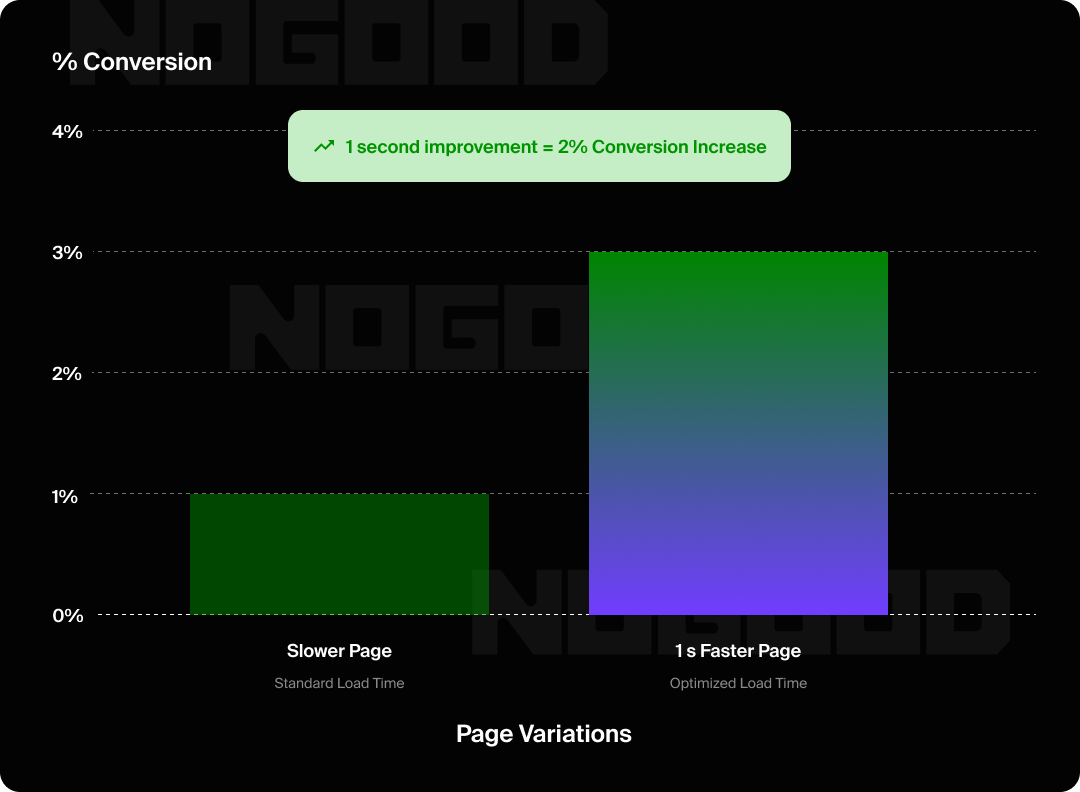
CRO is an intricate process that involves detailed experimentation, data analysis, and the ideation of roadmaps to improve user engagement, where it requires both creativity and technical prowess. So where do LLMs like ChatGPT come in?
Think of ChatGPT as the assistant or intern you’ve always wanted: smart and fast, but only as good as your guidance. In AI terms, that means your prompts are the training. The better your instructions, the sharper the output.
In this article, we will explore how growth marketers can use ChatGPT to streamline CRO workflows; from insight extraction and hypothesis creation to copywriting, design ideation, and reporting with real prompts and examples you can start using today.
Understanding CRO & the Role of ChatGPT
CRO isn’t a single tactic. It’s a continuous loop of data analysis, hypothesis, experimentation, and learning. Where teams often struggle is speed and scale:
- Analyzing thousands of data points
- Generating new test ideas
- Producing dozens of creative variants
Coincidentally, that’s also where ChatGPT and other LLMs excel; processing complex and large data into actionable insights within minutes.
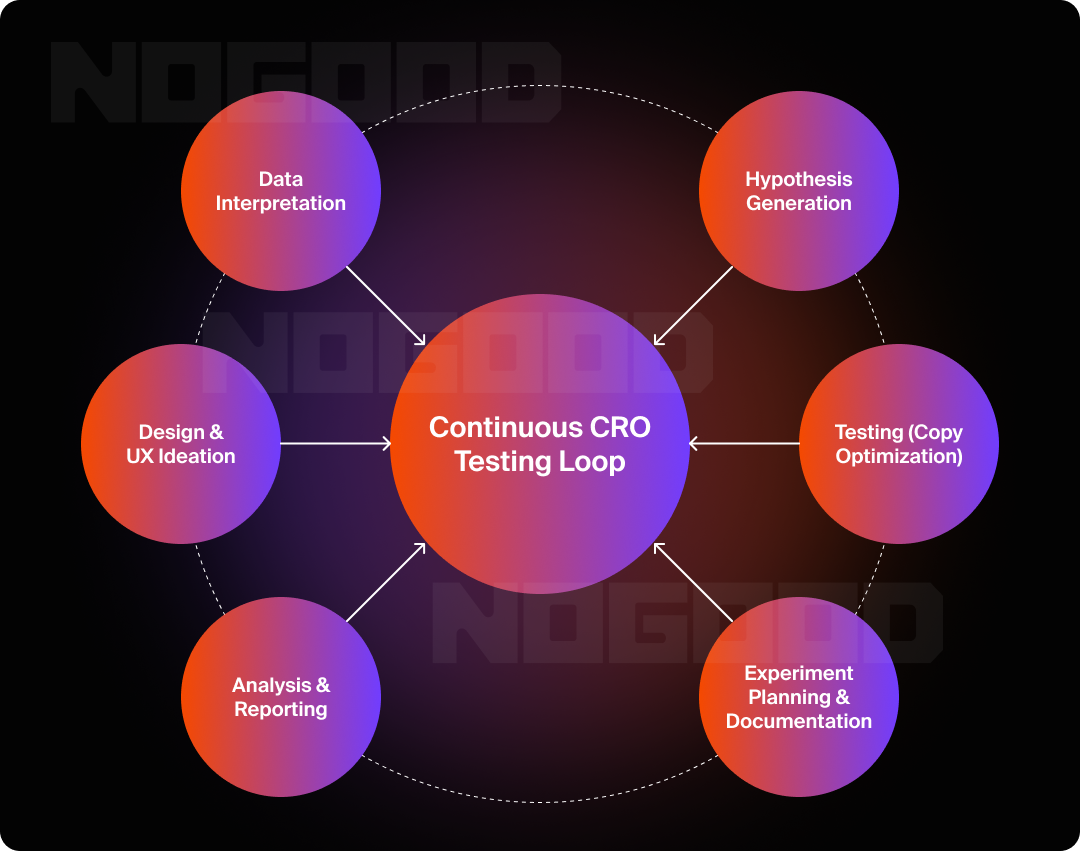
The Stages of Conversion Rate Optimization
|
1. Data Interpretation & Insight Extraction |
Collect and validate data from GA4, heatmaps, and surveys; ensure data accuracy. |
Summarize patterns, identify insights, and translate quantitative + qualitative findings into actionable summaries. |
|
2. Hypothesis Generation & Test Prioritization |
Define business goals and decide what success looks like. |
Generate “if/then” hypotheses, apply ICE/PIE scoring, and propose prioritized test ideas. |
|
3. Copywriting & Messaging Optimization |
Set positioning, tone, and compliance guidelines. |
Draft and refine multiple on-brand copy variants based on Voice of Customer (VoC) inputs and triggers (trust, urgency, value, etc.). |
|
4. Design & UX Ideation |
Approve user journey goals and visual direction. |
Suggest layout and component improvements, describe visual hierarchy changes, and explain expected behavioral impact. |
|
5. Experiment Planning & Documentation |
Decide experiment scope, allocate resources, and approve variants. |
Draft structured A/B test plans, define KPIs, and create pre-launch QA and readiness checklists. |
|
6. Analysis & Reporting |
Provide results, validate statistical accuracy, interpret implications, and decide next steps. |
Summarize performance lift, identify top-performing variants, and draft learnings and recommendations. |
When generating and prioritizing test ideas, not every hypothesis deserves immediate attention. Teams need a structured way to decide which ideas to test first, especially when using ChatGPT to produce dozens of potential experiments.
That’s where prioritization frameworks like ICE and PIE come in. ICE and PIE are simple frameworks that help prioritize CRO test ideas based on their potential impact and effort.
- With ICE (Impact, Confidence, Effort), you score each idea from 1-10 for how much it could improve results, how confident you are in it, and how hard it is to execute. It’s perfect for quick-win, fast-testing cycles.
- PIE (Potential, Importance, Ease) focuses on opportunity size and business value, making it better for structured programs on high-traffic or high-revenue pages.
Higher-scoring ideas move up your testing queue, ensuring time and resources go where they’ll deliver the biggest lift.
Why ChatGPT Elevates CRO
- Faster Insight Discovery: LLMs analyze unstructured data, surveys, NPS responses, and customer reviews and convert them into clear patterns or friction points.
- Structured Hypotheses: Instead of relying on just instinct, ChatGPT organizes test ideas using frameworks like ICE (Impact, Confidence, Effort) or PIE (Potential, Importance, Ease).
- Creative Acceleration: This is the most developed use case of AI, it can generate copy and creative variations instantly for rapid A/B testing.
- Documentation Efficiency: ChatGPT can draft test briefs, control and variant definitions, and analysis summaries (potentially saving hours per experiment).
ChatGPT’s Limitations With CRO
While ChatGPT can speed up and simplify many parts of CRO, it’s not flawless. Here are some things to keep in mind when using ChatGPT for CRO:
- Always verify outputs before implementation. Never accept them at face value; instead, test, validate, and human-edit every suggestion or variant it produces.
- There will be times when ChatGPT’s responses aren’t useful or miss the mark entirely. That’s normal. The key is to use prompt engineering to iterate and refine your prompts until you get results that align with your objective.
As you learn where it performs best, you’ll start using ChatGPT less as a novelty and more as a reliable partner in experimentation
What Information Brands Should Gather for Smarter CRO Decisions
Effective CRO starts with understanding why users convert (or don’t). The best optimization decisions come from data rooted in real customer behavior and sentiment. Therefore, brands should collect a mix of quantitative and qualitative insights to map the full conversion journey:
- Behavioral Data: Things like click paths, heatmaps, scroll depth, form drop-offs, and time on page. These reveal friction or confusion.
- Demographic & Psychographic Data: Age, gender, region, pain points, and triggers that influence purchase decisions.
- Source & Device Data: Identify where high-intent traffic originates and which experiences perform best on mobile vs. desktop.
- Feedback & Sentiment: Post-purchase surveys, NPS scores, live chat transcripts, or support tickets showing user hesitations or frustrations.
- Voice of Customer (VoC): Exact phrases customers use to describe their needs could prove invaluable for copy and messaging tests.
ChatGPT in Action: Best Practices to Prompt ChatGPT for CRO
The quality of CRO output from ChatGPT (or any LLM, for that matter) depends entirely on how you prompt it. Think of prompting as writing a creative brief for your smartest intern: the clearer the context, the better the work.
A good prompt should always include context (the who, what, and why), the goal (desired outcome or KPI), and the constraints (brand tone, word limits, persona details, etc.).
Must-Haves in ChatGPT CRO Prompts
- Specify target persona, goal metric, and stage of the funnel.
- Provide real data or examples (existing copy, page description, audience insight).
- Ask for structured outputs (tables, bullet points, PIE and ICE frameworks).
- When possible, upload a screenshot or image of your landing page, allowing the AI to see every element of the page
Don’ts of ChatGPT CRO Prompts
- Avoid vague requests (“make my page better”).
- Don’t share confidential or user data.
Prompting ChatGPT for Each CRO Phase
Prompt:
“Act as a CRO strategist to identify friction points and conversion barriers for [URL].
- Persona: [e.g., Mid-market SaaS marketing manager]
- Funnel stage: [e.g. Landing page → demo request]
- KPI: [e.g. Increase lead conversion rate]
- Data: [e.g. GA4 stats, heatmaps, or VoC snippets]
- Visual: [e.g. Landing page screenshot]”
2. Hypothesis Generation & Test Prioritization
Prompt:
“Act as a CRO Strategist to generate and prioritize hypotheses for the following.
- Persona or Segments: [e.g. DTC skincare shopper]
- Funnel Stage: [e.g. Product page → add-to-cart]
- KPI: [e.g. Increase the add-to-cart rate]
- Task: Generate a CRO hypothesis based on the above information and return a table: Hypothesis | Metric | Segment | ICE | PIE | Effort (S/M/L) | Est. Lift% | Notes
- Recommend the top 3 to test and justify briefly.”
3. Copywriting & Messaging Optimization
Prompt:
“Act as a Website Content Manager to craft messaging angles (prioritize value, urgency, credibility, emotional appeal, curiosity). For each, provide the following:
- Headline (≤60 chars)
- Subheadline (≤120 chars)
- CTA (≤25 chars)
- Voice-of-Customer-based bullet points
- Task: Use above information to present a table with following information: Angle | Headline | Subheadline | CTA | Bullets | Psychological Trigger
- Ensure language mirrors real customer phrasing.”
4. Design & User Experience Ideation
Prompt:
“Act as a UI / UX Designer to review the uploaded page screenshot and pinpoint UX issues affecting clarity, trust, or navigation.
Task: Suggest layout or component changes to resolve the issues [as identified in the Data Interpretation & Insight Extraction section].
Describe each with content hierarchy, visual order, and intended behavioral impact.”
5. Experiment Planning & Documentation
Prompt:
“Act as a CRO Experimentation Manager to create an A/B test plan.
Include: Goal & Hypothesis, Primary & Secondary Metrics, Control vs. Variant, Audience, Duration, Success Criteria.
Task: Present in a table (Section | Details | Owner | Due Date | Status) and add:
- Pre-launch checklist (tracking, QA, traffic sufficiency, stopping rules).”
6. Analysis & Reporting
Note: Since LLMs can’t directly access your analytics tools, you will need to manually provide the experiment data. Share key metrics like impressions, conversions, conversion rates, or bounce rates, and then request a summarized analysis or report.
With this type of CRO prompt, there can also be two scenarios and the prompt could change in both the scenarios, while the task section can remain the same:
Prompt:
“Act as a Growth Analyst reviewing the results of a CRO experiment to derive insights and next actions.
Scenario 1: If the test was a before-and-after comparison, review the following data:
- Before the test: [Dates, Baseline metrics before test]
- After the test: [Dates, Metrics after test implementation]
- Additional Context: [Add any additional information that’s relevant for the test, like success metric, objective, audience segment, etc.]
Scenario 2: If the test were an A/B experiment, you can use these inputs:
- Success Metric: [e.g., Increase in conversion rate, clicks, or reduction in bounce rate]
- Variation A Results: [Insert data]
- Variation B Results: [Insert data]
- Additional Context: [Add any additional information that’s relevant for the test, like what you were testing, visuals in case some element got changed, the success metric, audience size, etc.]
Task:
- Compare the provided results and calculate the performance lift.
- Assess whether the outcome is statistically and practically significant.
- Explain what likely influenced the results/
- Write a short summary [less than 200 words] with key takeaways and recommended next steps.”

Recap: How to Use ChatGPT for CRO
- Tailor prompts to your specific use case: No two experiments are identical. The prompts shared above are starting points; refine and adapt them to your funnel, audience, and business goals.
- Provide complete, relevant context: Include device type, traffic source, audience segment, and funnel stage for more accurate and actionable outputs.
- Balance your input: Too little context leads to vague or generic suggestions, while too much irrelevant detail can overwhelm or confuse the model.
- Use visuals whenever possible: Upload screenshots or wireframes to help the model understand layout, hierarchy, and design context.
- Iterate on prompts: Rarely is the first response perfect. Follow up with clarifying or refining prompts to sharpen insights and outputs.
- Always test, validate, and human-edit: LLM-generated ideas before implementation. Treat ChatGPT as a brainstorming and analysis partner (not an execution engine). At least not until you build that confidence
- Document everything: Keep a prompt and result log. Over time, this builds an internal library of high-performing prompt structures you can reuse.
- Be mindful of data sensitivity: Never share personally identifiable information (PII) or confidential analytics into public AI tools.
- Combine AI with human judgment: The most effective CRO strategies come from blending data, your experience, and creativity.
If used thoughtfully, ChatGPT can help you get insights faster, run smarter experiments, and help scale optimization programs with confidence; turning your CRO process into a repeatable, data-driven growth engine.