Senior Iran politician renews threat to Bab el-Mandeb strait
Alaaeddin Boroujerdi, Deputy Head of the National Security Committee, warned Tuesday that Iran could retaliate in kind for the U.S. military blockade of its ports, which has seen interdictions and the seizure of some vessels. He claimed its forces could “easily respond to any such action by seizing one of the ships present in the region and, in effect, bringing it to Iran’s shores.”
“We have not yet revealed our new cards,” he said, renewing a threat to another strategic Middle Eastern shipping lane.
“In fact, the importance of Bab el-Mandeb may be no less than that of the Strait of Hormuz,” he said, referring to another crucial chokepoint for energy supplies in the region that Tehran has threatened previously to ask its Houthi rebel allies in Yemen to block with attacks on commercial vessels.
Iran’s “Yemeni allies are waiting to block it and deliver another blow to America, its economy, and its illegitimate interests worldwide,” Boroujerdi said.
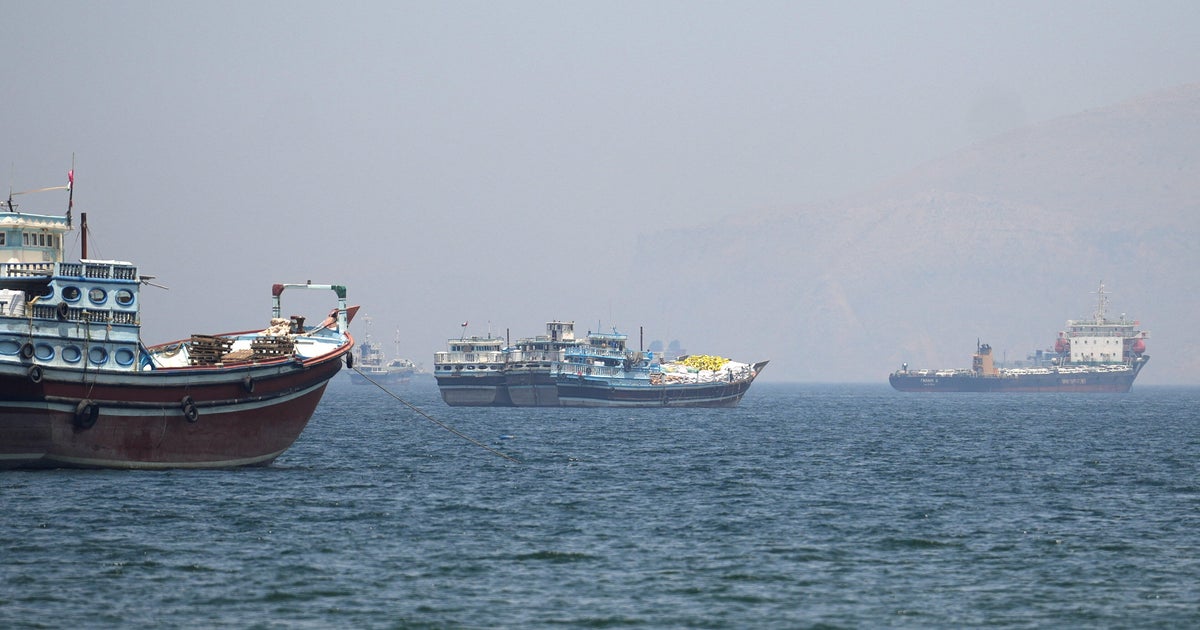
Already, Iranian forces have seized two commercial ships that it accused of violating its restrictions on the Strait of Hormuz.
Stringer/REUTERS
Boroujerdi dismissed threats issued by President Trump as “endless” and “empty,” and said they would only result in “further damage to America’s reputation and a demonstration of Iran’s strength.”
“We still hold the upper hand,” the parliamentarian said.
Iranian lawmaker vows Tehran “will never relinquish its control over the Strait of Hormuz”
Alaaeddin Boroujerdi, Deputy Head of the National Security Committee in the Iranian Parliament, said Wednesday that Iran “will never relinquish its control over the Strait of Hormuz.”
In remarks broadcast by Iranian state media, Boroujerdi claimed Iran still had sufficient missile stockpiles to sustain several years of war, adding that the U.S. and other Western countries had “come to believe in the capabilities of the Islamic Republic.”
He said Parliament Speaker Mohammad Bagher Ghalibaf was managing negotiations with the U.S., which have been carried out only indirectly, via Pakistani mediators, since a first round of unsuccessful direct talks in early April.
Since then Iran has maintained an effective blockade of the Strait of Hormuz, a vital shipping lane for global energy supplies, only permitting a select few vessels to transit the waterway with coordination — and reportedly for large fees. The U.S., in response, has imposed a military blockade of all Iranian ports and vessels linked to the country.
Boroujerdi dismissed those U.S. actions as ineffective, calling the blockade “a passive and worthless move” and claiming the U.S. would “not dare act” against some vessels “because they belong to other countries, such as China and others that the United States does not dare confront.”
The Pentagon said that, as of Tuesday, it had forced 39 vessels attempting to enter or depart from Iranian ports to turn around since the blockade began.
Trump warns Iran to “get smart soon,” with AI image of himself holding a rifle
President Trump warned Iran to “get smart soon,” posting a brief message on his Truth Social platform early Tuesday morning, along with an AI-generated image of himself holding a rifle in front of explosions, with the caption: “NO MORE MR. NICE GUY!”
“Iran can’t get their act together. They don’t know how to sign a nonnuclear deal. They better get smart soon!” the president said.
Mr. Trump has voiced optimism that the ongoing U.S. military blockade of Iranian ports and vessels will bring sufficient economic pressure on the Islamic Republic to force it to agree to a deal. He has abandoned previous deadlines for Tehran to agree to a deal, however, and most recently extended an ongoing ceasefire indefinitely, saying it was to give the regime time to present a coherent peace offer.
A proposal tabled by Iran earlier this week, which sources told CBS News would have involved a mutual dropping of restrictions on shipping via the Strait of Hormuz, was tacitly rejected by the Trump administration, probably because it would have delayed negotiations on Iran’s nuclear program.
Mr. Trump has not issued a new deadline for Iran to make a deal, but the administration has left the threat of renewed attacks on the table amid one of the most significant U.S. military deployments to the Middle East in decades.
Hegseth to be grilled by Congress for first time since Iran war began
Defense Secretary Pete Hegseth will face questioning from lawmakers Wednesday for the first time since the Trump administration launched the war against Iran, which Democrats have contested as a costly conflict of choice waged without congressional approval.
The hearing before the House Armed Services Committee is being held to discuss the administration’s 2027 military budget proposal, which would boost defense spending to a historic $1.5 trillion. Hegseth and the chairman of the Joint Chiefs of Staff, Gen. Dan Caine, are expected to stress the need for more drones, missile defense systems and warships.
Democrats are likely to pivot to the ballooning costs of the Iran war, huge drawdown of critical U.S. munitions and bombing of a school that killed children. Some lawmakers also may question how prepared the military was to shoot down swarms of Iranian drones, some of which penetrated U.S. defenses and killed or injured American troops.
Trump says King Charles agrees Iran shouldn’t have nuclear weapon
At the start of Tuesday’s White House state dinner, President Trump said King Charles agrees with the U.S.’ position that Iran shouldn’t have a nuclear weapon.
“Charles agrees with me even more than I do. We’re never gonna let that opponent have a nuclear weapon. They know that, and they’ve known it right now very powerfully,” Mr. Trump said after alluding to the conflict in the Middle East, without mentioning Iran by name.
The king and Queen Camilla are in the U.S. to mark the 250th anniversary of the signing of the Declaration of Independence.
At the dinner, Mr. Trump also lauded the nation’s relationship with the U.K., saying the two countries share a “nobility of spirit and heroic soul.”
Rising oil prices pull Wall Street off record highs
Stocks mostly advanced in Asia on Wednesday despite losses on Wall Street during the previous day’s trading. Oil prices gained on uncertainties over when the war in Iran will end and after the United Arab Emirates said it would leave OPEC in a blow to the powerful oil cartel.
U.S. futures edged higher Wednesday.
In Asia, South Korea’s Kospi rose 0.8% to 6,690.90 and the Hang Seng in Hong Kong gained 1.5% to 26,050.90. The Shanghai Composite index traded 0.7% higher at 4,107.51. Australia’s S&P/ASX 200 slipped 0.3%, to 8,687.00.
Taiwan’s Taiex lost 0.6%, and India’s Sensex gained 1.4%.
The price of a barrel of Brent crude oil to be delivered in June rose 1.1% to $112.47 early Wednesday. Brent to be delivered in July was also up 1.1% to $105.50. Brent oil was around $70 per barrel before the war began in late February.
Benchmark U.S. crude gained 1% to $100.94 a barrel.
U.K. ambassador says the “one country” with a “special relationship” with U.S. is “probably Israel”
Britain’s Ambassador to the U.S., Sir Christian Turner, said in February, before the U.S. and Israel launched their joint war with Iran, that to him it seemed the “only country” with a “special relationship” with the U.S. was “probably Israel.”
Turner made the remarks to a group of British high-school age students visiting the U.S. A recording of the comments was obtained by the Financial Times and reported by the newspaper on Tuesday.
Turner said he didn’t like the term “special relationship,” coined by Prime Minister Winston Churchill in the wake of World War II, to describe the U.S.-U.K. bond, calling it “quite nostalgic” and “backwards-looking,” according to the FT.
“I think there is probably one country that has a special relationship with the United States,” he said, “and that is probably Israel.”
CBS News has not reviewed the audio of his remarks, but the British government has not denied their authenticity.