Gil Corral knows what it’s like to live in a militarized region patrolled by immigration agents. The artist was born and raised in El Paso, Texas, a bustling, desert metropolis on the U.S.-Mexico border with deep-rooted Latino culture.
Mr. Corral’s home for the past 20 years in Biddeford, a slow-paced city along Maine’s southern coast, is a departure – and more than 2,500 miles – from the border.
“You stick out, being Latino,” he says of the town that is more than 90% white. “But I’ve always felt welcomed.”
Why We Wrote This
The killing of a Colombian man by an Immigration and Customs Enforcement officer in Biddeford, Maine, has made other immigrants and Latinos feel less secure. Some immigrants say they’re considering leaving the U.S.
That feeling shifted in the wake of last week’s fatal shooting of Johan Sebastián Durán Guerrero, a Colombian immigrant, by an Immigration and Customs Enforcement agent. Mr. Durán, according to the Maine Immigrants’ Rights Coalition, was legally authorized to work in the country.
Some Latinos and immigrants are now reckoning with what it means to be part of a community that has suddenly found itself at the epicenter of the national immigration debate.
Why Biddeford?
Tensions grew this year when masked federal agents caravanned into Maine in January to launch Operation Catch of the Day, an immigration enforcement campaign that led to regular ICE operations in Biddeford.
A little more than 3% of Biddeford’s estimated 22,000 residents are Hispanic, according to the last census. About 3.5% of residents are foreign-born, which is below the 14.8% national average.
That’s why Mr. Corral and others question why immigration enforcement has escalated in town.
“Who is the target? What are ICE agents looking for?” Mr. Corral asked. “Are they just looking at the color of our skin? That’s where the fear comes from.”
Mr. Corral’s neighbors and friends started asking him new questions.
“Hey, are you all right?”
“Do you need anything?”
“How are you?”
Mr. Corral, a Mexican American who has a brown complexion, says he knows the comments came from a place of love and concern. Still, it worried him.
“Whoa, what’s going on?” he says he asked himself. “I was born in this country.”
Mr. Corral explained that his family’s ancestry in El Paso predates the 1848 Treaty of Guadalupe Hidalgo that ended the Mexican-American War and resulted in Mexico ceding more than half its territory to the United States.
“The border crossed us,” he says. “I love this country. That’s why I’m so freaked out. My grandfather died fighting for this country in World War II.”
Still, he felt anxious enough to start carrying around his passport with him during trips out of town.
The shooting
The Department of Homeland Security says that, on July 13, ICE agents were watching a building in Biddeford where they believed someone with a removal order was living. They attempted to stop a white car that left the building, but said the person in the vehicle attempted to flee. “Fearing for public safety,” an agent fired, according to a statement, killing Mr. Durán, who was not the person agents were looking for.
DHS officials have made similar claims after a string of fatal shootings this year. In each killing, witnesses and video evidence have shown a more nuanced picture, at times contradicting official claims.
Mr. Durán’s death followed the ICE killing of Lorenzo Salgado Araujo, a Mexican man in Houston, a week earlier.
The average number of daily immigrant arrests hit record levels for this administration in June at more than 1,300, and has surpassed that in the first couple of weeks of July, according to ICE data released Monday.
Jasmin Alvarez says Mr. Durán, who worked as a DoorDash driver, regularly picked up orders from the restaurant she manages.
Ms. Alvarez, who was born in the U.S. and is of Salvadoran descent, says he was a friendly young man. In the depths of winter, when it snowed heavily, he was often the only driver still picking up orders and making deliveries, she noted.
“Why would they go after someone like that?” she asked. “They’re not just taking people now. They are killing them.”
Ms. Alvarez was one of those in the community who started carrying her passport after this past winter’s ICE operations. For those without a U.S. passport, the killing is leading them to reevaluate their plans.
Edgar Basurto, from Guerrero state in Mexico, says he’s likely to shorten his stay in the U.S. after what happened to Mr. Durán. Mr. Basurto, a line cook at a restaurant in nearby Saco, Maine, for the last three years, says he didn’t know Mr. Durán, but that they were about the same age.
“I prefer to leave on my own accord than wait for them to kill me and return to my country in a coffin,” he says.
For now, Mr. Basurto, who is in the country without legal status, says he just travels between work and home, limiting trips elsewhere.
Pressuring immigrants to leave the U.S. voluntarily has been one of the Trump administration’s stated objectives. The government has offered cash incentives to those willing to leave and pressures others to give up legal efforts by holding them in detention.
Marcos Lopes, a busser at a local restaurant, says he’s considering leaving, too.
Mr. Lopes, also in the country without legal status, says it is complicated living in a place like Biddeford. Mr. Lopes, originally from Chiapas in southern Mexico, says he has lived in places such as New Jersey and New York City before ending up in Biddeford.
Mr. Lopes likes small cities, like Biddeford.
“It’s more tranquil. There is less crime,” he says. “I feel safer.”
The drawback, he says, is that he can’t blend in as well in Biddeford as he does in bigger cities with more prominent Latino populations.
“Here, there are so few of us. So, we are more easy to spot, and maybe, take away and kill,” he says.
A community shaken
Though Biddeford’s foreign-born population currently falls below the national average, the city has been shaped by more than a century of immigration, transforming the 17th-century English settlement into a booming 19th-century industrial city. Waves of immigrants from French Canada, Ireland and Albania arrived in Biddeford to work in lumber mills and massive red-brick textile factories – now with new occupants – that line the Saco River, defining the town’s landscape.
Outside the industrial center, the city is defined by quiet coastal communities, craggy coastlines, tide pools and stretches of sandy beaches bordered by oceanfront homes.
The shooting took place just a few blocks from downtown in a verdant neighborhood lined with churches, shops, multifamily symmetrical homes and wooden three-story apartment buildings.
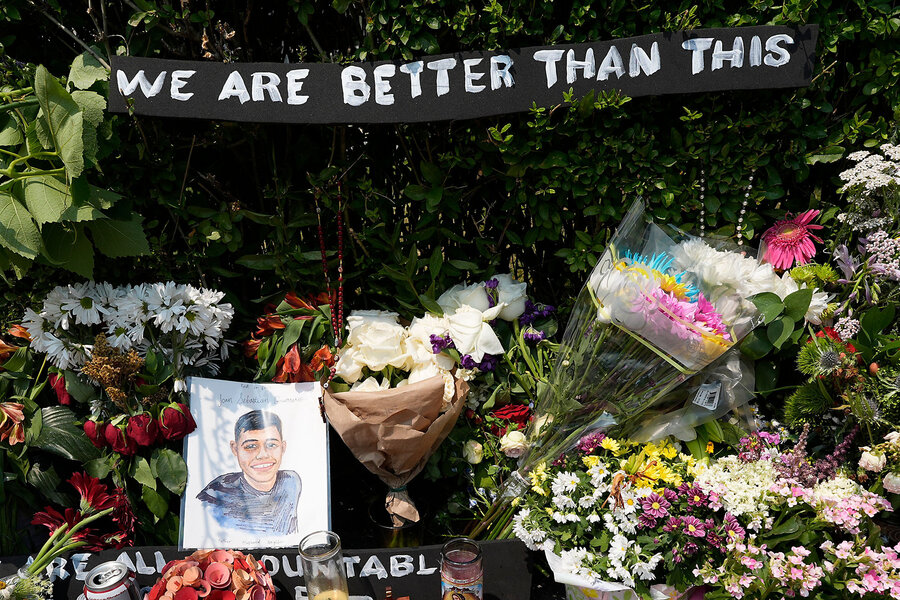
The killing has left some in Biddeford grieving. A few days after Mr. Durán’s death, a couple of locals created a chain of flowers and candles encircling the area where his body was last.
Balloons, a Colombian soccer jersey, dozens of flowers and handwritten notes – some with expletives; others, crayon drawings from children – decorated the makeshift memorial at the intersection of Hill and Pool streets.
Drivers honked in support of a man holding up a sign with a photo of Anne Frank next to a photo of Mr. Durán.
Nelson Elias Marcos, a legal resident who co-owns a restaurant in nearby Sanford, says he heard a commotion outside the morning of the shooting and arrived to see Mr. Durán’s body in the street.
When he noticed more agents had swarmed the area and were now looking at him, he says he ran inside and locked the door.
He and his partner, Karen Monzon, were neighbors of Mr. Durán.
Ms. Monzon, a Nicaraguan immigrant, says she’s past the stage of grieving and being scared.
“I’m angry,” Ms. Monzon says. “He had his papers to work. He had a Social Security card. He had a driver’s license. What was the problem?”
Ms. Monzon, who says she has legal authorization to work in the U.S., moved to Biddeford because the community is normally peaceful.
“But now? Shooting people in the streets?” she asks, adding, “This is the stuff you see in big cities. Not here. You don’t normally see those types of problems here. This is the kind of place where the town police officers are also calm.”
Mr. Marcos, a Guatemalan immigrant who has lived in town for nine years, says his two older brothers were taken during the winter ICE operation. They were in the country without legal status and, he says, endured three months in immigration detention before they were removed from the country.
The brothers told Mr. Marcos there were people with legal status in detention with them.
“They’ve even taken U.S. citizens. The agents don’t care,” Mr. Marcos says. “They don’t respect life.”
After his brothers heard about what happened to Mr. Durán, they called Mr. Marcos and urged him to leave Biddeford.
“You need to grab your belongings and just come back home,” one of them told Mr. Marcos recently.
He’s considering it.