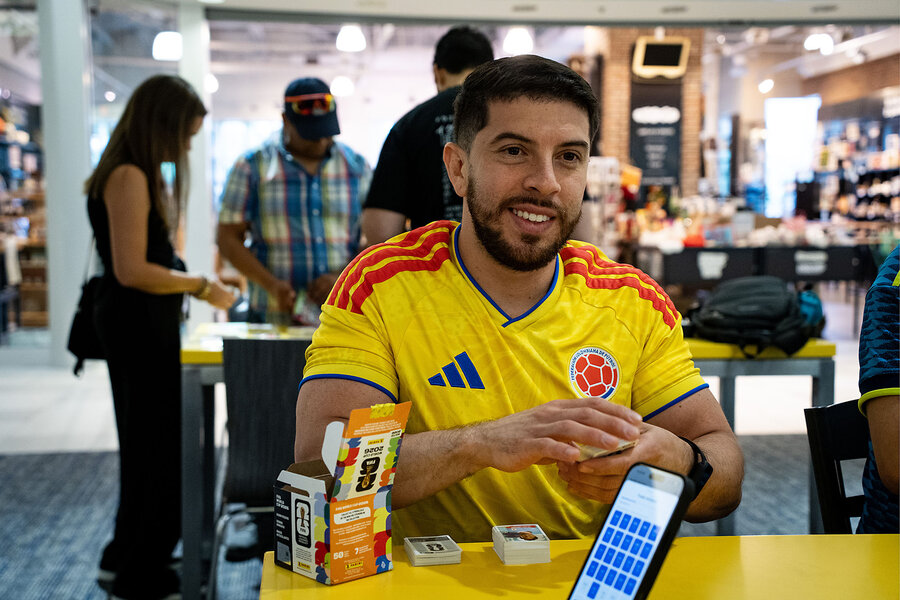
Alex Vargas is moving with the dexterity of a Las Vegas dealer, talking quickly, as he distributes glossy cards on a table. But it’s not the jack of hearts or ace of spades he is laying down. It’s Gilberto Mora of Mexico and Bukayo Saka of England.
A small circle of adults crowds in around him, concentrating intensely, checking names scribbled haphazardly on notepads or typed on propped-up phones, before they make a trade. Rhythmically, they peel the backing of each square and fix it inside their Panini FIFA World Cup sticker book.
The exchanges unfolding are part of a FIFA World Cup tradition that has connected soccer fans for decades and has expanded with this year’s wider pool of participating teams. Each vibrant sticker, strewn across Mr. Vargas’ tables and others around him, depicts a headshot of a World Cup soccer player.
Why We Wrote This
Some World Cup fans are building community by meeting up for gatherings where they trade stickers of tournament players, symbols, teams, and stadiums.
This ritual is familiar to Mr. Vargas. Growing up in Colombia, he watched his father collect and trade soccer stickers. By the time he was a preschooler, he could identify every national soccer team by its crest alone. Today, he’s completed every sticker album since the 1998 World Cup and shares the hobby with his colleagues and, soon, his young son.
“It just brings the community together, and that’s what it’s all about, right?” Mr. Vargas says. “It’s about people.”
Mr. Vargas is just one of the legions of soccer fans who meet outside stadiums and in malls, restaurants, and other public venues to swap stickers. The shared goal of completing each year’s World Cup album brings these soccer fanatics together. But the trading events have become more than an exchange of stickers. People of all ages, backgrounds, and nationalities gather together to share their love for the sport. As the World Cup progresses, records are made, and underdogs emerge, the hunt for hard-to-find stickers heats up.
“It’s way bigger now this year than it ever has been before,” says Jeff Morris, an avid sports card collector and writer for Sports Collectors Daily. “The fact that there’s 48 teams now instead of 32 … you’ve got close to a thousand stickers.”
Each pack of seven stickers costs $2 and includes a random selection of players, symbols, teams, and stadiums. Rare variations of cards, such as differently colored borders or sought-after “one-of-ones” (meaning there is only one like it) have also raised the thrill of collecting.
“It’s a global market. They’re buying them in South Africa; they’re buying them in Australia and New Zealand. Everyone is so excited about it. It’s much bigger than the last World Cup,” says Mr. Morris.
Collecting stickers enhances the World Cup experience by helping fans become more familiar with players and national teams, Mr. Morris says. He believes stickers give fans a way to celebrate both established stars and unexpected breakout stories. Increased interest in soccer players worldwide has also driven the hobby’s popularity in recent years, he says.
“People want [goalkeepers] Eloy Room [for Curaçao] and Vozinha [Josimar José Évora Dias for Cape Verde], and some of the players who have emerged as stars, when earlier in June, no one on a global scale knew who they were,” says Mr. Morris.
A tradition decades in the making
Sticker trading began more than 50 years ago with two young Italian brothers, Benito Panini and Giuseppe Panini. In 1960, the brothers bought an unsold collection of adhesive soccer player prints from a company in Milan and sold them at their family newsstand in Modena, Italy. A year later, they launched the Panini Group and created stickers of Italian players for soccer fans across the country. By the 1970 FIFA World Cup, the brothers released their first global collection of World Cup stickers.
Today, Panini has become a global leader in collectible stickers and trading cards. They are readily available on Amazon and at major national retailers, such as Walgreens and Ace Hardware.

Medara Udoekong/The Christian Science Monitor
Jason Howarth, senior vice president of marketing and athlete relations at Panini America, says the sticker business is still growing. As reported by The Athletic, Panini estimates that its 2026 net sales from FIFA-licensed products will be $1.48 billion, double the sales of $720 million for the last World Cup in 2022.
As sticker sales continue to grow, Panini has developed new ways to expand the hobby’s reach. During this year’s World Cup, four mobile Panini tour vehicles are traveling the United States and hosting swapping events. A collaboration with Coca-Cola features special-edition stickers randomly hidden behind bottle labels. A Panini Collectors app allows fans to digitally organize album checklists and share albums with friends.
A common language
But for hobbyists who collect simply for the fun of it, Instagram and Facebook groups with tens of thousands of members let fans collect stickers at little or no cost. Within these groups, trading is typically based on “have” and “need” lists, with stickers exchanged at roughly equal value; rarer stickers may be traded for multiple common ones or another high-quality sticker. The system is governed by ad hoc agreements among collectors.
Fans who grew up collecting stickers across Latin America or Europe and later moved to the U.S. are introducing the hobby to new enthusiasts. In 1994, the last time the U.S. hosted the World Cup, 2% of American sports fans said soccer was their favorite sport, according to Gallup. Today, 27% of U.S. adults are fans of professional soccer.
At the sticker swap in Cambridge, Leticia Zampier, who grew up in Brazil, says sticker collecting felt like “a party” when she was a child. Today, she still finds joy in attending sticker trading events and connecting with people from around the globe.
Mr. Vargas still remembers when trading partners were hard to find in the U.S., but that’s not the case this year.
“Every time the World Cup comes around, as you can see, this is what it does – brings people together,” says Mr. Vargas, looking around the room at the mall lobby as people swap and talk about soccer, hoping to complete their albums.
“Someday, my kids will see me doing this, and they’ll all want to do it. And they’ll carry on the tradition,” Mr. Vargas says.