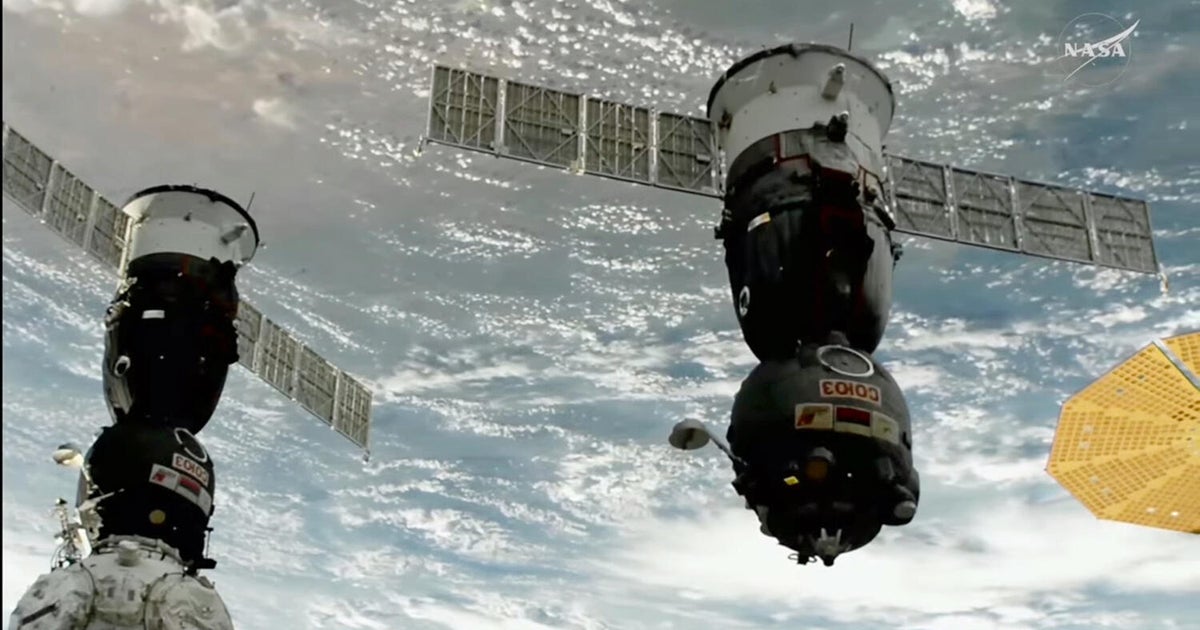
Two Russian cosmonauts and a NASA astronaut closed out a 241-day stay aboard the International Space Station early Sunday with a fiery plunge back to Earth and an on-target touchdown on the broad steppe of Kazakhstan.
Strapped into the Soyuz MS-28/74S ferry ship, commander Sergey Kud-Sverchkov, flight engineer Sergey Mikaev and NASA’s Chris Williams undocked from the station’s Russian Rassvet module at 3:03 a.m. EDT and slowly backed away from the lab complex.
NASA/Roscosmos
Two-and-a-half hours later, now a safe distance away and properly lined up for re-entry, the Soyuz’s braking rockets fired for four minutes and 42 seconds, dropping the craft out of orbit on a southwest-to-northeast trajectory toward Kazakhstan.
After rapidly decelerating in a blaze of atmospheric friction, the Soyuz crew module’s main parachute unfurled and inflated for a 10-minute descent to a jarring rocket-assisted touchdown at 6:27 a.m. EDT (3:27 p.m. local time) near the town of Dzhezkazgan.
Mission duration: 241 days over 3,856 orbits covering 102 million miles since launch last Nov. 27.
Russian recovery crews stationed nearby quickly raced to the crew module to help the returning fliers out of the cramped capsule as they began re-adjusting to gravity after eight months in weightlessness.
As with virtually all Soyuz landings, Kud-Sverchkov, Mikaev and Williams were carried to nearby recliners for initial medical checks, a bit of fresh fruit and satellite phone calls home to family and friends.
“I am feeling better and better with each moment,” Kud-Sverchkov said from his recliner. “I would like to thank everyone who supported this landing. Everything was smooth and perfect. Everything was just excellent.”
NASA/Roscosmos 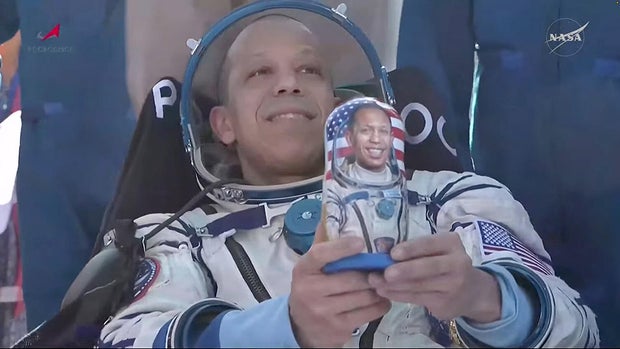
All three crew members were given personalized Russian matryoshka dolls as welcome home gifts.
“There is vodka inside,” someone said through a translator. “Well, actually, this is why I flew to space in the first place,” one of the crew members joked.
After doffing their bulky pressure suits, the trio was to be flown by helicopter to the town of Karaganda some 285 miles away. From there, Williams faced a long flight back to the Johnson Space Center in Houston aboard a NASA jet while his crewmates headed home to Star City near Moscow.
With landing Sunday, Williams and flight engineer Mikaev completed their first space flight while Kud-Sverchkov, a seasoned veteran who logged 185 days aboard the space station in 2020-2021, wrapped up his second.
Over the course of the flight, Williams participated in two spacewalks: one to replace a joint in the lab’s robot arm and another to prepare for installing new roll-out solar blankets. Kud-Sverchkov and Mikaev also staged a maintenance spacewalk outside the Russian segment of the station.
Williams said he could not have asked for better crewmates.
“It’s a really great crew,” he said in a NASA interview before launch. “Sergey and Sergey are both just absolutely wonderful people, really kind, super interested, super intellectually curious, which is really fun. Had a lot of really, really great discussions, just talking and talking about things.”
NASA 
Left behind aboard the station were NASA Crew 12 commander Jessica Meir, Jack Hathaway, European Space Agency astronaut Sophie Adenot and cosmonaut Andrey Fedyaev. Meir took over command of the station from Kud-Sverchkov during a brief ceremony Saturday.
Also on board were Soyuz MS-29/75S commander Pyotr Dubrov, cosmonaut Anna Kikina and NASA astronaut Anil Menon, launched to the station from the Baikonur Cosmodrome in Kazakhstan on July 14 to replace Williams and his crewmates.
The Crew 12 fliers, launched last Feb. 13, will be replaced by a fresh NASA-sponsored crew launching from Florida on Sept. 12.
Williams is a former volunteer firefighter and emergency medical technician who went on to earn a Ph.D. in astrophysics from MIT. He was serving as a board-certified medical physicist at Harvard Medical School when he was selected to join NASA’s astronaut corps in 2021.
And that was the answer to a lifelong dream.
“As far back as I can remember, so when I was a little kid, I was always fascinated by exploration and, in particular, space,” he told an interviewer while aboard the station.
“I think it’s one of those things that a lot of kids have fascinations with, and I just never grew out of (it). It’s something that’s always been a big point of curiosity for me. … I never never let go of that dream throughout my life.”
NASA 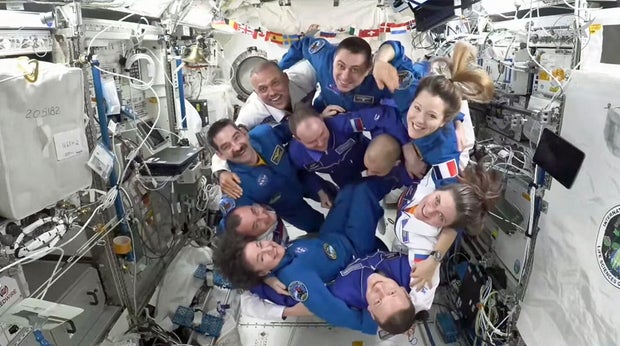
In another interview aboard the lab, he said the experience more than lived up to his expectations.
“I think being up here on the space station, one of the things that I’ve really appreciated is just looking out the window at the Earth, how much I appreciate it that I maybe didn’t appreciate otherwise,” he said.
“I think anybody that comes up here kind of turns into a little bit of a budding geologist when you see the amazing patterns of how things develop on Earth.”
Likewise, if he ever makes it to the moon, “I think that one of the things I’d be really excited to do is to just take some time and look around. … I think that’s something that sort of the human eye and the human brain, situated on the moon, can be really a unique sort of tool.
“And so I’d love to spend any free time I have sort of looking and drinking it all in.”