
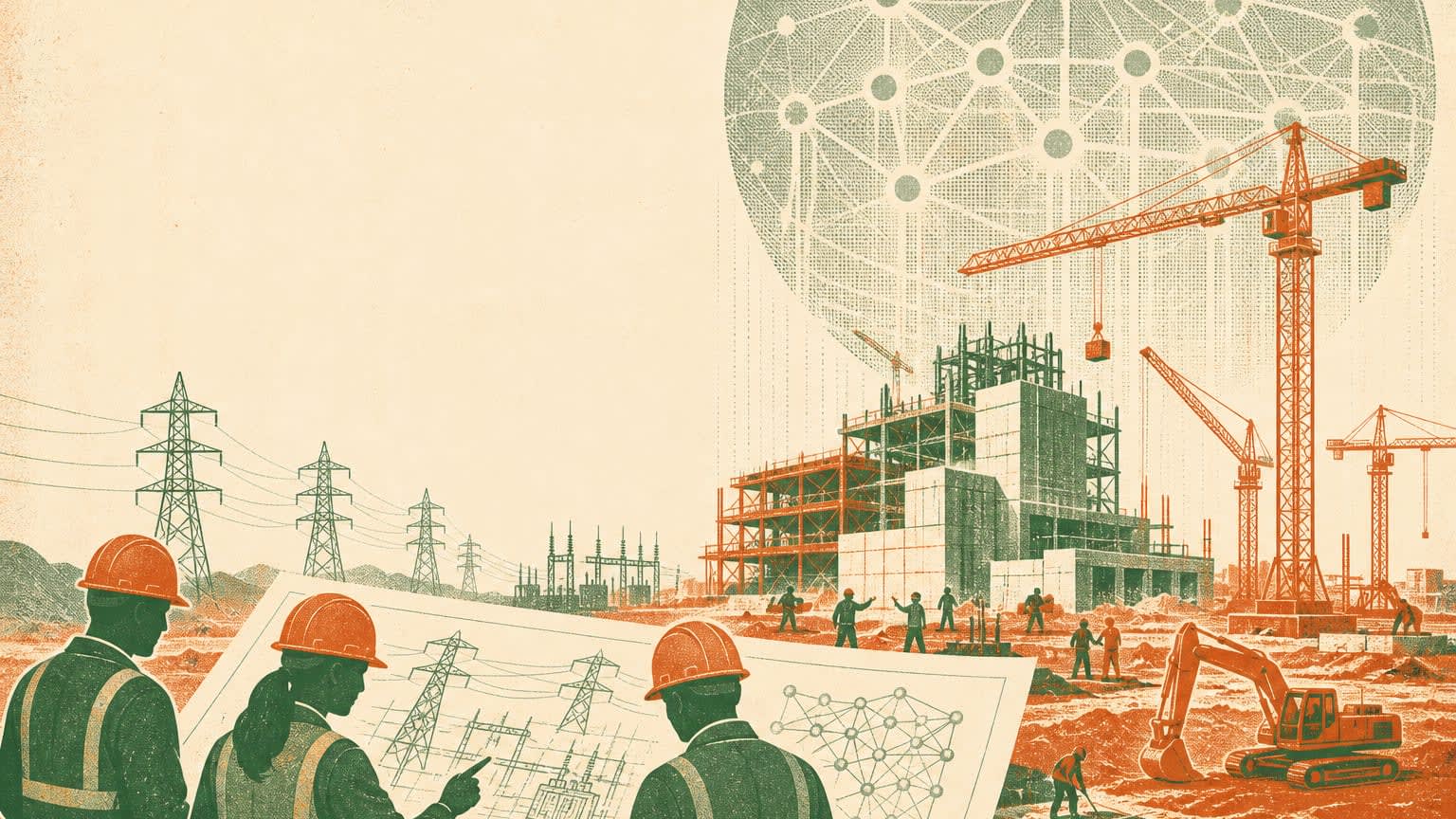
Nvidia is investing $3 billion in Lancium to address AI’s increasing demands on power infrastructure. This move, along with AWS’s focus on CPU efficiency and Jeff Dean’s departure from Google, is indicative of the growing pressures on AI infrastructure. These shifts are reshaping how enterprises approach their procurement strategies in the technology sector.
Nvidia has agreed to invest $2 billion in Lancium, the power infrastructure developer backing the OpenAI and Oracle AI campus in Texas, with a commitment to deploy an additional $1 billion as Lancium secures more planned power capacity, according to reporting by The Information. The deal values Lancium and its portfolio of land and grid connections at approximately $10 billion in enterprise value, inclusive of debt, and gives Nvidia a roughly 20% stake in the company.
The move is a direct response to the single constraint that now governs AI infrastructure buildout more than any other: access to power. Blackstone, which already backs Lancium, has been central to the Stargate project, the sprawling AI data center initiative that has drawn in OpenAI, Oracle, and SoftBank. Nvidia’s decision to invest upstream, at the level of land acquisition and grid interconnection, rather than simply supplying GPUs, marks a material shift in how the company is positioning itself along the AI supply chain.
Power is now a procurement problem, not just an infrastructure one
For enterprise procurement and operations leaders, Nvidia‘s Lancium investment carries a signal that goes beyond one deal. When the world’s dominant GPU supplier starts writing nine-figure checks to secure electricity capacity, it confirms that compute availability is no longer just a function of silicon supply. It is a function of megawatts, transmission lines, and land. Organizations planning large-scale AI deployments in 2026 and beyond are increasingly competing in a market shaped by energy scarcity, not just chip lead times.
When the world’s dominant GPU supplier starts writing nine-figure checks to secure electricity, compute availability is no longer a silicon problem. It is a power problem.
That pressure is surfacing inside the hyperscalers as well. According to The Information, AWS has directed its engineers to cut CPU waste amid a broader compute crunch. The internal directive suggests that even at the scale of a hyperscaler, capacity headroom is tighter than it has been, and that efficiency is being enforced from the top down rather than left to individual teams. Enterprise cloud customers who have grown accustomed to elastic capacity on demand should treat this as an early indicator of potential tightening.
The practical implication for IT operations and cloud procurement teams is straightforward: workload rightsizing and utilization monitoring are no longer just cost-management exercises. They are contingency planning. Teams that have not audited compute utilization in the past six months are likely leaving themselves exposed to both waste and availability risk simultaneously.
Google’s talent drain puts frontier AI research in play
Concurrent with the infrastructure story, a talent shift is reordering where frontier AI research is being done. Jeff Dean, who served as Alphabet’s Chief Scientist and is one of the most cited figures in modern machine learning, has co-founded a new startup called Discovery Loop alongside other longtime Google researchers, according to The Information. The company, backed by Radical Ventures partner Rob Toews, is focused on applying AI to accelerate scientific discovery.
Toews described the rationale publicly: the team believes AI is approaching a capability threshold where it can meaningfully compress the timelines of scientific research, and that an independent, focused organization is better positioned to pursue that mission than a large incumbent with competing priorities. Whether or not that thesis proves out, the composition of the founding team matters operationally. Deep research expertise in AI modeling has historically concentrated inside a handful of large technology companies. Its movement into independent ventures increases the probability that specialized AI capabilities will become available via APIs, partnerships, or enterprise licensing from sources outside the traditional hyperscaler ecosystem.
What this signals for AI infrastructure strategy in 2026
Taken together, these three developments describe a single underlying dynamic. AI at enterprise scale has moved beyond the phase where compute was the primary bottleneck. The constraints now are energy, physical infrastructure, and specialized research talent, and the organizations structuring deals around those constraints today are positioning to control the economics of AI deployment for the next several years. Nvidia’s Lancium investment is the clearest expression of that logic at the infrastructure layer.
For enterprise operators, the near-term decisions are more concrete. Cloud budget holders should re-examine consumption patterns in light of AWS’s internal efficiency push. Infrastructure and real estate teams evaluating private AI deployments should model power costs and availability alongside hardware and licensing. And technology strategy teams tracking where advanced AI capabilities are emerging should widen their vendor and partner scanning beyond the established hyperscalers, as research talent and early-stage companies proliferate outside the big tech perimeter.
The next visible marker to watch: whether Nvidia’s additional $1 billion commitment to Lancium closes as the developer secures incremental power capacity. That figure will serve as a real-time indicator of how fast grid-connected AI land is being absorbed across the Stargate project and beyond.
What this means for your team
- Audit cloud compute utilization now. AWS’s internal CPU-waste directive is an early signal; enterprise teams with unoptimized workloads face both cost exposure and potential availability constraints if hyperscaler capacity tightens externally.
- Factor power costs into any private AI infrastructure evaluation. Nvidia’s $3 billion bet on a power developer confirms that energy access, not just hardware, is the binding constraint on large-scale AI deployment. Include utility capacity and grid interconnection timelines in site selection and capex planning.
- Broaden your AI vendor and research partner map. With senior AI researchers leaving major incumbents for focused startups, specialized capabilities are increasingly emerging outside traditional hyperscaler channels. Procurement and technology teams should actively track and pre-qualify emerging providers.
- Model your Stargate and large-campus dependencies. If your organization has committed to or is evaluating AI infrastructure tied to the Stargate project, Nvidia’s equity position in Lancium changes the counterparty landscape. Understand who now controls the underlying power and land assets.












Leave a Reply