
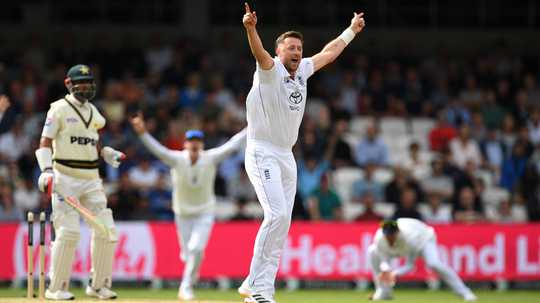
Matt Henry had his moments. Nathan Smith had his. Mohammad Abbas, in his own unhurried way, made batters question their shot selection. But the summer ultimately belonged to Ollie Robinson, who arrived on a comeback trial and ended up defining the conditions better than anyone else.
Medium menace
The numbers explain why. Robinson has averaged a scarcely believable 7.96 in the 2026 English summer. Henry is next at 13.33, followed by Abbas at 20.80. Josh Tongue and Jofra Archer, despite enjoying fruitful seasons, but operating at opposite ends of the pace spectrum, have not quite matched that efficiency.
The more revealing comparison is between medium and high pace. Balls below 80mph have taken 40 wickets at 17.92, striking every 33.4 balls and conceding just 3.21 an over. Those above 80mph have taken three times as many wickets, but at a slightly higher average of 23.38. Only once in the ball-tracking era has this group produced a better average: 26 wickets at 17.42 in 2019, 13 of which were taken by Irish bowlers in the three-day shootout at Lord’s.
Best average for balls under 80 mph in an English season
| Season | Mat | Wkts | Avg | SR |
|---|---|---|---|---|
| 2019 | 6 | 26 | 17.42 | 31.6 |
| 2026 | 6 | 40 | 17.92 | 33.4 |
| 2018 | 7 | 19 | 23.84 | 51.6 |
| 2016 | 7 | 28 | 28.25 | 56.3 |
| 2022 | 7 | 27 | 28.37 | 49.8 |
| 2010 | 8 | 27 | 28.51 | 50.0 |
| 2021 | 7 | 26 | 28.88 | 65.8 |
Seamers have been unusually efficient at taking them with the conditions doing their bit this summer. In the ball-tracking era, stretching back to 2006, only one English summer has produced a lower expected average for seamers than 2026. According to CricViz, the expected average this summer is 23.6; the actual figure, 22.14, is even better. This has not been an environment in which bowlers have had to manufacture wickets against the grain. The combination of movement, length and uncertainty has repeatedly tilted the contest towards the ball, with wobble seam being the flavour of the season.
And that has altered the nature of the dismissals. The stumps, rather than the cordon, have become the primary target. In the traditional English template, the outside edge and the catch behind square are familiar currency. But this summer, bowled and LBW dismissals accounted for 45.6% of all wickets – the seond-highest proportion in an England summer in post-War since 1945.
Highest proportion of bowled & LBW dismissals in England

Since 2006, only one English summer has produced a lower expected average for seamers than 2026 ©Cricbuzz
That is where the medium pacers have found their opening. With wicketkeepers frequently standing up, they have been able to attack the stumps with movement rather than simply search for the outside edge. The objective has been about making batters defend their stumps against a ball that refuses to behave predictably.
Robinson has been the most striking beneficiary of that shift. He has taken 26 wickets in only four Tests with another innings to go, at 7.96, and won the Player-of-the-Match award in each of his first three appearances. The last England player to collect three such awards in three consecutive appearances on English soil was Ian Botham in 1981 – a summer that is now synonymous with him.
Alongside his wickets tally, the number of false shots he has induced has been remarkable. Robinson has made batters get it wrong more often than any bowler in an English season for which this data is available. His false-shot rate stands at 39.7% – twice every five deliveries producing a false response. It is comfortably ahead of Abbas in 2026, who is second on the list this season at 32% (minimum 60 overs).
Highest false shot % induced by a bowler in an English season
| Player | Season | Mat | Balls | Wkts | Avg | SR | FS % |
|---|---|---|---|---|---|---|---|
| OE Robinson | 2026 | 4 | 545 | 26 | 7.96 | 20.9 | 39.7 |
| Muhammad Abbas | 2026 | 2 | 402 | 10 | 20.80 | 40.2 | 32.0 |
| KS Rabada | 2022 | 3 | 444 | 14 | 23.35 | 31.7 | 31.3 |
| MA Wood | 2024 | 3 | 458 | 11 | 22.45 | 41.6 | 29.6 |
| JC Archer | 2026 | 5 | 777 | 22 | 20.50 | 35.3 | 29.0 |
Comeback, refined
That is particularly significant given where Robinson was two years ago.
Despite outstanding numbers during his first 20 Tests, he disappeared from England’s plans early 2024 for 24 months as Brendon McCullum’s regime pursued greater pace in its attempt to conquer Australia. In 24 Tests, Robinson has taken 102 wickets at 19.10 – with a possible innings in hand; to bring in perspective Jasprit Bumrah had 101 at 22.79 at the same point in his career. Robinson’s strike rate of 42.5 is also markedly better than Bumrah’s 51.4 with six Player of the Match awards to his name compared to Bumrah’s one.
His six Player-of-the-Match awards in those 23 Tests underline the impact. Since his debut in 2021, only Travis Head has won more, with 10 in 48 Tests. Robinson’s six have come in just 23 – an extraordinary 26.1% of his matches – the highest share for anyone.
Most POTM awards since Robinson’s debut
| Player | POTM | Mat | % mat |
|---|---|---|---|
| TM Head | 10 | 48 | 20.8% |
| OE Robinson | 6 | 23 | 26.1% |
| HC Brook | 5 | 40 | 12.5% |
| RA Jadeja | 5 | 39 | 12.8% |
| NGRP Jayasuriya | 5 | 24 | 20.8% |
And yet the most interesting part of his comeback is not what has stayed the same. It is what has changed.
Less reliant on swing and more trusting of seam.
Compared to his debut summer of 2021, his average swing has almost halved – from 1.06 to 0.55 degrees – while his average seam movement has increased from 0.72 to 0.85 degrees. Accordingly, the proportion of his deliveries in the good-length zone has risen from 61.2% to 69.5%.
That is the essence of the new Robinson. Rather than trying to beat batters primarily through movement in the air, he is arriving at the crease, hitting the 6-8 metre zone and allowing wobble seam to make the ball’s behaviour uncertain after pitching.

Compared to his debut summer, Robinson’s average swing has almost halved ©Cricbuzz
Angle changed. Outcome changed.
The change has been especially devastating against left-handers. Robinson’s average against left-handed batters between 2021 and 2024 was a respectable 28.32. In 2026, it has plunged to 6.60: 11 wickets have come from only 262 balls.
A large part of it has come from bowling around the wicket – a now familiar method for right-arm seamers against left-handers, but one Robinson was significantly less effective with during his first stint for England. Between 2021 and 2024, he only bowled 37% of the balls from that angle accounting for seven wickets in 584 balls from that angle, at 39.28. Come 2026, he has taken ten from 210 balls, at 6.20 with 80% of balls to southpaws coming from this angle.
Robinson vs left handers
| Period | Balls | Wkts | Avg | SR |
|---|---|---|---|---|
| 2021-24 | 1578 | 25 | 28.32 | 63.1 |
| 2026 | 262 | 11 | 6.36 | 23.8 |
Around the wicket stats vs LHB
| Period | Balls | Wkts | Avg | SR | % balls |
|---|---|---|---|---|---|
| 2021-24 | 584 | 7 | 39.28 | 83.4 | 37.0% |
| 2026 | 210 | 10 | 6.20 | 21.0 | 80.2% |
Robinson has shown how a bowler can adapt to what England is offering him.
His career home average was already among the best of the modern era. This summer, he has sharpened it further by reducing the dependence on conventional swing, increasing his use of wobble seam, hitting the good length more often and developing a far more potent method against left-handers.
The result is a bowler who looks less like a relic of England’s traditional seam-bowling culture and more like its most refined expression. Quite fittingly, he reached the milestone of the 100th wicket on the first morning of the third Test – southpaw Saim Ayub trapped in front with a nip backer delivered around the wicket.
Robinson got to the 100th wicket in just 4285 balls – the fifth fastest in the post-War era, only behind the likes of legends Dale Steyn, Vernon Philander, Waqar Younis, and Kagiso Rabada. His career average at this point read 19.10 – the sixth best amongst the 206 bowlers with 100+ wickets in the format and the best in the last 100 years. His average of 16.05 in home Tests read the fourth best all time (minimum 50 wickets) and again the best in the last century.
Best avg for a bowler in last 100 years (Min: 100 wickets)
| Player | Team | Mat | Wkts | Avg | Econ | SR |
|---|---|---|---|---|---|---|
| OE Robinson | Eng | 24 | 102 | 19.10 | 2.69 | 42.5 |
| JJ Bumrah | Ind | 52 | 234 | 19.79 | 2.77 | 42.8 |
| JH Wardle | Eng | 28 | 102 | 20.39 | 1.89 | 64.6 |
| AK Davidson | Aus | 44 | 186 | 20.53 | 1.97 | 62.2 |
| MD Marshall | WI | 81 | 376 | 20.94 | 2.68 | 46.7 |
| J Garner | WI | 58 | 259 | 20.97 | 2.47 | 50.8 |
| CEL Ambrose | WI | 98 | 405 | 20.99 | 2.30 | 54.5 |
The summer of 2026 has brought medium pace back in vogue. Robinson has embodied that shift better than anyone. His comeback has not been about rediscovering the bowler England had two years ago, but refining him: less swing, more wobble seam, a fuller commitment to the good length and a new-found potency around the wicket to left-handers. In a summer when the stumps have mattered more than the cordon, Robinson has found a way to keep batters guessing after the ball has pitched. And if he can sustain this level, Robinson is potentially the leader of this England attack.
* All stats correct till end of Pakistan’s 1st innings at Edgbaston.



Leave a Reply