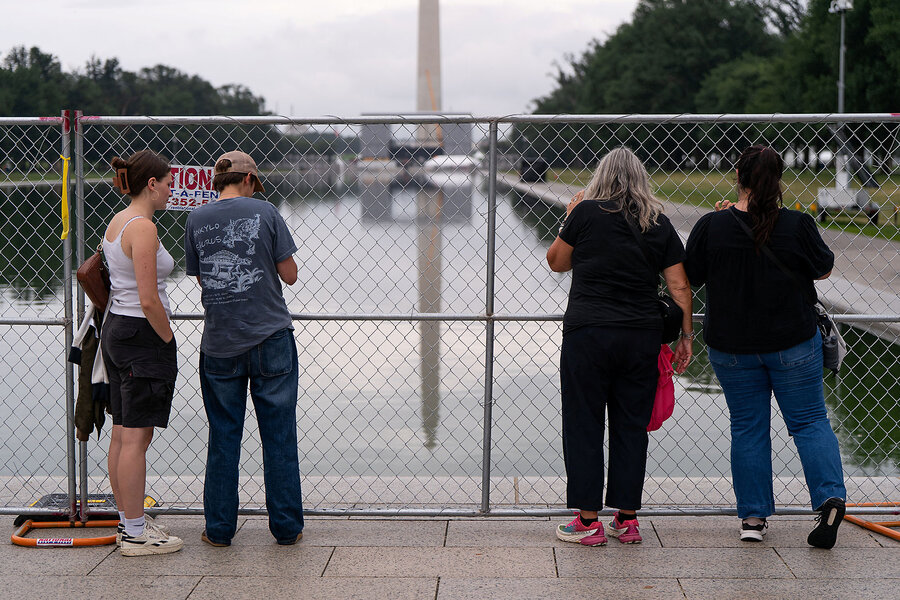
As I approach the Lincoln Memorial Reflecting Pool, the barrier to an up-close view of its now-infamous, algae-infested water is readily apparent.
A chain-link fence lines the pool’s perimeter, with eight National Guardsmen clustered near one corner. On the fence, a sign conveys an alarming message: “Danger: Explosives.”
That’s in anticipation of the July 4 fireworks, a guardsman explains, some of which will be set off near the Reflecting Pool. Hearing this, a tourist jokes: “They’re going to blow the algae out of the water.”
Why We Wrote This
As the nation prepares to celebrate its 250th, a major topic in Washington isn’t the meaning of democracy but a shallow pool of water. Views on the Reflecting Pool, like many things these days, are shaped by politics.
Days before the celebration of America’s 250th anniversary, the No. 1 topic of conversation in Washington isn’t the meaning of democracy or even the World Cup, but a shallow, 2,028-by-167-foot pool of water.
Tourists are here in abundance – and everyone has an opinion. Some are convinced by the allegations of vandalism, involving seven arrests; others think it’s all nonsense.
In political terms, the Reflecting Pool debate has become a great national Rorschach test. Support President Donald Trump? The algae infestation is sabotage. Not a Trump fan? It’s another example of presidential incompetence (or mendacity).
The Reflecting Pool – an iconic site on the National Mall where, among many memorable moments, the Rev. Martin Luther King Jr. delivered his “I Have a Dream” speech in 1963 – has long been plagued by algae and leaks. Its renovation is part of President Trump’s effort to beautify Washington in time for the big national birthday commemoration.
On this partly cloudy afternoon, the water appears greenish-brown, perhaps reflecting the surrounding trees. It looks no different from the nearby pond in Constitution Gardens.
Ryan Allen, an architect from Houston visiting Washington for the first time, came to see the pool to try to find out what’s really going on.
“What is the media saying, and what is the truth?” asks Mr. Allen, a Trump supporter, sitting on a park bench alongside the fence. “Hopefully our judicial system will do its due process. Our tax money is paying for it.”
Mr. Allen and his wife, Cecilia, also an architect, are here on an extended “date night,” he says – a quick trip to the capital while a grandparent watches their two young daughters back home.
Later, at the foot of the Lincoln Memorial, a woman strides toward the chain-link fence and shouts in the direction of six workers wielding long-handled tools in the Reflecting Pool.
“Sorry to have to say this, but tell your boss he [expletive],” she yells, referring to Mr. Trump. “We’re paying for this.”
The woman, Mei Chappo, is an actor visiting from Los Angeles, and she’s mad that the Reflecting Pool is inaccessible to the public. Her companion, Rob, who declines to give his last name, is also unhappy. “None of this rings any patriotism for me,” he says.
The cost of the repairs has triggered public dismay. In April, when Mr. Trump first raised the idea of a renovation, he said it would cost about $1.5 million and be finished well before July 4.
So far, the project has cost upward of $16 million, including a separate $1.7 million contract to install “nanobubblers” aimed at killing algae. Both contracts were issued on a “no bid” basis, citing the urgency of finishing by July 4. And both companies have presidential connections: One had done pool work at the Trump club in Virginia; the other is owned by a trust led by a Trump donor.
Under President Barack Obama, some $34 million was spent on a two-year renovation, but problems remained. Mr. Trump’s latest plan is to drain the pool again after July 4 and make repairs.
Patricia Glibert, an environmental scientist at the University of Maryland, says the persistent algae issue is hardly a surprise.
“Algae grow very well in warm water, and in June, the waters are warming very fast,” Professor Glibert says. She notes that Mr. Trump’s decision to make the pool floor darker – “American flag blue,” as he put it – means “more heat is going to be absorbed, and the water is going to warm faster.”

The president, too, may have inadvertently contributed to the problems when he had his motorcade drive the length of the pool on May 7, directly on its drained, freshly painted bed.
Mr. Trump insists that saboteurs intentionally tried to harm a national landmark – and by extension, embarrass him – by pulling up the lining and pouring in toxic chemicals.
Dan Schnur, a former Republican strategist who now teaches at the University of California, Berkeley, says the Reflecting Pool project has taken on outsize importance for a president who is more at home addressing matters of style and appearance than policy.
When Mr. Trump gets frustrated by difficult domestic or international matters, such as the Iran war, “he can retreat to construction and real estate,” Mr. Schnur says. “That’s his safe space.”
Back at the pool, a family from Greeneville, Tennessee – hometown of President Andrew Johnson, the mom says proudly – has come to take a look.
“It’s just extremely sad,” says Stacy Lee, a retail manager who’s on her first visit to Washington. “Look how fast he got it cleaned, and people decided, let’s destroy it.”
Still, not all is gloomy as July 4 approaches. Mr. Allen, the tourist from Houston, says he’s glad to be here in spite of it all.
“I got emotional seeing the Lincoln Memorial for the first time,” he says.