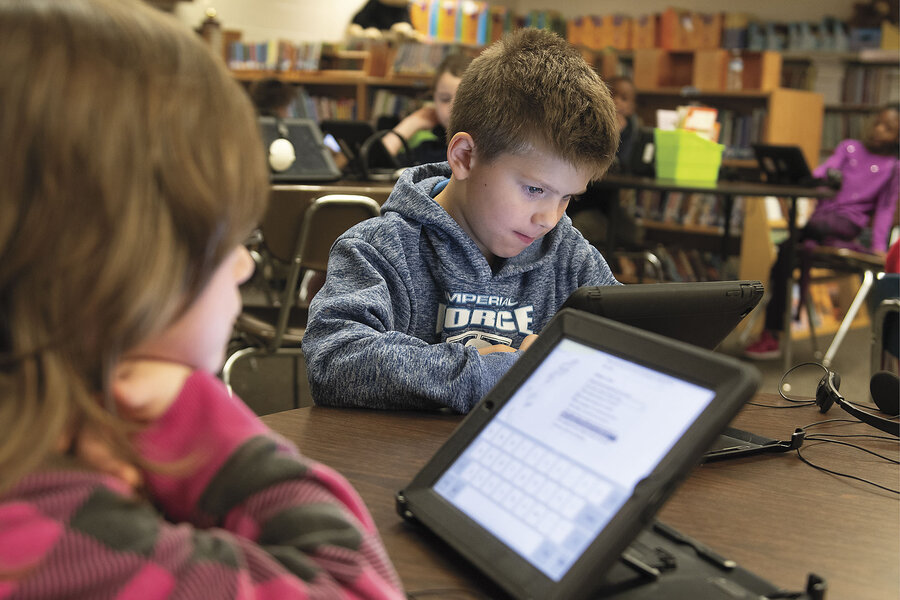
Miriam Kendall has never gotten her children an iPad. She doesn’t allow screens at home, except for limited TV time. So, when her oldest daughter was handed a tablet in kindergarten, it felt to her like opening a Pandora’s box.
“She came home and said, ‘Mommy, you have to let me watch YouTube,’” recalls the mother of three from Evanston, Illinois. Ms. Kendall, who encourages her children to play outside and not on devices, held the line on her household rule.
But when her daughter entered second grade, Ms. Kendall found something concerning when she checked the school tablet’s tracker: Her daughter had spent two hours watching Taylor Swift videos at school when she should have been learning.
Why We Wrote This
Parent groups across the country are pressuring schools to rethink the rapid advancement of technology in the classroom, due to concerns over the impact of rising screen time on student development.
She wondered: Did the school have a clear policy on technology use? She reached out to other parents, who shared her concerns.
Today, Ms. Kendall, founder and director of parent group Screen Sense Evanston, is leading the charge in her neighborhood and with others nationwide to unplug kids from devices in classrooms. She speaks at school board meetings and lobbies for screen-time limits and a return to pencil-and-paper learning, particularly in elementary grades.
“We want there to be a really thoughtful and strategic reevaluation of the use of technology in schools,” says Ms. Kendall, who launched a petition last year to limit screen time that garnered over 1,400 signatures in her local pre-K through eighth grade district of about 6,000 students. “This is widespread. … Parents are demanding change.”
Indeed, parents from California to Illinois to Pennsylvania are pushing back against technology they say creates distractions, negatively impacts learning, and conflicts with screen-time limits set at home. Many had heeded the advice of Jonathan Haidt’s bestselling book “The Anxious Generation” to limit digital exposure, only to find themselves undermined by the place that is supposed to be most attuned to child development: the classroom.
“How in the world are you providing these highly addictive, highly distracting devices to every single student in the district?” asks Ms. Kendall, who wants to see clearer policies and more staff training.
From a tech surge to growing caution
A decade ago, many districts across the United States raced to close the “homework gap” and “digital divide,” as educators viewed technology as essential for preparing students for a modern world. They signed multiyear contracts with technology companies and invested billions of dollars into digital tools such as iPads and Chromebooks. In 2020, the pandemic accelerated the trend as districts used federal Coronavirus Relief Fund money to invest in technology and remote learning.
When students returned to classrooms, parents had hoped to trade tablets for textbooks as it became clear technology could not replace in-person learning. Today, many school districts have still not fully recovered from historic academic declines in student achievement due to school closures and remote learning, according to the National Assessment of Educational Progress.
“Nobody stepped back after COVID and took a fresh look at the use case for the iPad and the school policies and said, ‘Is this the optimal way to use the tool?’” says parent Aaron Friedman of Glenview, Illinois, who launched a petition to limit devices last spring that garnered 1,000 signatures.
In spring 2020, about 45% of public schools assigned devices to individual students, according to the National Center for Education Statistics. By the 2024-25 school year, that figure had nearly doubled: Around 88% of public schools had 1:1 computing programs, which provide every student with a school-issued device.
Organizers point to growing evidence that shows excessive screen time harms children, including a U.S. Department of Health and Human Services advisory issued in May linking it to poorer student well-being.
Many of these parents helped drive the national Wait Until 8th pledge movement to delay smartphones until eighth grade, which over 155,000 families have signed. They’re also mobilizing to support school-wide cellphone bans. At least 37 states now require school districts to ban or restrict student cellphone use during class time, according to Education Week.
At school board meetings across the U.S., parents have reported kids playing video games in class and students watching prerecorded lessons instead of learning from a teacher. Part of the solution, parents say, is to let students dig in the dirt during science class or leaf through a library book during English.
Parent Jordan Spicklemire from Morton, Illinois, runs a device-free home for her first-grade son and 2-year-old daughter. She understands that screens can play a role in learning, but she wonders: “Are they better than a human teacher?”
Ms. Spicklemire points to how some learning apps are designed to be highly addictive. She’s concerned ed tech companies are profiting from children’s education and prefers to use paper flash cards with students she tutors instead of quiz apps that often have pop-up ads.
Internet Safety Labs, a nonprofit research group, reported in 2022 that 96% of educational apps share children’s data with third parties, often unbeknownst to students, parents, or schools.
Educators suggest the question isn’t whether technology belongs in classrooms, but how it’s used. Research shows digital tools can improve literacy and STEM comprehension when used with teacher oversight. A 2024 meta-analysis across 119 studies in the Review of Educational Research looked at ed tech’s effects on literacy in K-5 grades and found positive outcomes for reading comprehension and writing proficiency.
But some parents want more say in how their children learn, including the right to remove their students from screen-based instruction. Parents in the Lower Merion School District in Pennsylvania drew national attention in June when yelling broke out at a board meeting after the district repealed a policy that had given families a choice to opt out.
Many districts, including Lower Merion, are reexamining their policies. After facing pressure from parents and the group Schools Beyond Screens, the Los Angeles Unified School District in June approved a ban on classroom screen time for students through first grade, while gradually increasing access in higher grade levels. Meanwhile, at least 16 states have introduced or enacted legislation to limit screen time or take a closer look at ed tech policies.
Since launching her petition in Evanston, Ms. Kendall says her district has banned YouTube and over 300 noneducational apps from school-issued devices. The district also agreed to screen-free indoor recess, she says. The Evanston-Skokie School District 65 did not respond to requests for comment.
When Mr. Friedman brought parents’ concerns to his school board in Glenview last spring, they listened. “Our district takes this very seriously,” says Mr. Friedman, who has a third grader. “Within a matter of weeks, they came back and instituted meaningful changes,” he says, including a decision to review and clarify appropriate use policies for technology in classrooms.
Parents agree technology, when properly supervised, can help students conduct research, take online exams, or learn multimedia skills.
College student Nadia Easley from Northbrook, Illinois, learned how to type and code in middle school at a private school, Willows Academy. But getting taught by humans is what she remembers most. She grew to love her least favorite subject, history, thanks to a teacher who made the class engaging.
A survey of 600 U.S. teachers in May found that 85% believe students spend too much time on screens in class, according to researchers at Auburn University College of Education and Christopher Newport University.
It’s soft skills that matter most, and those are learned face to face, with good, in-person interactions, says Kim Whitman, a parent from Overland Park, Kansas, and organizer with Distraction-Free Schools Policy Project. “Kids coming out of school need to be able to speak to people and look them in the eye.”