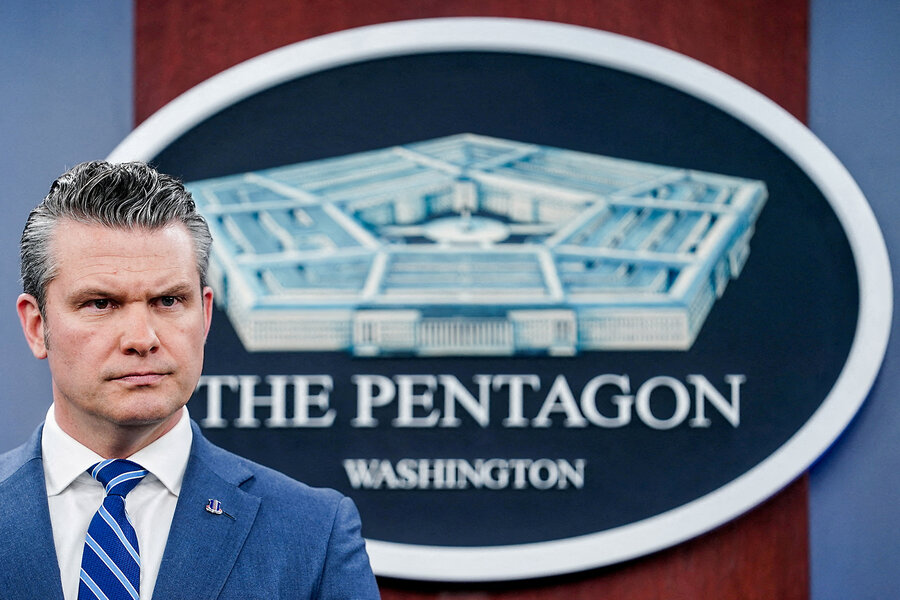
In a grassy square dotted with Adirondack chairs that lies at the heart of the Pentagon, evangelist Franklin Graham delivered a special sermon in December at the request of Defense Secretary Pete Hegseth.
“We know that God loves,” Mr. Graham said. Then, he took a turn. “Did you know that God also hates?” he asked the dressed-up children and troops attending. “Do you know that God is also a god of war?”
Mr. Graham then told a story about God taking revenge on ancient Israel’s enemies. “Kill them, both man, woman, infant, nursing child, ox, sheep, camel, and donkey,” Mr. Graham said, quoting the Bible. For those who don’t believe in a vengeful God, “Well,” he warned, “you’d better believe in him.”
Why We Wrote This
Public prayer for troops has long been a part of America’s history. But Defense Secretary Pete Hegseth’s rhetoric is raising concerns about the impact that Christian nationalist ideas are having on military unity and religious freedom.
Secretary Hegseth thanked Mr. Graham for his “bold” message. And in the following weeks, as the United States launched major military attacks against Venezuela and Iran, he echoed it.
Though public prayer for troops is routine, and some applaud Mr. Hegseth’s approach, bipartisan critics warn that his pointed Christian rhetoric risks undermining troops’ religious liberty and the unity of the American military. His vision, stated repeatedly in media briefings and other public remarks, is seen by many as a form of Christian nationalism, an ideology that seeks to fuse American identity and government with a specific, conservative form of Christianity.
A noticeable shift
From the Pentagon podium, Mr. Hegseth has promised “no quarter, no mercy” to America’s adversaries and has portrayed the U.S. military as a righteous dispenser of divine justice.
He has rolled out monthly Christian prayer services during working hours in the Pentagon auditorium, raising concerns among some troops about potential pressure to attend. (Administration officials say the events are voluntary.) In one March briefing, Mr. Hegseth appealed for Americans to pray for U.S. troops “in the name of Jesus Christ.”
It is not just about prayer. Mr. Hegseth has railed against America’s “internal enemies” in religious terms. And, last week, he compared U.S. journalists with the Pharisees – “the so-called and self-appointed elites of their time,” he said – who opposed Jesus.
Next month, conservative Christian leaders and Cabinet members, including Mr. Hegseth, are scheduled to lead an event on the National Mall aimed at “rededicating” the U.S. as “One Nation under God.” Rabbi Meir Soloveichik, a member of President Donald Trump’s Religious Liberty Commission, is the sole non-Christian leader listed. The lineup doesn’t include other non-Christian faiths or leaders from mainline Christian or historically Black denominations, critics say.
Rights and religion
Government officials need not “leave their right to be religious at the front door,” says Rachel VanLandingham, who served as chief international law adviser for U.S. Central Command during the wars in Iraq and Afghanistan. But Mr. Hegseth is encroaching on the Constitution’s First Amendment protections of freedom of religion, she argues. “And it is dangerous to our military.”
Veterans in Congress, retired military leaders, and activists have spoken out about what they say is the secretary’s promotion of Christian nationalism, accusing him of undermining democracy and military cohesion.
Others reject the pushback.
Last month, after Mr. Hegseth called for a prayer in Jesus’ name, Arkansas Gov. Sarah Huckabee Sanders responded to complaints in the news media, posting: “Only in DC is something like this considered even remotely offensive.” Baptist writer Daniel Darling called Mr. Hegseth’s comments “normal stuff,” citing the D-Day prayer that President Franklin Roosevelt invited Americans to join.
How this new tone at the Pentagon will play out is yet to be seen. Though Trump administration officials point to rebounding military recruitment figures, complaints from service members concerned about religious freedom are also on the rise since Mr. Hegseth took over the Defense Department last year.

Requests for help and legal advice from active-duty service members have tripled in that time, according to the Military Religious Freedom Foundation (MRFF), a nonprofit that protects service members from religious harassment or mandatory religious activities. Many of these roughly 200 complaints involve concerns about the potential promotion of Christian nationalist values or theology. Mr. Hegseth’s own affiliation is with the Communion of Reformed Evangelical Churches, or CREC, many leaders of which align themselves with Christian nationalist values.
By contrast, America’s overwhelmingly Christian founders enshrined religious freedom and pluralism in the Constitution’s Bill of Rights.
Pentagon press secretary Kingsley Wilson said in a statement to the Monitor that Mr. Hegseth is proud to host the Pentagon prayer services and “will continue to do so.” The services are “100% voluntary” and constitutionally protected, she added. “No special treatment or punishment is given as a result of one’s choice to attend these prayer services.”
Boundary lines blurred?
Yet military life includes times when requests, though not explicit, are understood as orders, says Michael Weinstein, a former U.S. military lawyer and founder of MRFF. The U.S. military word for it, he notes, is “volun-told.” Soon after Mr. Hegseth established the Pentagon services, some troops reported commanders or spouses saying to them, “Come by our house. We’re going to do a Bible study and explain it all,” Mr. Weinstein says. “What are they supposed to do?”
One Navy officer says she has never, in more than a decade of military service, felt pressured about faith. But she believes Mr. Hegseth is using his position to spread his religion, and she is concerned that it will embolden commanders to do the same.
“How does this trickle down?” wonders the officer, who requested anonymity to speak frankly.
Earlier this month, Army Maj. Gen. William Green Jr., a Black service member with a Master’s in Divinity, became the first military chief chaplain ever fired. It was seen as part of a wave of personnel decisions connected to Mr. Hegseth’s efforts to reverse policies aimed at diversifying the military’s top ranks. No explanation has been provided for most of these firings, prompting comment from, among others, the president of the National Baptist Convention, a historically Black denomination that had endorsed Mr. Green.

“When leaders of this caliber are removed without public clarity, it creates concern not only about the individual decision, but about the larger climate of interference affecting trusted national institutions,” the Rev. Boise Kimber, the convention’s president, said in a statement.
Mr. Hegseth had foreshadowed his plans, saying last year that he was going to rid the Defense Department of “new age” spirituality, “godless” diversity measures, and chaplains who are “therapists instead of ministers.” He called them necessary steps in tending to “our warriors and their souls.”
Next, he rejected the Army’s official Spiritual Fitness Guide – designed to help soldiers build resilience, find purpose, and manage stress – for “alienating” troops by “pushing” secular humanism. “It mentions God one time,” Mr. Hegseth said in a social media post, then later repeated in public remarks. “That’s it. It mentions feelings 11 times. It even mentions playfulness, whatever that is.”
And last month, Mr. Hegseth announced that the Pentagon would reduce the number of official religious affiliation categories from 200 to 31 in an effort, he said, to reform a chaplain corps “infected by political correctness.” The faith codes included dozens of highly specific Christian denominations, as well as groups such as Ásatrú, which honors Norse gods; Eckankar, which emphasizes soul travel, dreams, and past-life study; and the Troth, a form of Germanic polytheism.
“Protecting our culture and our religion from godless ideologies and pagan religions is not political, it’s biblical,” Mr. Hegseth said this year during a speech to a Christian conference in Nashville, Tennessee.
In polling, many Americans say it’s important for leaders to have strong religious beliefs. (About half said the same about their president in a 2024 Pew Research Center survey).
Mr. Hegseth takes the role of religion further by aligning with views espoused by Doug Wilson, the Idaho-based founder of the CREC, which includes Mr. Hegseth’s church in suburban Nashville. A core belief of Mr. Wilson is that God intended for America to be a Christian country. Mr. Wilson, who opposes women in combat and says women’s husbands should vote for the household, preached in the Pentagon auditorium at Mr. Hegseth’s invitation in February.

Polling from the Public Religion Research Institute in 2024 identified 3 in 10 Americans as adherents or sympathizers with Christian nationalist views, as measured by people’s degree of agreement with ideas including the statements that “U.S. laws should be based on Christian values,” that “being Christian is an important part of being truly American,” and that “God has called Christians to exercise dominion over all areas of American society.”
A 2022 Pew Research Center report found that, though some 62% of Americans identify as Christian, just 45% said America should be a Christian nation, though there was disagreement about exactly what that means. About two-thirds of those in the Pew survey said that churches should “keep out of political matters.”
An emphasis on retribution
Mr. Hegseth’s apparent focus on retribution has raised concern among U.S. forces as well as top religious figures. Pope Leo XIV, the first U.S.-born pontiff, last week weighed in on the administration’s war rhetoric, which he says reflects a “desire for domination entirely foreign to the way of Jesus Christ.”
Kyleanne Hunter, who leads Iraq and Afghanistan Veterans of America, says the revenge-laced rhetoric echoed by Mr. Hegseth is unsettling to many service members.
The group’s membership is evenly divided by political affiliation: About one-third each identify as Democrats, Republicans, and Independents. But across the board, they are questioning Mr. Hegseth’s focus on retribution, Ms. Hunter says. “It’s not like it’s just the far-left Democratic side that’s raising concerns.”
The laws of warfare are important to veterans, she adds. “We recognize, even if they are the enemy and a legitimate combatant, that they’re still people – and so it’s concerning to hear language like that, because words mean things.”