When it comes to the AI search landscape, there is no “even playing field.” Like any industry with big investments, it’s all shaped by deals.
When a brand asks why their YouTube content shows up in Perplexity but not ChatGPT, or why their X posts appear in Grok but nowhere else, the answer isn’t algorithmic preference. It’s structural. The partnerships, licensing agreements, and ownership structures between AI companies and social platforms determine what content gets retrieved, cited, and surfaced to users.
I call this phenomenon platform coupling: the measurable concentration of citations from specific social platforms within specific AI models, driven by commercial and technical relationships rather than content quality alone.
Platform coupling is one of the most underappreciated dynamics in AI search today. It explains why the same piece of content can be highly visible in one AI surface and completely invisible in another. It reveals why certain social platforms punch above their weight in specific models while being ignored by others. And it fundamentally changes how brands should think about social content strategy for AI visibility.
This article breaks down the mechanics of platform coupling, maps the current partnership landscape, and provides a framework for adapting your strategy to a world where access determines citation.
What Is Platform Coupling?
Platform coupling occurs when a specific AI model disproportionately cites content from a specific social platform due to structural relationships between the two.
These relationships take several forms:
- Ownership integration. When the same company owns both the AI model and the social platform, citation concentration follows naturally. Google owns YouTube. xAI (Elon Musk’s AI company) is deeply integrated with X. These ownership ties create unmediated access to content, metadata, and engagement signals that competitors cannot replicate.
- Licensing agreements. Formal data deals grant AI companies API access to social content in exchange for payment. OpenAI’s deal with Reddit, estimated at $70 million annually, gives ChatGPT structured access to Reddit’s real-time content. Google’s licensing agreement with Reddit, valued at roughly $60 million per year, does the same for Google’s AI surfaces.
- Distribution partnerships. Some deals focus on embedding AI capabilities within social platforms rather than extracting content from them. Perplexity’s $400 million partnership with Snapchat embeds Perplexity’s answer engine inside Snap’s interface, reaching 900 million monthly active users. OpenAI powers Snapchat’s “My AI” chatbot. These integrations don’t directly affect citation patterns, but they signal strategic alignment that often precedes deeper data relationships.
- Access restrictions. The inverse of licensing is blocking. When platforms restrict AI companies from accessing their content (through updated terms of service, anti-scraping enforcement, or litigation) citation patterns shift rapidly. Reddit’s lawsuit against Perplexity in October 2025 caused Perplexity’s Reddit citation share to drop 86% almost overnight.
The result of these structural relationships is that AI citation behavior becomes predictable not by analyzing content quality, but by mapping commercial relationships.
The Data: Measuring Coupling Across 10 AI Surfaces
Goodie’s social citation research provides the clearest view of platform coupling in action. Across 45.2 million total citations and 1.8 million social citations tracked between September 2025 and February 2026, we identified distinct coupling patterns for each major AI surface.
The Coupling Matrix
|
Perplexity |
YouTube Long Video |
97.4% |
Reddit Post |
1.0% |
|
Grok |
X Post |
77.3% |
Reddit Post |
21.1% |
|
Gemini |
YouTube Long Video |
74.7% |
Reddit Post |
18.7% |
|
ChatGPT |
Reddit Post |
59.5% |
LinkedIn Article |
19.8% |
|
DeepSeek |
LinkedIn Article |
57.3% |
Reddit Post |
33.3% |
|
AI Mode |
YouTube Long Video |
54.1% |
Reddit Post |
23.7% |
|
AI Overview |
YouTube Long Video |
47.6% |
Reddit Post |
18.1% |
|
Meta AI |
LinkedIn Article |
42.0% |
Reddit Post |
41.5% |
|
Copilot |
LinkedIn Article |
41.8% |
Reddit Post |
40.1% |
|
Claude |
Medium Article |
27.8% |
TikTok Profile |
18.2% |
Three patterns stand out immediately:
Pattern 1: Ownership Creates Near-Exclusive Coupling
The tightest coupling in our dataset occurs where ownership connects the AI model and social platform.
Grok × X: 99.7% Exclusivity
Of all X citations across the 10 AI models we track, 99.7% come from Grok. No other model meaningfully cites X content.
This isn’t a content quality issue. X hosts real-time commentary, expert threads, and breaking news that would be valuable citation material for any AI model. But Grok has something no other model has: native integration with X’s infrastructure, built by the same ownership group.
Grok can search X posts in real-time, access engagement signals, and pull from X’s full content archive without negotiating access or navigating terms of service restrictions. Every other AI model would need to scrape X (increasingly difficult and legally risky), license X data (no known deals exist), or simply ignore it.
The result is that X has become a Grok-only citation source. If your audience uses Grok, X presence is non-negotiable. If they use any other AI surface, X content is essentially invisible to the models answering their questions.
Google × YouTube: Structural Integration
YouTube doesn’t have the same single-model exclusivity as X, but the concentration is still significant. Across Google’s AI surfaces (AI Overview, AI Mode, and Gemini) YouTube accounts for 47.6%, 54.1%, and 74.7% of social citations respectively.
Google owns YouTube. This means Google’s AI models have unmediated access to video transcripts, metadata, view counts, engagement signals, and the full archive of YouTube content. No licensing negotiation required. No API rate limits. No access uncertainty.
Perplexity, despite not being a Google product, also shows extreme YouTube concentration at 97.4% of social citations. This likely reflects Perplexity’s reliance on Google’s search infrastructure and transcript accessibility rather than any direct YouTube relationship.
The strategic implication: if your target audience uses Google AI surfaces or Perplexity, YouTube Long Videos are not optional. They’re foundational citation infrastructure.
Pattern 2: Licensing Deals Create Structured Access
Not all coupling stems from ownership. Formal licensing agreements create privileged access that shows up clearly in citation patterns.
ChatGPT × Reddit: A $70 Million Relationship
In May 2024, OpenAI announced a data licensing deal with Reddit, gaining API access to real-time, structured Reddit content. The deal’s estimated value is roughly $70 million annually.
The citation data reflects this relationship directly. Reddit accounts for 59.5% of ChatGPT’s social citations (the highest Reddit concentration of any model except Claude). ChatGPT’s Reddit reliance isn’t because Reddit is objectively the best social source for every query. It’s because ChatGPT has structured, reliable, legally defensible access to Reddit content in a way it doesn’t have for YouTube or X.
Compare this to ChatGPT’s YouTube citation share: just 5.6% of social citations. ChatGPT doesn’t have the same transcript access that Google surfaces enjoy. Without a licensing deal or ownership tie, YouTube content is harder for ChatGPT to reliably retrieve and cite.
Google × Reddit: Parallel Licensing
Google struck its own Reddit licensing deal in February 2024, valued at approximately $60 million per year. This ensures Reddit content remains a consistent citation source across AI Overview, AI Mode, and Gemini, even as Google’s primary social citation source (YouTube) dominates.
Reddit’s dual licensing strategy (deals with both OpenAI and Google) makes it the most universally cited social platform in our dataset. Reddit is the only platform cited at meaningful volume by all 10 AI surfaces we track.
Pattern 3: Restrictions Cause Rapid Citation Substitution
Coupling works in both directions. When access gets restricted, citation patterns shift immediately.
Reddit × Perplexity: Litigation Impact
In October 2025, Reddit sued Perplexity, alleging unauthorized scraping of Reddit content for AI training. The citation impact was measurable within days.

Before October 22, 2025: Reddit accounted for 19.51% of Perplexity’s social citations. After October 22, 2025: Reddit’s share dropped to 2.67%.
That’s an 86% decline triggered by a single legal action.
Where did those citations go? YouTube. Perplexity’s YouTube citation share jumped from 51.98% before the lawsuit to 95.25% after. When one source becomes legally risky, retrieval reroutes to more defensible alternatives almost instantly.
This pattern has significant implications for brands building social content strategies around AI visibility. The coupling landscape isn’t static. A lawsuit, a failed licensing negotiation, or an updated terms of service can eliminate a citation source overnight. Brands concentrated in a single platform face real visibility risk when access relationships change.
The Partnership Landscape: A Complete Map
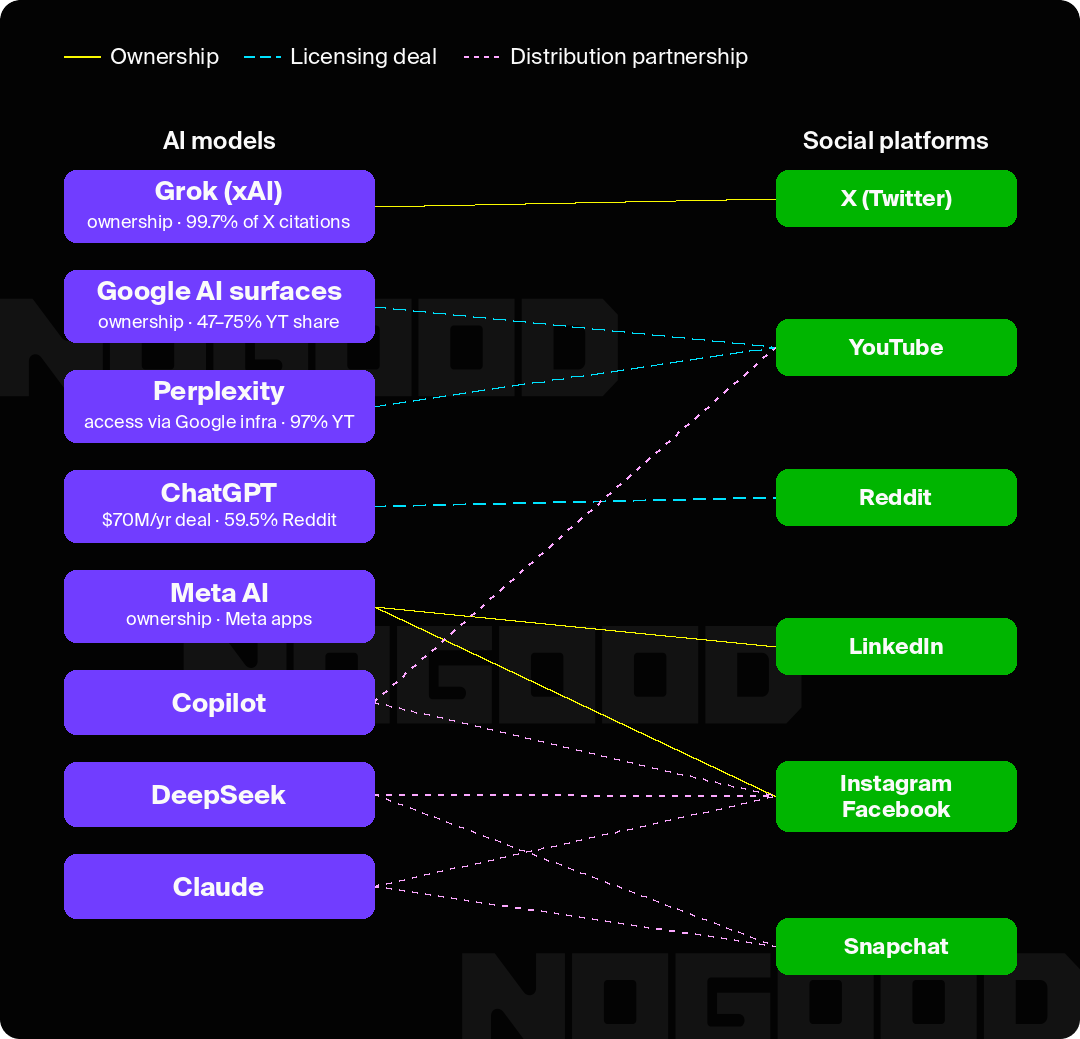
To understand where coupling currently stands (and where it might shift), here’s a comprehensive map of known relationships between AI models and social platforms as of early 2026.
Ownership & First-Party Integration
|
X |
Grok (xAI) |
Ownership integration |
Grok has native access to X posts, engagement signals, and real-time search |
|
YouTube |
Google AI (Gemini, AI Overview, AI Mode) |
Ownership integration |
Full transcript access, metadata, engagement signals, no API limits |
|
Instagram, Facebook, WhatsApp |
Meta AI |
Ownership integration |
Meta AI embedded across Meta apps with deep content access |
Licensing & API Access Deals
|
|
OpenAI |
Data licensing |
~$70M/year |
ChatGPT access to real-time, structured Reddit content |
|
|
|
Data licensing |
~$60M/year |
Google AI access to Reddit content for training and retrieval |
|
Stack Overflow |
OpenAI |
API access |
Not disclosed |
OverflowAPI access with attribution in ChatGPT |
Distribution Partnerships
|
Snapchat |
Perplexity |
Distribution integration |
~$400M/year |
Perplexity answers embedded in Snapchat interface |
|
Snapchat |
OpenAI |
Distribution integration |
Not disclosed |
“My AI” chatbot powered by GPT |
|
Telegram |
xAI (Grok) |
Distribution integration |
Not disclosed |
Grok distributed via Telegram to ~1B users |
Access Restrictions & Litigation
|
X |
Third-party AI developers |
Terms of service update |
X blocked third parties from training on X content (June 2025) |
|
|
Perplexity |
Litigation |
Reddit sued Perplexity for unauthorized scraping (October 2025); Perplexity Reddit citations dropped 86% |
|
|
Anthropic |
Litigation |
Reddit lawsuit alleging unauthorized scraping for Claude training |
Let’s put it all together and wrap it with a bow:
The Four Mechanisms of Coupling
Based on the data and partnership analysis, platform coupling operates through four distinct mechanisms that determine what AI models can and will cite.
Mechanism 1: Eligibility
Licensed or API-based access makes content consistently retrievable, structured, and legally defensible.
When ChatGPT has formal API access to Reddit through a $70 million licensing deal, Reddit content becomes reliably available for every relevant query. The content is structured, timestamped, and legally cleared. Compare this to a platform where ChatGPT would need to scrape content, navigate anti-bot measures, and face potential legal exposure. The licensed source wins by default.
Eligibility isn’t just about whether a model can access content. It’s about whether accessing that content is reliable, efficient, and low-risk enough to prioritize in retrieval.
Mechanism 2: Ranking Bias
First-party ownership creates gravitational pull toward internal properties.
When Google’s AI surfaces answer a question, YouTube content isn’t just accessible; it’s structurally preferred. Google has tighter integration with YouTube’s metadata, transcripts, and engagement signals than any external source. The iteration loops are faster. The data is richer. The product incentives align.
Owning both the retrieval system and the content source creates compounding advantages: richer metadata, faster iteration loops, aligned product incentives. Those advantages compound over time as the integration deepens.
Mechanism 3: Prompt Mix Shifts
Distribution integrations change what users ask.
When Perplexity is embedded inside Snapchat, the queries it receives will skew toward discovery (“best places to eat nearby”), real-time context (“what are people saying about X”), and creator-driven searches (“show me TikToks about Y”). The prompt distribution shapes the retrieval patterns, which shapes the citation patterns.
This mechanism is harder to measure directly, but it explains why distribution partnerships matter even when they don’t involve content licensing. The user base and query patterns that come with distribution change what the model needs to retrieve.
Mechanism 4: Substitution Dynamics
When access becomes restricted, citation patterns reroute instantly.
The Reddit-Perplexity case study demonstrates this clearly. An 86% drop in Reddit citations, offset by a corresponding jump in YouTube citations, all triggered by a single lawsuit. When one source becomes risky, models substitute for the next most accessible alternative.
This creates both risk and opportunity. Risk for brands concentrated in platforms with uncertain access futures. Opportunity for brands positioned across multiple platforms that can capture substitution flows when competitors lose access.
Strategic Implications: Adapting to a Coupled Landscape
Platform coupling changes the calculus for social content strategy. Here’s how to adapt.
1. Map Your Audience to AI Surfaces
Before choosing which social platforms to invest in, understand which AI surfaces your audience uses.
If your buyers primarily use ChatGPT for research, your Reddit and LinkedIn Article presence matters most. ChatGPT barely cites YouTube (5.6% of social citations) despite YouTube being the largest social citation source overall.
If your audience relies on Google’s AI surfaces (AI Overview, AI Mode, Gemini) or Perplexity, YouTube Long Videos should be your top priority. These models pull 47-97% of their social citations from YouTube.
If Grok is relevant for your audience, X presence becomes non-negotiable. But if Grok isn’t in your audience’s consideration set, X offers minimal AI visibility value despite its cultural prominence.
The model your audience uses determines which platforms get cited. Social strategy must be mapped to AI surface strategy.
2. Prioritize Universal Substrates
Some platforms are coupled to specific models. Others work across the board.
Reddit and LinkedIn are the two platforms cited at meaningful volume by all 10 AI surfaces we track. They function as universal substrates: platforms where investment pays off regardless of which model your audience uses.
Reddit’s universality comes from its text-native format, threaded discussion structure, and licensing deals with both OpenAI and Google. It’s the top social source for ChatGPT, Claude, DeepSeek, Meta AI, and Copilot.
LinkedIn’s universality comes from its professional content focus and stable URL structure. LinkedIn Articles are cited by 9 of 10 AI surfaces and represent the #1 social source for Copilot, DeepSeek, and Meta AI.
If you can only invest in two social platforms for AI visibility, Reddit and LinkedIn provide the broadest coverage.
3. Diversify Against Access Risk
The coupling landscape isn’t static. Licensing deals expire. Lawsuits create uncertainty. Terms of service change.
Brands concentrated in a single platform face real visibility risk when access relationships shift. Perplexity’s Reddit citations dropped 86% after a single lawsuit. That kind of volatility can eliminate months of content investment overnight.
Diversification across multiple social platforms is a risk management strategy (it’s not just about audience diversification). When one source loses access, you want content on alternative platforms that can capture the substitution flow.
4. Monitor Partnership Announcements
Coupling shifts often telegraph in advance through partnership announcements, litigation filings, and terms of service updates.
When Reddit announced licensing deals with OpenAI and Google, it signaled that Reddit would remain a prioritized source for those models. When Reddit sued Perplexity, it signaled that Perplexity’s Reddit access was at risk.
These signals are leading indicators of citation pattern shifts. Brands monitoring the partnership landscape can adjust strategy before the citation data changes, rather than reacting after visibility has already dropped.
5. Treat Social as Retrieval Infrastructure
The fundamental mindset shift is this: social content is no longer just a brand awareness or engagement channel. It’s part of the retrieval infrastructure that determines whether and how AI models represent your brand.
Your YouTube Long Videos, Reddit threads, and LinkedIn Articles aren’t just reaching human audiences directly. They’re becoming source material for the AI systems that mediate between your brand and your customers.
This means optimizing social content for extractability (text-dense, structured, stable URLs), not just engagement metrics. It means publishing on platforms with strong coupling to the AI surfaces your audience uses. And it means monitoring citation patterns as seriously as you monitor traditional social metrics.
Looking Ahead: How Coupling Will Evolve
Several trends will shape platform coupling over the next 12-24 months.
- More licensing deals. As AI companies face increasing legal pressure over training data, formal licensing agreements will become more common. Platforms with valuable content will monetize access. AI companies will pay for legal certainty. The winners will be platforms that strike multiple deals, becoming universal citation sources with defensible access across models.
- More access restrictions. The inverse will also accelerate. Platforms that view AI companies as competitive threats (or that want to monetize access they’ve been giving away for free) will tighten restrictions. Updated terms of service, anti-scraping enforcement, and litigation will create new citation vacuums that other sources will fill.
- Vertical coupling. We may see coupling emerge around vertical-specific content sources. Medical AI models might develop privileged relationships with health content platforms. Financial AI might couple with market data sources. Legal AI might couple with case law databases. The horizontal coupling patterns we see today could fragment into specialized vertical relationships.
- Distribution partnerships as coupling precursors. Today’s distribution deals (Perplexity × Snapchat, OpenAI × Snapchat) may evolve into deeper data relationships. Distribution creates alignment of interests. Alignment creates trust. Trust creates willingness to share data. The distribution partnerships announced today could become the licensing deals of 2027.
Conclusion: Access Is the New Algorithm
For two decades, search visibility was about understanding algorithms. Keywords, backlinks, technical optimization… the levers were complex but knowable. You could study the algorithm and adapt.
AI search adds a new layer: access. The partnerships, licensing deals, and ownership structures between AI companies and social platforms now determine what content is even eligible for citation before any algorithmic ranking occurs.
Platform coupling is the measurable expression of this access layer. It explains why the same content performs differently across AI surfaces. It reveals which social platforms matter for which models. And it provides a framework for making strategic investments in a world where commercial relationships shape retrieval behavior.
The brands that win AI visibility in the coming years will be the ones that understand coupling dynamics, diversify across universal substrates, and monitor the partnership landscape for signals of change.
Because in AI search, it doesn’t matter what you publish if the model can’t access it.
—
This analysis is based on Goodie AI’s social citation research covering 45.2 million total citations and 1.8 million social citations across 10 AI surfaces from September 2025 to February 2026.