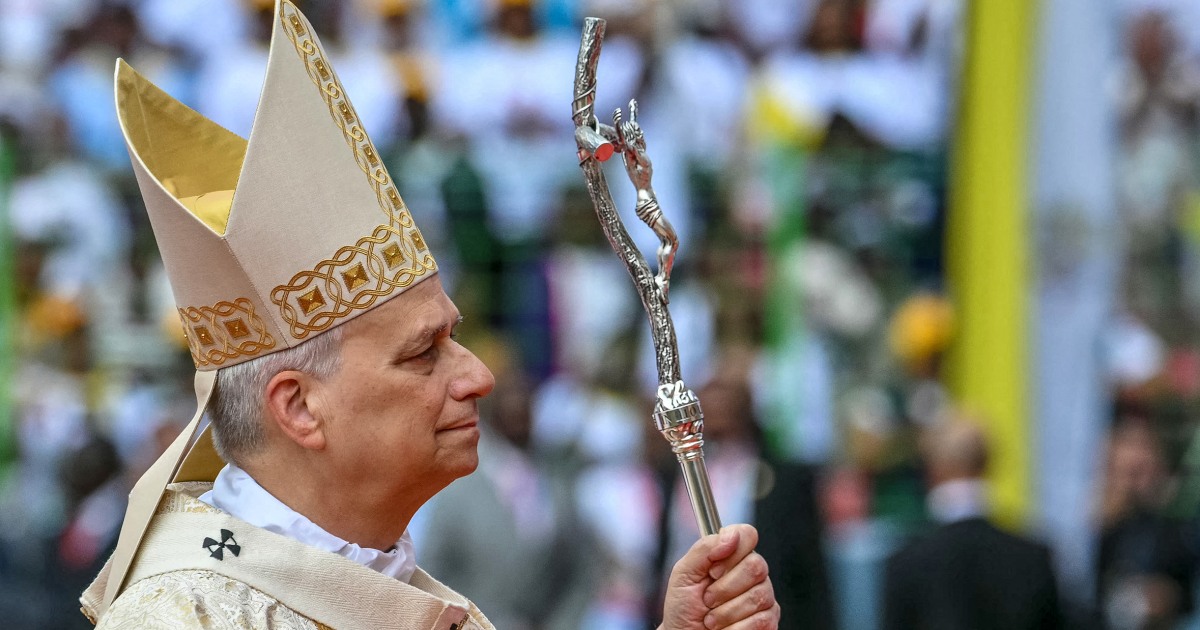
ABOARD THE PAPAL PLANE — Pope Leo expressed frustration Thursday that U.S. and Iranian leaders have not been able to get the diplomatic efforts to end the war back on track.
Subscribe to read this story ad-free
Get unlimited access to ad-free articles and exclusive content.

“One day Iran says ‘yes,’ the United States says ‘no,’ and vice versa,” Leo told reporters on the flight back to the Vatican after an 11-day pastoral visit to Africa. “We don’t know where this is going to lead, which has created again this chaotic situation, critical for the world economy.”
Leo spoke out as the fragile ceasefire that has been in place since April 8 was being tested anew by the standoff over the strategic Strait of Hormuz.
The narrow waterway between Iran and Oman, through which up to 20% of the world’s oil supply is shipped, was effectively shut down in early March after Iran imposed a blockade on the waterway, and then the U.S. imposed its own by barring ships from entering or exiting Iranian ports.
President Donald Trump declared Thursday on Truth Social that “Iran is having a very hard time figuring out who their leader is” and insisted that the U.S. has “total control over the Strait of Hormuz.”
But Iran’s Foreign Minister Abbas Araghchi later posted on X that the country’s leadership is unified. “Iran’s state institutions continue to act with unity, purpose, and discipline,” he wrote.
In the meantime, Leo told reporters on the papal plane, “there is also the entire population of Iran, of innocent people who are suffering because of this war.”
Asked about reports that the hard-line Iranian regime was executing political opponents, Leo said he condemns capital punishment and “the taking of people’s lives.”
“So when a regime, when a country, takes decisions which takes away the lives of other people unjustly then obviously that is something that should be condemned,” the pope said.
Leo has drawn Trump’s ire by forcefully advocating for an end to the war with Iran. That public spat has overshadowed his pontifical tour of four African countries, which ended Thursday with a Mass for thousands of people in Malabo, the former capital of Equatorial Guinea.
The Chicago-born pontiff has appeared to be trying to dial down the tension with Trump, saying last week that it was “not in my interest at all” to debate the U.S. president.
And when asked by reporters Thursday about the contentious issue of immigration, Leo made a statement that Trump would likely agree with.
“I personally think a state has the right to implement rules for their borders and I do not say that everyone should enter without order, creating situations which can sometimes be even more unjust in the places they are arriving to then from where they just left,” the pope said.
Leo, however, laid the responsibility for easing the immigration crisis on wealthy countries rather than on desperate migrants trying to escape poverty in their home countries.
“I ask what do we do in the richer countries to change the situation in the poorer countries,” Leo said. “Why can we not find help from states for investments also in large, rich, multinational companies, to change the situations in countries like those we have traveled to during this trip?”
Migrants, the pope added, “are human beings and we must treat human beings in a humanitarian way and not treat oftentimes them worse than pets or animals.”
Leo began his tour of Africa on April 13 with a stop in Algeria, making him the first leader of the Roman Catholic church to visit the mostly Muslim country.
There, Leo walked in the footsteps St. Augustine, one of Christianity’s greatest thinkers and the inspiration for the religious order to which he belongs, by making a pilgrimage to the ruins of the ancient Roman city where Augustine lived and worked in the fifth century A.D.
From there, Leo flew to Cameroon, a country in central Africa where he presided over a Mass attended by more than 100,000 people.
There, Leo openly criticized corruption in the presence of Cameroon’s President Paul Biya. The 93-year-old president has clung to power since 1982, in a country where 43% of the population lives in poverty.
The next stop for Leo was Angola, where he criticized the unequal distribution of wealth in the mineral-rich country.
Leo declared that many people in the world were being “exploited by authoritarians and defrauded by the rich.”
Throughout his African journey, Leo made several trips from his seat at the front of the papal plane to the back of the jet to speak with reporters — and make news. Like on the flight from the Vatican to Algeria, when the pope hit back at Trump’s broadside that Leo was “WEAK on crime” and “terrible for Foreign Policy.”
“I have no fear of the Trump administration, or speaking out loudly of the message of the gospel, which is what I believe I am here to do, what the church is here to do,” the pope said.