Molly Metz stands outside a TV station in Lexington waiting for Thomas Massie to emerge. A five-time world jump-rope champion, Ms. Metz spent the day knocking on doors for the seven-term Republican congressman – her first time volunteering for any candidate.
She’s not actually from Kentucky. She and her husband flew here from Colorado to volunteer. In fact, she’s not even a Republican on paper, but is registered as “unaffiliated.”
Yet Ms. Metz, who’s waving a Massie sign and sporting a Massie hat and T-shirt, is all in, saying she sees few other politicians in the United States standing on principle and delivering for the people the way he has.
Why We Wrote This
Tuesday’s GOP primary in Kentucky pits President Donald Trump’s power and the pull of party unity against an independent-minded lawmaker with deep ties to his constituents.
“Thomas is doing everything Trump set out to do,” she says.
Ms. Metz is part of a broader coalition that Mr. Massie actually credits President Donald Trump with forming: a mashup of right-wing populists, libertarian-minded independents, establishment Republicans, and some disgruntled Democrats – all under the MAGA umbrella.
Lately, however, that coalition has been fracturing. Mr. Trump, beset by challenges at home and abroad as he closes in on his final years in office, is alienating supporters and lashing out at anyone he views as less than loyal. Like Mr. Massie.
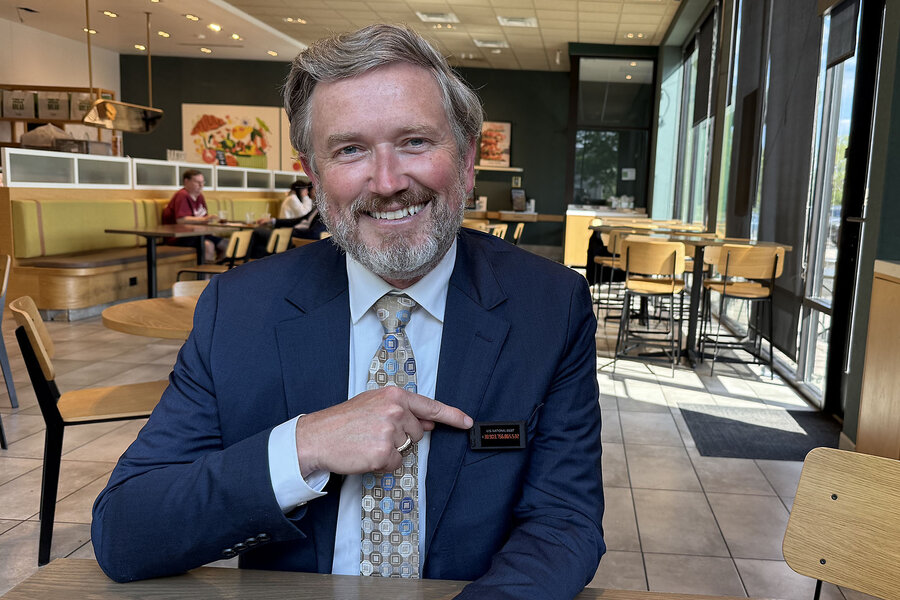
“Each [group in the MAGA coalition] is not that large, and the president doesn’t need to run for office again. So, he’s prone to sticking his finger in their eyes,” says Mr. Massie, sitting in a Panera in Lexington. “But it’s at the expense of our Republican Party.”
Mr. Massie, an MIT grad and engineer who was first elected to Congress in 2012 during the tea party wave, has always been a somewhat different kind of Republican. He describes himself as a true conservative – anti-abortion and pro-gun, opposed to foreign aid and foreign wars. A deficit hawk, he has for years proudly worn a ticking “debt clock” on his lapel. And as he points out, he votes with his party 90% of the time.
But it’s the other 10% that often draws attention, and that has put him squarely in Mr. Trump’s crosshairs heading into Tuesday’s primary election. Last year, Mr. Massie voted against the president’s One Big Beautiful Bill Act because it increased the national debt. He has been an outspoken critic of the war in Iran, sponsoring a War Powers Resolution to try to force the administration to terminate hostilities.
And he spearheaded the effort to release the Epstein files, which Mr. Trump attempted to block. The president personally recruited Ed Gallrein, a farmer and retired Navy SEAL officer, to run against Mr. Massie in what has become one of the most expensive primaries in the history of the House, topping more than $25 million in ad spending.
To his supporters, Mr. Massie is a kind of Capitol Hill unicorn: a rare lawmaker who resists the pull of partisan politics and votes his conservative values, for the good of his constituents and his country.

Julia Demaree Nikhinson/AP
To critics, he’s more of an eccentric attention-seeker: a politician who in recent years gained a huge online following with his maverick brand of Republicanism, precisely because he often causes problems for his own party and, especially, his own president.
Most polling has shown Mr. Massie, who has handily won all his previous elections, in a very tight race with Mr. Gallrein. Some recent polls have put Mr. Gallrein ahead.
“This is really a battle between party unity and ideological purity,” says Stephen Voss, an associate professor of political science at the University of Kentucky.
Mr. Massie, who lives off the grid on a 1,500-acre farm in Garrison, Kentucky, in a timber-framed house he built from trees on his property, embodies a type of small-government conservatism that has unique appeal in this part of the country, Professor Voss says. Yet many Kentucky voters also “recognize that Donald Trump is moving policy in a direction they like.” These voters will have to choose which they value more.
The one endorsement that matters
There was a time when Mr. Massie lobbied hard for Donald Trump’s endorsement. Back in 2020, he even ran ads in South Florida to try to get the president’s attention. He secured Mr. Trump’s backing in 2022.
But the relationship between the two men, which has always been marked by ups and downs, now appears unrepairable. In recent weeks, Mr. Trump has called the Kentucky lawmaker the “WORST Republican Congressman in decades,” a “very bad guy,” and “a LOSER.”
The final days of the race will be a turnout game. Mr. Massie has been campaigning at a breakneck pace, attending candidate forums and speaking to voters at county dinners between votes in Washington. As a 14-year incumbent who frequently makes news, he is widely known in his northeastern Kentucky district.
Mr. Gallrein, by contrast, is a blank slate who has never served in public office. He did not agree to any debates with Mr. Massie, and has made relatively few campaign appearances.

Sophie Hills/The Christian Science Monitor
Still, to some voters, all that matters is that the president has endorsed one candidate and excoriated the other.
“Whoever we have, I don’t want them to vote against Trump’s bills,” says Shirley, a retired human resources manager who declined to give her last name. Shirley, who lives in the Kentucky suburbs just south of Cincinnati, has voted for Mr. Trump in the past three elections and plans to vote in Tuesday’s House primary. But not for Mr. Massie.
“I’ll be voting for the other man,” she says.
“It’s hard to look past the Trump endorsement,” Mr. Massie acknowledges in an interview. “That’s the one political endorsement that matters.”
Later, he checks his phone after sitting for a 30-minute conversation with a local TV station, which was intended to be a candidate forum until Mr. Gallrein declined to attend. “Let’s see what the Massie Moneybomb’s at,” he says. “$75,000,” he nods. Five days on, the “moneybomb,” fueled by small dollar donations, passes $1 million, and later $2 million.
Kentucky’s 4th Congressional District encompasses the outer suburbs of three cities – Cincinnati, Louisville, and Lexington – with three different media markets.
Mr. Massie has faced an onslaught of attacks from a Trump-aligned super PAC as well as several pro-Israel groups, including the the American Israel Public Affairs Committee and the Republican Jewish Coalition. Some ads label Mr. Massie, who has been accused of antisemitism by figures on the left and the right, as pro-Palestine and pro-Iran. This week, Mr. Massie introduced legislation that would require AIPAC to register under the Foreign Agents Registration Act, which compels public disclosure of efforts on behalf of foreign interests.

Sophie Hills/The Christian Science Monitor
In one now infamous anti-Massie ad, AI-generated video shows the congressman alongside progressive Reps. Ilhan Omar of Minnesota and Alexandria Ocasio-Cortez of New York, and labels the trio as “a throuple.” That ad, which generated outrage among Massie supporters, might have backfired – at least, based on how often Mr. Massie himself has been referencing it on the campaign trail. “It’s so disgusting,” he says to a group of voters, shaking his head.
Pro-Massie ads, meanwhile, have attacked Mr. Gallrein as “woke,” noting that he left the GOP and registered as an independent for several years before rejoining the party.
Mr. Trump noted as much at a rally with Mr. Gallrein in March, saying the candidate had come back to the party because of Mr. Trump’s leadership. Mr. Gallrein ran for the state Senate as a Republican in 2024 but lost narrowly in the primary.
“Just give me somebody with a warm body to beat Massie, and I got somebody with a warm body but a big, beautiful brain,” Mr. Trump said at the rally in Hebron, Kentucky. “Ed Gallrein has my complete and total endorsement.”
“I want to thank you for your endorsement, because once you did that, my support skyrocketed,” Mr. Gallrein responded, standing next to the president. “As you folks know, you deserve an authentic, true Republican conservative that stands shoulder to shoulder with our president.”
Mr. Gallrein’s campaign did not respond to numerous calls and emails from the Monitor.
“Thomas Massie is the conscience”
In Shelbyville, near where Mr. Gallrein lives, several voters who say they know and like him personally, nevertheless say they plan to vote for Mr. Massie. One woman, who asks that her name not be used, says she regrets voting for Mr. Trump last year and appreciates Mr. Massie’s principled stands more than ever. “He looks at the facts – he’s not voting straight party,” she says.
Another man, who also asks not to use his name because of his friendship with Mr. Gallrein, calls himself a strong Trump supporter but shrugs off the president’s attacks on Mr. Massie. “Trump has a ‘you hit me, I’m gonna hit harder’ strategy,” he says. In his eyes, the president’s attacks on Mr. Massie “may have helped him as much as it hurt him.”

Sophie Hills/The Christian Science Monitor
For his part, Mr. Massie doesn’t see himself as “opposing” the president, but rather voting in the interests of his constituents.
“President Trump and my opponent both misunderstand the chain of command for congressmen. If you’re a U.S. representative, who do you represent? Do you represent the president? No,” he says. “You report to 750,000 people in your congressional district.”
“This is a referendum on whether people want a rubber stamp or not,” he continues.
But some Republicans aren’t sure how closely Mr. Massie is listening to his constituents. “Massie has been very loved by Northern Kentucky,” says Mike Fisher, chair of the Harrison County Republican Party. But “the folks that have broken [away from him] and are on the Gallrein side have just said they’ve had it and they want somebody who’s gonna support Trump.”
“As much as I understand Thomas’ views, I’m not sure he understands the viewpoints of the public,” says Mr. Fisher, who’s out talking with voters amid his own campaign for the state legislature.
That perception gap seemed to grow, he adds, as Mr. Massie doggedly pushed for the release of the Epstein Files. To some voters, that became too singular a focus. To Mr. Massie, it’s been a crusade for transparency and justice – exposing what he calls a “criminal enterprise” of “rich and powerful and political donors to the establishment.”
Former state senator Paul Hornback worked with Mr. Massie in the Kentucky legislature, and says they share many values. But he’s worried Mr. Massie has alienated too many people in Washington. How can a congressman deliver for Kentucky if the president and his team won’t take his phone calls?
As a farmer, it irks Mr. Hornback that Mr. Massie has never voted for a farm bill, instead taking stands on issues Mr. Hornback sees as insignificant in the larger scheme of things, like raw milk. “Ed [Gallrein] is one that’s gonna weigh all the stuff and do it right,” he says.
There’s a fine line, he adds, between being principled and being inflexible. With Mr. Massie, it’s always “all or nothing. And that’s not the way legislation works,” Mr. Hornback says. “Trump’s only got two years left, so you’ve gotta think past that.”
Still, many Massie supporters say they trust him to do what’s right, and see no contradiction supporting both him and Mr. Trump.
“Trump restored the presidency. I like what he does there,” says Gex Williams, a state senator who represents a district north of Frankfort. “But we have a coequal branch.”
“Congress is broken,” Mr. Williams avers. “And Thomas Massie is the conscience.”