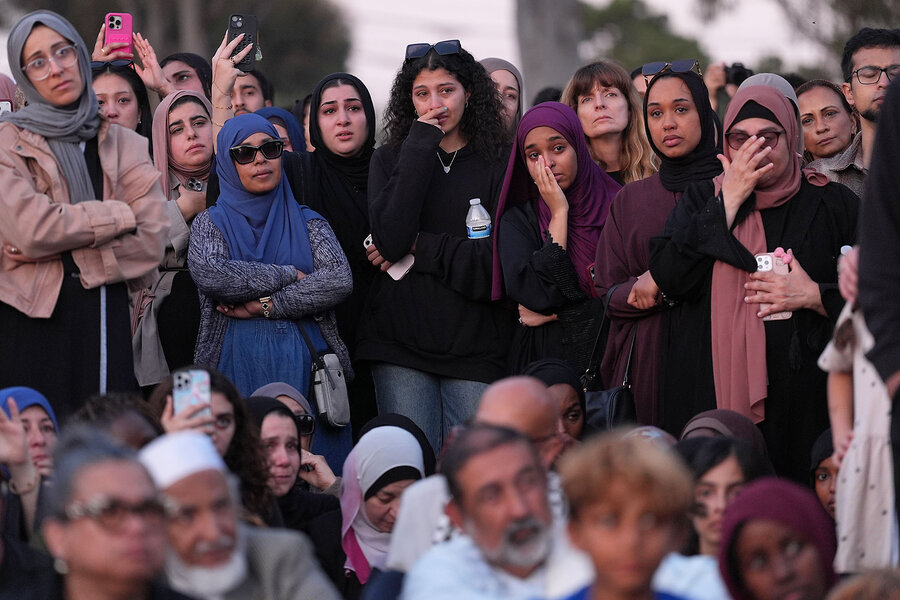
The deadly attack on a California mosque this week has reignited concerns about rising Islamophobia in the United States and the radicalization of young people, often men, in extremist corners of the internet.
After the May 18 shooting at the Islamic Center of San Diego, police recovered writings, believed to have been authored by the two teenage suspects, that expressed hatred not only toward Muslims but a broad range of minority groups. That follows a familiar pattern in which extremist attacks appear motivated by a smorgasbord of ideologies.
“What we know from the manifesto is it’s a little bit of everything,” says Mia Bloom, a professor at Georgia State University who studies extremism. “They’re cherry picking elements of the far-right, of Islamophobia, of antisemitism, of anti-LGBT, of racism and white supremacy.”
Why We Wrote This
The fatal shooting at a San Diego mosque this week comes amid a rise of incidents of hate or prejudice against Muslims in the U.S. The attack also renewed attention on how young people are radicalized online and prevention efforts.
The shooting, in which the gunmen fatally shot three people before killing themselves, appears to be the first ideologically motivated, lethal attack on a mosque in the U.S. this century, according to a report by the Center for Strategic and International Studies. It has rocked the country’s Muslim community, which has faced a sharp rise in Islamophobic rhetoric and incidents since Hamas attacked Israel on Oct. 7, 2023, and Israel retaliated by declaring war against Hamas in Gaza.
“Islamophobia had been quiet in the United States for a while,” says Corey Saylor, research and advocacy director at the Council on American-Islamic Relations, highlighting a 23% decrease in complaints between 2021 and 2022. CAIR is the country’s largest Muslim civil rights group. “And then it was like somebody flipped a light switch.”
The violence in San Diego comes after a slate of attacks against religious institutions in recent years. Four people died in a shooting at a meetinghouse of The Church of Jesus Christ of Latter-day Saints in Michigan last September. More recently, in March, a man drove a truck through a Michigan synagogue before killing himself during a gunfight with security officers. Those attacks followed a 2018 mass shooting at a Pittsburgh synagogue, which left 11 people dead. Authorities are investigating the San Diego attack as a hate crime.
As the details of this week’s attack emerged, questions have resurfaced about how, and why, such extremist views creep into the minds of American youth.
What do we know about the mosque attack?
Hours before the shooting, the mother of one of the suspects reported that her son, several guns, and her car had gone missing, San Diego police said at a news conference. The mother told police that her son was with a companion. Police launched a search for the teenagers, during which they received reports of gunshots at the Islamic Center.
A security guard, who was killed in the attack, exchanged gunfire with the suspects, police said. San Diego Police Chief Scott Wahl said the guard’s actions “without a doubt delayed, distracted, and ultimately deterred these two individuals” from reaching part of the Islamic Center where some 140 children had gathered for school.
Mark Remily, the FBI special agent in charge of the San Diego field office, said at a May 19 news conference that the suspects had been “radicalized” online. They apparently livestreamed the attack, and videos seemingly taken from the perspective of one of the shooters quickly ricocheted across the internet.
After arriving on the scene, police said they found the suspects dead in a vehicle from self-inflicted gunshot wounds. That’s where they recovered the manifesto, which referenced mass killers who have been exalted in dark nooks of the internet.
What’s the state of Islamophobia in the U.S. generally?
CAIR, which fields reports of Islamophobic incidents, said it received 8,683 complaints in its 2025 report. That’s the highest number the group has seen since it began tracking complaints three decades ago, according to Mr. Saylor.
The Institute for Social Policy and Understanding, a think tank based in Dearborn, Michigan, reported that its “Islamophobia Index,” which uses a zero-to-100 scale to measure anti-Muslim sentiment in the U.S., leapt from 25 in 2022 to 33 in 2025. To calculate the index, a survey asks members of the public to rate how much they agree with common stereotypes about Muslims – for example, that “Most Muslims living in the United States are more prone to violence than other people.”
Saher Selod, the institute’s director of research, points also to a sharp rise in anti-Islamic rhetoric from politicians and public figures.
This week, Laura Loomer, a right-wing conspiracy theorist known for informally advising President Donald Trump, wrote on social media characterizing Muslims as an “invasive species” and saying that they should all be deported. A February 2025 post from Texas Republican Gov. Greg Abbott, amplifying an unfounded claim that a Muslim housing development near Dallas was a “Sharia city,” also drew scrutiny, says Dr. Selod, who has studied Islamophobia for more than 15 years.
“We see politicians right now in the midterms campaigning on very overt anti-Muslim sentiment,” Dr. Selod says. Though both parties have used Islamophobic rhetoric, it has become more plain among some Republicans, she says.
Andrew Cuomo, a Democrat, came under fire during last year’s New York City mayoral race, when he did not push back in a radio interview when the host suggested that now-Mayor Zohran Mamdani, who is Muslim, would “be cheering” if New York experienced another attack like those on Sept. 11, 2001.
Islamophobic rhetoric is a long-standing problem in the U.S. Mr. Saylor, who has studied Islamophobia for three decades, says that CAIR has seen several waves of anti-Muslim sentiment. Those include in 2015, when Mr. Trump – who was running for president at the time – called for a ban on Muslims traveling to the U.S., and during the midterm elections in 2010, when plans to build an Islamic cultural center near the World Trade Center in Lower Manhattan sparked controversy.
Last year, Mr. Abbott and Florida Gov. Ron DeSantis both designated CAIR as a foreign terrorist organization, accusing the nonprofit of ties to overseas groups like Hamas. CAIR disputes those claims and the legality of the declarations and has filed lawsuits in both states.
What drives youth to radicalization?
Scholars point to trauma, isolation, and online echo chambers. They note that emotional distress and loneliness can drive young people to radical thoughts.
Dr. Bloom, from Georgia State, also cites a loss of trust. When people’s core beliefs are challenged – such as by a loss of faith in their government – they become receptive to radical ideas, she says. Dr. Bloom also points to the polarization of online discourse as a source of radicalization for many young people.
“The online space allows people to curate the kind of information they’re exposed to, and they never hear a different point of view,” she says.
Last year, the FBI coined a new category for certain acts of violence: nihilistic extremism, characterized by online networks that encourage youth to commit acts of violence. Researchers say perpetrators driven by that viewpoint often express extreme disaffection with the political system. Dr. Bloom says that the San Diego manifesto drew on aspects of “accelerationism,” a spectrum of radical beliefs, one prong of which advocates violence to tear down society.
What’s less clear to researchers is how exposure to extremist thoughts morphs into violent action. Dr. Bloom emphasizes that “lots of people might have radical ideas, but the base rate for people who then engage in violence is extremely small,” citing a recent study that found the rate to be below 1% for several groups.
What can be done to prevent more attacks?
Because it can be difficult to know what might push someone to violence, prevention can be tricky. Some programs, such as one by New Zealand-based tech company Moonshot, try to redirect those searching for violent content online.

Friends, family, or classmates coming forward when they suspect someone might hurt others is also key. “That is the best way for prevention of an actual attack,” says Dr. Bloom.
Clamping down on polarizing narratives in the media and public discourse can also help. Pointing fingers across political parties or demographic groups can exacerbate divides, researchers say.
Also key: time. Assumptions and conclusions tend to run rampant after an attack, but when both investigators – and the media – take time to process and verify information, it can curb misinformation that can create polarized discourse.
“It’s important that we just slow everything down, acknowledge what we do know and then what we don’t know,” says Dr. Bloom.