
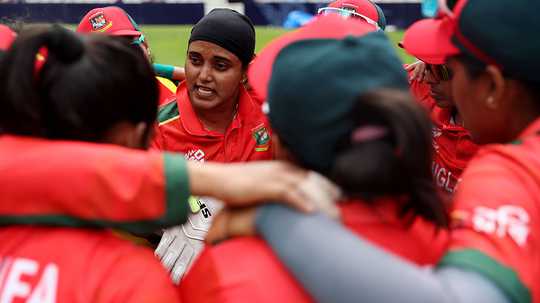
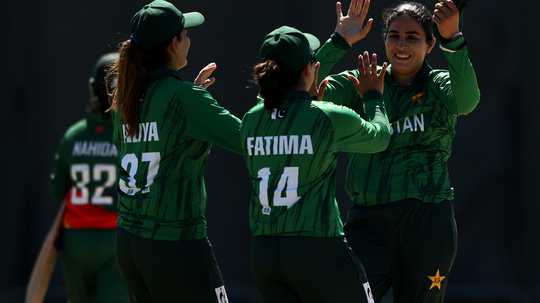
While Nigar Sultana had shied away from inviting controversy after deciding to step down as Bangladesh’s T20I captain, insisting that she had taken the decision to focus on her game, head coach Sarowar Imran did not hesitate from disclosing unrest in the dressing room following their loss to Pakistan at the Asian Games in Japan, which forced them to return home empty-handed.
Cricbuzz earlier revealed that Nigar was not interested in leading the side after the T20I [captaincy], and later disclosed that the board was planning changes to the coaching staff, with Imran making way for a new head coach. David Hemp is the frontrunner for the post. It is understood that current batting coach Nasiruddin Faruque will also be replaced, with Hemp expected to take charge of the batting department while also guiding the women’s cricketers in the coming days.
It was not surprising to see changes coming in the team management, and is understood that Nigar took the decision to step down as she did not want to be made a scapegoat following the Asian Games.
According to Imran, things were quite different following the last World Cup, with the atmosphere changing only midway through the Asia Cup.
“You know who holds the primary responsibility (of our failure) better than I do. However you want to frame it… you’re asking me! We weren’t in this state before. We played in World Cups under entirely different circumstances. Now, everything has suddenly shifted,” Imran, who guided Bangladesh in the inaugural Test match against India in 2000, told reporters after the game.
“Our problem actually started back in the Asia Cup. We lost a close match against Sri Lanka there. Ever since that loss, various kinds of reports and rumors have been coming out from different places… to the point that we couldn’t even score 120-130 against teams like Indonesia and the UAE. And we are still carrying that exact slump into the Asian Games,” he said.
“That kind of thing (negative report) can impact the team and the players. I think – I’m not entirely sure, but – it could be one of the reasons. No excuses, but it could be a factor. We just aren’t able to hit our stride; we can’t seem to reach that level at all,” he said.
“Suppose it is being said about me that I won’t be retained, he won’t be retained, and things like that. This happened during a tournament… We are playing a tournament. In the middle of it, you have sidelined the head coach and the captain, so how can you expect [results]?” he said.
“My two-year contract is ending in October anyway, so I don’t have any expectations either.”
“Criticism affects individuals on a personal level. The captain made that statement (of not continuing as T20I captain) only after all of this (negative report) happened,” he said.
Imran added that Bangladesh women’s cricket is lagging behind due to a lack of infrastructure.
“They (women’s cricket) are definitely stuck. And it’s a much larger issue. People watching from the outside – including journalists – might think a team just does net practice and goes out to play, but it doesn’t work like that. There is a whole process behind it,” said Imran.
“Look at Sri Lanka: school cricket is thriving there with hundreds of girls’ schools competing. We don’t have any structure like that. There are no new players coming through; we can barely find 30 players total when we need to call up a squad,” he said.
“So these foundational things need attention. We need school cricket, Under-18 setups, age-group cricket, and dedicated training facilities for women. None of these exist right now. Only when those are established will we start seeing new talent emerge,” he said.
“Of course, infrastructural problems are definitely there. Women’s cricket has only started gaining some traction recently, and it needs to grow properly day by day.
‘Since Faruque bhai took over, I can see efforts being made to treat the women’s side similarly to the men’s. If this continues – if school cricket is launched, U-18 programs begin, HP (High Performance) camps are set up for women, and separate training facilities are built – then in a year’s time, we might actually be able to compete with India, Pakistan, and Sri Lanka,” he concluded.






Leave a Reply