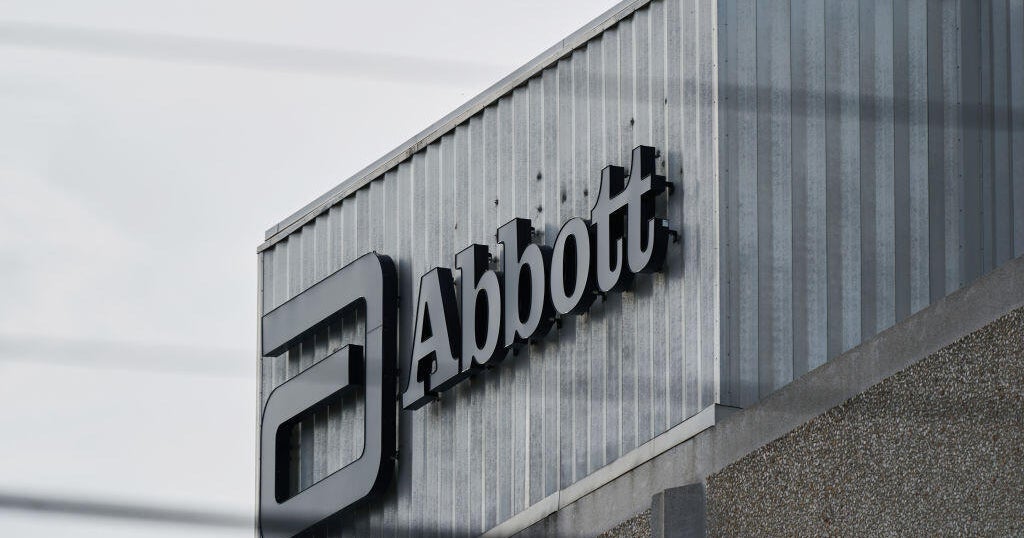
Washington — California Democratic Sen. Adam Schiff is launching a congressional inquiry into why the Justice Department shuttered a long-running criminal investigation into Cronobacter bacterial contamination at an Abbott Laboratories plant that made baby formula.
In a July 8 letter to acting Attorney General Todd Blanche reviewed by CBS News, Schiff said he is seeking answers about why senior DOJ officials did not follow prosecutors’ advice to pursue felony charges against the company and several of its executives.
“Under your management, DOJ does not consider a case involving deadly risks to medically sensitive infants, after a recommendation of a felony charge, to be worthy of criminal prosecution,” Schiff wrote.
“If prosecuting cases involving the risk of injuries or death to premature infants are not a priority enforcement matter, I have questions about what priorities the DOJ considers worthy of pursuing,” he added.
A Justice Department spokesperson confirmed receiving the letter from Schiff’s office.
In 2022, Abbott Laboratories recalled several of its popular powdered formula brands, including Similac, after consumers complained about infant illness related to products from Abbott Nutrition, in Sturgis, Michigan. The FDA in March said five infants had to be hospitalized due to reported bacterial infections which it said “may have contributed to death in two patients.”
In a statement, the company told CBS News that “no unopened, distributed Abbott infant formulas have ever tested positive for Cronobacter sakazakii” and said the Food and Drug Administration also separately confirmed in March 2022 that “the unopened product from homes of the infants under investigation at the time of the 2022 recall tested negative for Cronobacter.”
Further, Abbott said that in four of the cases, open containers of formula were tested, and three of the four were negative for Cronobacter. It said the fourth was positive for two strains of Cronobacter sakazakii, one of which was the same strain that caused the infection in the infant. But neither of the two strains was found at the Sturgis plant.
Abbott also said that it learned a year later, in March 2023, that Cronobacter sakazakii was found on breast pump parts in the home of one of the four cases.
Federal prosecutors wanted to pursue felony charges in the case, and they had the support of Tysen Duva, the assistant attorney general of the Justice Department’s Criminal Division, according to sources with knowledge of the matter.
However, senior DOJ leadership ordered the case closed, the sources added. The Justice Department is working on a civil settlement with the company in a parallel False Claims Act case, according to a public May 12 docket entry, but no details have been made public.
A senior DOJ official told CBS News that the department believed that a civil False Claims Act resolution was “the best mechanism to achieve accountability, deterrence and protection of the public” in the matter.
The official added that the agreement reached in principle with Abbott includes a “significant” monetary penalty, and said that Abbott’s plans to possibly build a new $1 billion facility in Ohio played no role in its decision to drop the criminal investigation.
The Wall Street Journal was the first to report on the closure of the case. Bloomberg Government previously reported on Duva’s efforts to keep the case alive, and how the case has sparked broader concerns about a retreat of corporate prosecutions involving public health and safety.
A federal law known as the Food, Drug and Cosmetic Act prohibits the sale, distribution or manufacturing of counterfeit, adulterated or misbranded drugs and medical devices, as well as food, supplements and cosmetics.
The law allows prosecutors to bring misdemeanor charges against companies and individuals under a strict liability standard, meaning they do not need to prove a defendant knowingly violated the law. But historically, the Justice Department has focused its efforts on investigating felony violations of the law.
In the public False Claims Act case, which was filed by numerous states and joined by the Justice Department, the company is accused of lying about the conditions under which the formula was manufactured to federal and state regulators.
“Abbott repeatedly lied to the U.S. Department of Agriculture’s (‘USDA’) and State agencies when it represented that it produced powder infant formula under conditions that complied with U.S. Food and Drug Administration … rules,” DOJ lawyers wrote in a February 2026 filing after the company asked a federal judge to dismiss the case.
“None of the misplaced arguments in Abbott’s motion can turn a years-long and widespread failure to manufacture compliant powder infant formula into a ‘regulatory disagreement’ or ‘record-keeping’ error.”
Schiff, in his letter to the Justice Department, pointed to some of the language in those court filings and questioned the department’s decision not to pursue a criminal case.
“For such serious allegations, a DOJ dedicated to enforcing the law — regardless of the political affiliation of its Attorney General — would likely insist on criminal charges and a civil penalty, not simply a settlement that is a cost of business for a corporation,” Schiff wrote.
He also raised questions in his letter about the fact that the company is represented by the law firm Kirkland & Ellis, which was one of the firms that struck a deal with the administration to provide pro-bono legal services to pro-Trump causes last year.
An attorney at Kirkland & Ellis who represents the company did not respond to a request for comment.
In his letter, Schiff asked Blanche to respond to a series of questions about the case, including whether he had personally reviewed it.
Schiff, who sits on the Senate Judiciary Committee, will have an opportunity to ask the acting attorney general about the Abbott Labs case in person on July 15 — that’s when Blanche is scheduled to appear before the panel for his confirmation hearing to be attorney general.