
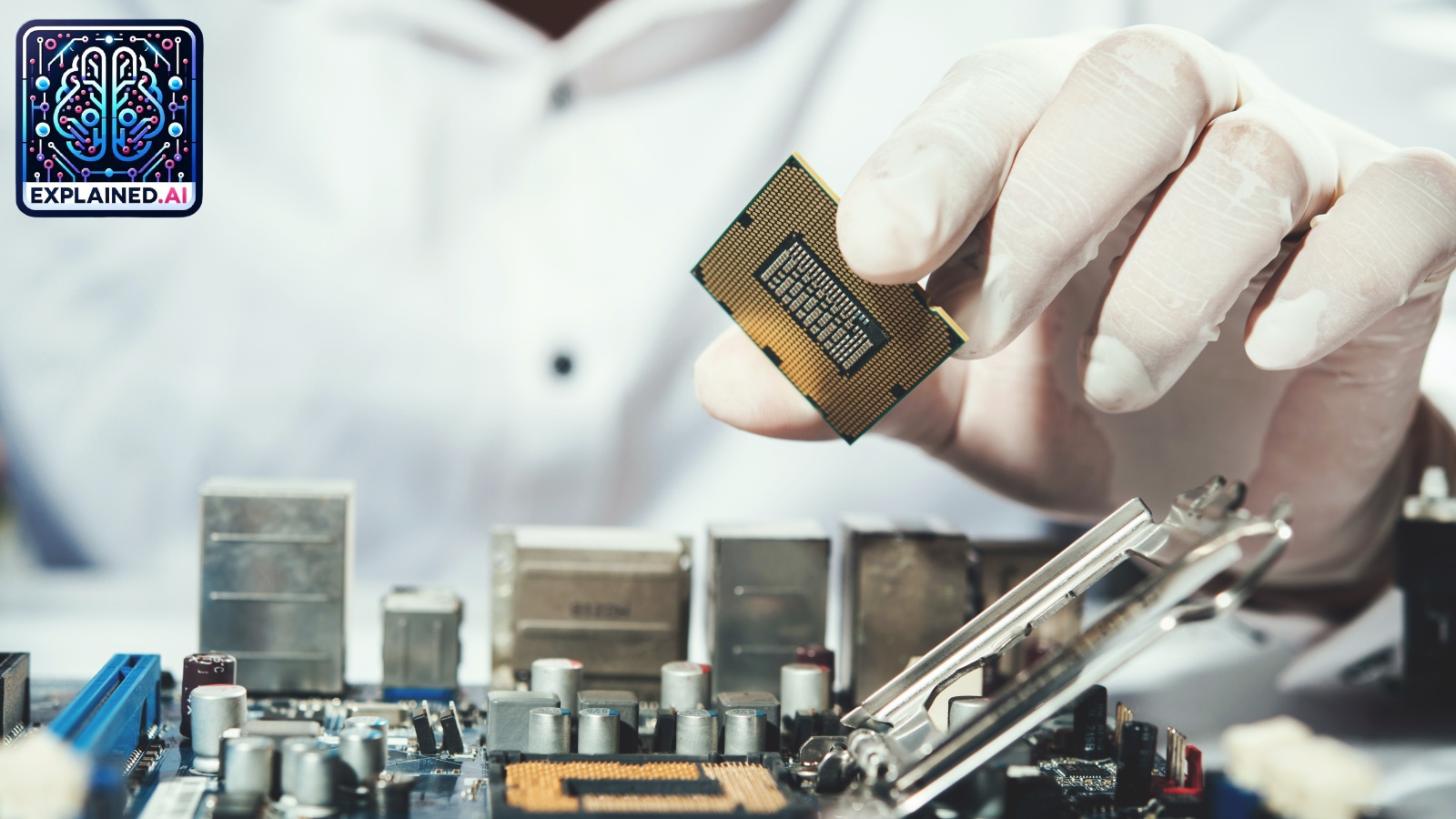
Nearly 600 companies from 52 countries attended SEMICON India, the India Semiconductor Mission’s (ISM) flagship conference, in New Delhi this week. The ISM falls under the Ministry of Electronics and Information Technology (MeitY), and Prime Minister Narendra Modi inaugurated the event, stating that “India’s semiconductor ecosystem is expanding rapidly.”
The conference comes at a moment of exceptional global demand for semiconductors, or chips, driven largely by artificial intelligence (AI) and the infrastructure required to support it. Some describe this expansion as a semiconductor “supercycle” — a multi-year period of investment and growth driven by a fundamental tech shift.
Unlike an ordinary boom caused by short-term changes, a supercycle alters the underlying source and structure of demand. It was earlier seen with computers in the 1990s, then smartphones in the 2010s, and now AI and data centres may be playing a similar role. Here is what is behind this shift and where India fits within it today.
What is driving the chips boom?
Data centres are generating a large share of this demand. Essentially, these are physical facilities that house equipment to store and process digital data (think servers and computers). They are necessary for running digital services of any kind.
AI data centres contain the infrastructure needed to support the increasing adoption of AI technology, which needs a specialised set of components to function. A central element is the AI chip or accelerator itself, responsible for carrying out the massive calculations needed to train and run AI models. Specialised computer chips known as Graphics Processing Units (GPUs) are widely used since they can handle a range of calculations simultaneously and can support training.
Such processors must also receive data rapidly enough — something traditional memory hardware struggles with because of its distance from the processor. In comparison, high-bandwidth memory (HBM) chips stack layers of a computer’s working memory close to the processor. HBM thus allows large volumes of data to move rapidly between the memory and the processor.
Today, the HBM market is highly concentrated with only three players — South Korea’s SK Hynix and Samsung, and Micron in the United States — manufacturing at scale. In June, Micron estimated that producing equivalent quantities of HBM requires three times the manufacturing capacity of standard memory since HBM chips are physically larger.
Story continues below this ad
Further complicating production is the stacking process itself, which can involve up to 16 memory layers, where a defect in a single layer can compromise the entire stack. Processors and memory stacks are combined using advanced packaging techniques that create electrical connections between components and also protect the hardware to enable them to operate as a single unit.
Beyond data centres, robotics and autonomous vehicles, as rising industries, are also poised to increase demand for advanced chips. According to Micron’s estimates, such vehicles contain more than five times the memory and storage of an average car, while humanoid robots will require 10 times more than those vehicles.
How is the demand for chips being secured?
Traditionally, memory manufacturers produced for and relied on consumer sales to absorb their output. The AI buildout is, however, increasingly shifting the market structure towards business-to-business sales.
Big Tech companies are planning their data centres and negotiating chip supply two to three years in advance, accompanied by substantial spending. According to S&P Global data, Microsoft, Amazon, Google, and Meta have planned to spend nearly $635 billion on AI infrastructure in 2026 alone.
Story continues below this ad
Memory chipmakers are, in turn, entering into long-term take-or-pay agreements, where customers must buy the agreed chips regardless of their current demand or pay hefty penalties. In June, Micron reportedly signed 16 such agreements covering roughly 2026 to 2030.
Such contracts may make demand more predictable and reduce some of the swings traditionally associated with consumer electronics. But AI infrastructure spending is still concentrated among a small group of cloud and AI companies, and the fortunes of the industry will ultimately depend on the revenue AI services generate in relation to the sizable investments.
The commercial relationships supporting this expansion are also interconnected. Chip designer Nvidia has taken a 7% stake in the AI cloud computing company CoreWeave, and has agreed to buy $6.3 billion worth of services from it. In turn, CoreWeave relies on Nvidia chips to provide capacity. ChatGPT’s creator OpenAI, meanwhile, has agreed to purchase AMD chips and is poised to become one of AMD’s largest shareholders.
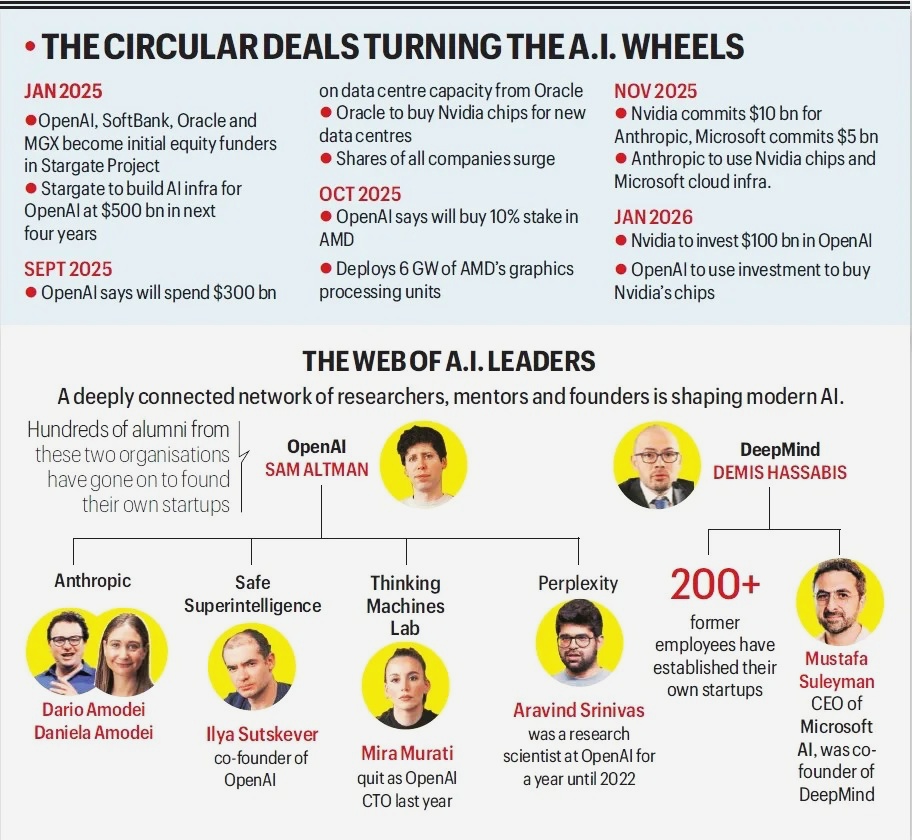 Interconnectedness within the AI ecosystem. (Express graphic)
Where does India fit?
Story continues below this ad
Under the ISM 1.0, India has approved 12 semiconductor projects, and some packaging facilities have begun production. India does not yet have a large-scale wafer fabrication plant actively producing chips.
India has been focused on establishing an initial manufacturing base and building capacity in assembly, testing, and packaging. Micron’s Sanand facility in Gujarat will process imported specialised wafers, and Sahasra Semiconductors will package NAND flash, a kind of storage technology. These projects bring India into the later stages of memory chip production, while wafer manufacturing is happening elsewhere.
This means that India is currently experiencing much of the AI chip boom through its effect on the cost and availability of imported components, rather than capturing the profits being generated by HBM and advanced accelerators. In July, a parliamentary reply noted that demand from AI servers and data centres was tightening memory supplies and raising prices.
The effects are also visible in capital markets. Some of the foreign investment withdrawals from Indian markets in 2026 have been linked to the growing interest in the semiconductor-heavy markets of Taiwan and South Korea. While several factors influence capital flows, this aspect does indicate India’s limited presence among the immediate beneficiaries of the current boom.
Story continues below this ad
ISM 2.0 aims to build on the existing base, with its packaging scheme offering financial support for capital expenditure incurred in that process. The scheme also covers other manufacturing stages that help connect processors and memory within AI systems. Another scheme will support R&D in chiplet technologies.
The NITI Aayog’s semiconductor roadmap report also recommends establishing pilot lines for chiplets and HBM-class integration, which would combine advanced processors and memory via packaging techniques.
The NITI Aayog’s semiconductor roadmap report also recommends establishing pilot lines for chiplets and HBM-class integration, which would combine advanced processors and memory via packaging techniques.
Unlike conventional chips, which are made using a single piece of silicon, chiplets combine several smaller, specialised chips to lower costs and waste, and provide a workaround for the physical limits on how large a traditional chip can be made.
Chip design offers another possible entry point, as nearly a fifth of the global chip workforce is based in India. Under the design-linked incentive scheme, startup Netrasemi is developing edge-AI processors for cameras, drones, and robots, which perform AI computations on the device instead of sending data to the cloud, allowing faster responses and reducing the need to transmit data over the internet.
Story continues below this ad
Germany’s Infineon also recently acquired the Bangalore-based fabless company (one that designs and sells chips) C2i, which designs AI power controllers, and may illustrate another part of an emerging value chain.
The author is a research analyst in the Technology and Society Program at Carnegie India.








Leave a Reply