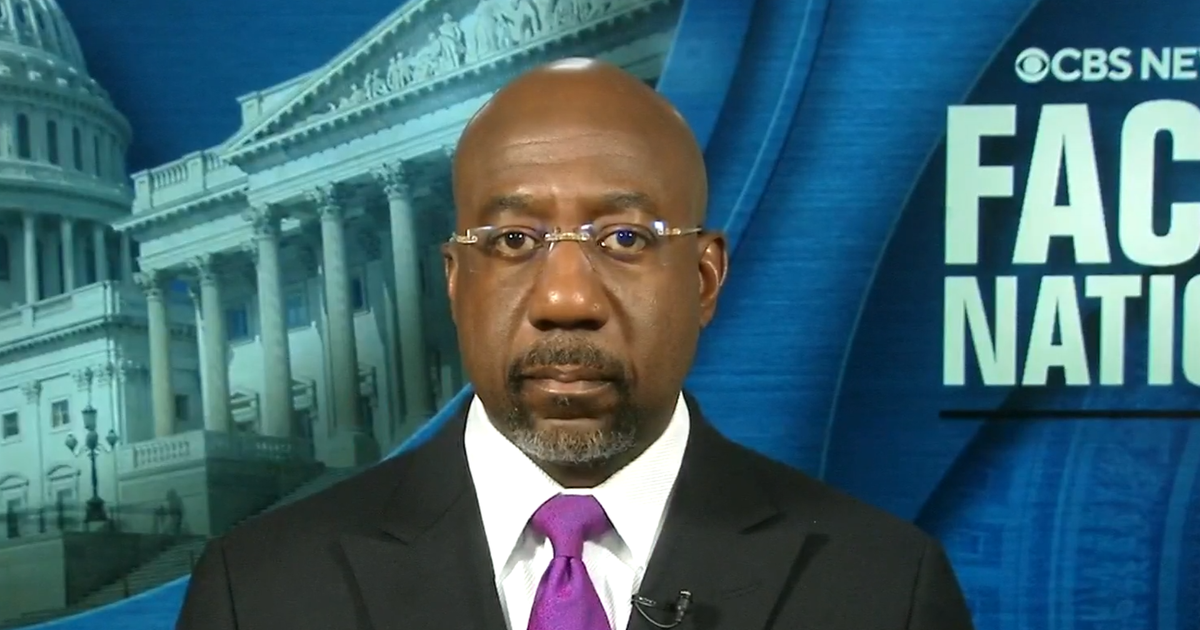
Washington — Democratic Sen. Raphael Warnock of Georgia called the Supreme Court’s decision last week to strike down Louisiana’s congressional map and narrow the Voting Rights Act “a massive and devastating blow,” while warning of its implications for the redistricting fight.
“The court, sadly, poured fuel on this redistricting arms race,” Warnock said Sunday on “Face the Nation with Margaret Brennan.”
The ruling was a key victory for Republicans, striking down a map that included two majority-Black districts. And it followed a redistricting battle that began last year when President Trump’s political team pushed Texas GOP leaders to redraw the state’s congressional map, which sparked a counterpush by Democrats in California and efforts by both parties in other states to redraw their maps.
Warnock, a pastor who’s represented Georgia in the Senate since 2021, said he supports the push by Democrats on redistricting “because Donald Trump — who is better at dividing us than anybody I know — instituted an arms race in redistricting.”
“I don’t like gerrymandering, but we could not unilaterally disarm,” Warnock said. “He’s the one who called Texas and said, literally, ‘give me six more seats.’ And so California and other states had to respond, Virginia, in kind.”
But Warnock said “the solution to this really is to ban partisan gerrymandering,” which he said “turns our elections on its head, so that rather than the people picking their politicians or their public servants, the politicians are picking their voters.”
The high court’s decision narrowed the landmark Voting Rights Act, with the court’s conservative majority finding that compliance with Section 2 could not justify the state’s use of race in redrawing its House district lines. The outcome is expected to make it more difficult for minority voters and voting rights groups to successfully challenge voting maps under Section 2, with implications far beyond political representation in Louisiana.
Since the Supreme Court’s decision, Republican governors in a handful of states, including Louisiana and Tennessee, have called for special sessions of the state legislature or otherwise expressed interest in redrawing congressional maps.
Warnock said “what happened this week is nothing less than a massive and devastating blow, not only to our democracy, but particularly to people of color in the South.”
“We will see a devastating impact as a result of this, and now, more than ever, we’ve got to stand up and fight for our democracy,” he said.
On the Voting Rights Act and the law more broadly, Warnock said “I know that there are those who are tired of the remedy — I’m tired of racism.”
“I think it’s a strange position to be more concerned about the medicine than you are about the malady,” Warnock said.
The Georgia Democrat pointed to changes to the Voting Rights Act in recent decades, including when the high court in 2013 struck down a formula for states to get preclearance from the federal government before instituting voting procedure changes under Section 5. He said “since they removed the protections of Section Five, states that used to play old games, they’re playing new games.”
“They’re 21st Century Jim Crow tactics in new clothes — moving voter polls, closing polls in Black and brown communities,” Warnock said. “And now, as a result of the decision this week, they’re saying that even when you show up, we have given the green light so that politicians can play games with the lines, so that even when you overcome those barriers to show up, your voices will be muted.”
On the question of representation, Warnock said the idea that it doesn’t matter “ignores history, it ignores the facts — it’s uninformed.”
“When I go to the Senate, every week, I bring my story and my experience as a Black kid who grew up in public housing in Savannah, and so does that White kid who grew up in Appalachia,” he said. “And so when, when we create an increasing monolith, which is what I think is going to happen as a result of this decision this week, we hurt the democracy itself, and we make it harder to get at a policy, policies that embrace all of our children and give every child a chance.”