
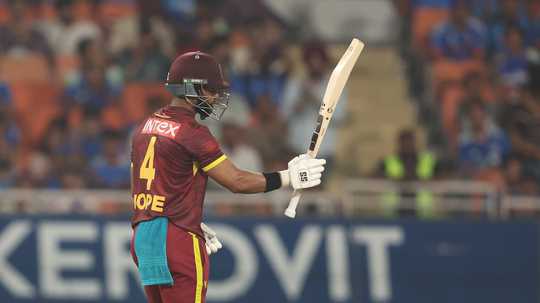
“He didn’t say a word. He just put on his pads and went out”.
Shai Hope had just kept wickets for 50 overs, when coach Daren Sammy told him he had to quickly find an opening replacement for Jewel Andrew. There was nothing to be said: the pads were on again, and Hope had instantly switched into an ODI opener after four years.
Neither was there any outward emotion when Hope was taking his gloves off 104 balls later, not indulging in celebration when the bigger goal was yet to be achieved. Nor when the target was ticked off. The talking had been done elsewhere: he would later reveal a “great chat” with MS Dhoni helped him time his chase.
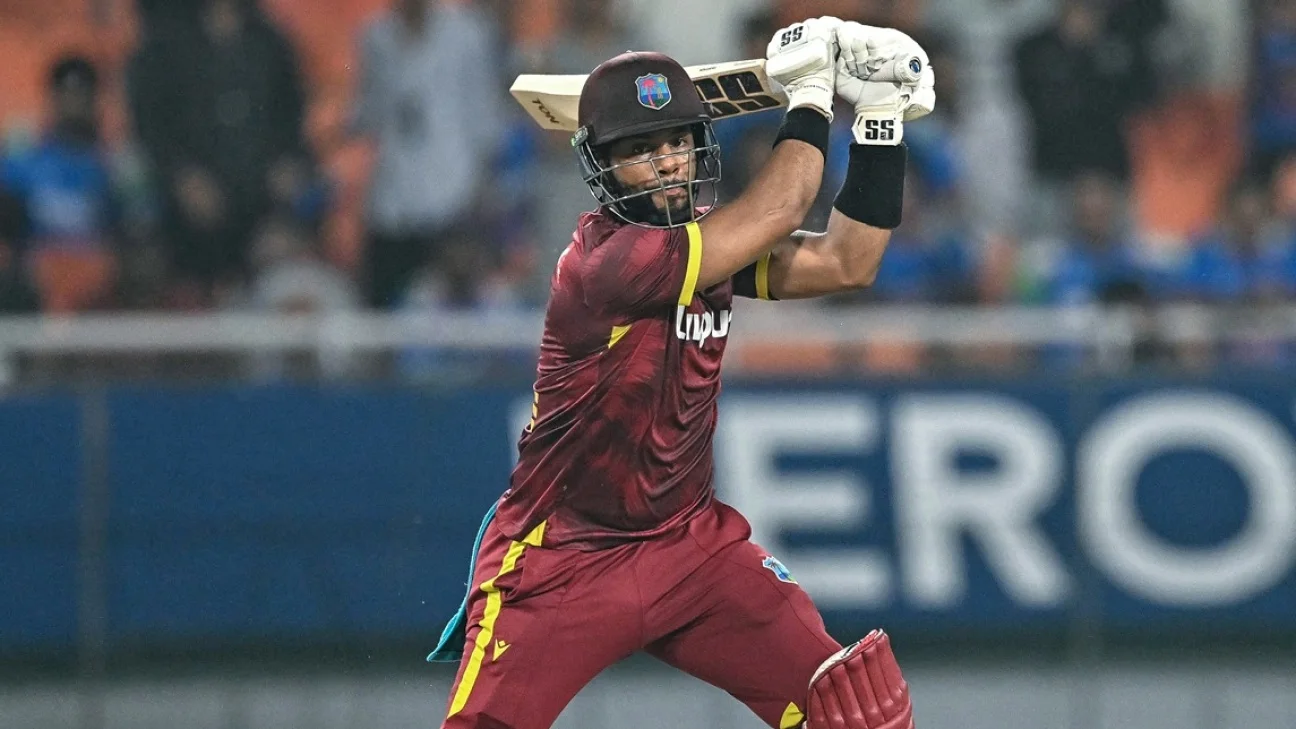
With Hope, ODI record-breaking rarely ceases, and he’s already done this enough in India. But in a format increasingly feeling like the masquerade of a stretched-out T20, Hope’s knock brought back the grit and guile of a one-day knock. It wasn’t a stitching of big-hits, but more intricately woven fabric of phases, each played on its merit and dealt in its kind.
Tasking himself to take on the new ball, Hope set the tempo with old-school approach in the Powerplay, threading the gaps without the need to overhit. Chasing in the series for the first time, West Indies found fitter conditions to bat. But they were essentially two players down, and had 352 runs in front of them.
It needed skill, which Hope’s 21 ODI tons prove enough, and composure, which Hope also brings as a leader. “He believes that he leads by his performance,” Sammy later said. “He doesn’t really say much, but when he speaks, he is quite clear as to what he is expecting from himself and from the group”.
There were enough ways to get rattled. Amir Jangoo, until then matching Hope stroke-for-stroke, ran himself out off a misfield. Sherfane Rutherford was sure he was fleeced, furiously kicking the boundary triangles after arguing with the umpires over a caught-behind. Hope was there for both, but didn’t react. In fact, he was on the field for every bit of the action. Limping through groin pain towards the final act.
In the middle phase, he played a measured 72 off 87, hitting four fours and a six as India squeezed them and snatched back control. There was no time to hit out and perish. “You always have more time than you think,” was Dhoni’s mantra to him.
Even as the equation got steeper and partners disappeared, Hope marched on, before the final switch came. Fifty one off the last 24, wizardry on an injured groin. At one point, India had one outfielder less and had to pack the offside. Hope still managed to pierce it, hopping a step back and carved back-to-back fours.
No frenetic hitting, all cold and calculated.
It took Hope a monumental effort to beat another one.
Both the keeper-batters from the evening have some clear similarities. Their debuts came months apart, they have moved roles to best serve their teams, have built their game through traditional scoring methods, and let their bats be the preferred medium of expression.

Rahul his his ninth ODI ton. ©BCCI
KL Rahul wasn’t happy with the final stroke of his epic knock. He had just taken 20 runs off the innings’ last five balls, and reached his highest ODI score. He jammed the last ball out to midwicket, and as he walked back, did a shadow ramp to himself. That was probably a better choice.
That mind hadn’t switched off.
He walked back, in his solitary path away from non-striker Gurnoor Brar. Only when he got closer to the boundary line did the meditation break, and he raised his bat in acknowledgement.
In an interview last year, Rahul confessed overthinking had taken the fun out of his cricket. It’s the curse of his gifts. Rahul houses the ability to play nearly every stroke there is. There must be options and backups in his head running amok before every ball is hit.
He hadn’t had a chance to bat in the first two games. The top-order had feasted on flatbeds, sharing two centuries and a double-century. In Trivandrum, when the presentation ceremony was on, a padded-up Rahul ran to the makeshift nets behind. The bat had to be warmed up for a job that could come anytime.
It came only a week later.
At 141/3, and batting in the heat for the first time in the series, India were finally navigating through the middle overs of an ODI, not a glorified T20. The pitch wasn’t as insipid: there were patches of life aside from lateral movement. Jayden Seales made it count with his sharp lengths.
Rahul played himself in, sizing up the pitch, and the right moments to react to. The first boundary did not come until the 15th ball, a typically delicate open-face punch through covers, against arguably the weakest bowler of the afternoon, Vitel Lawes. Two overs before the new-ball rule kicked in, Rahul had ambled to 22 off 22. His frequent pitch tapping and gardening felt like a sensory reload.
Even with a feeble tail to follow, Rahul didn’t lose grip over his control of the game.
Just like he often makes it happen at five, India went from 159/4 to 250/6. Rahul from 7 (12) to 56 (48).
It was the bounciest wicket of the series. Interestingly, Rahul did not hit any boundaries on the square on either side to pacers, either waiting for the bowlers to err and bowl too full, or riding the bounce and playing it behind square, even over the keeper.
Just like Hope, Rahul’s old-style phase-by-phase work allowed him to double-down at the death. He cracked five fours and as many sixes across his last 41 balls. From a position of safety, he had propelled India to a commanding total.
Another run-heavy night. Two big centuries. Two tricky scenarios, and two mega efforts, each a reminder of the sophistication of ODI batting.



Leave a Reply