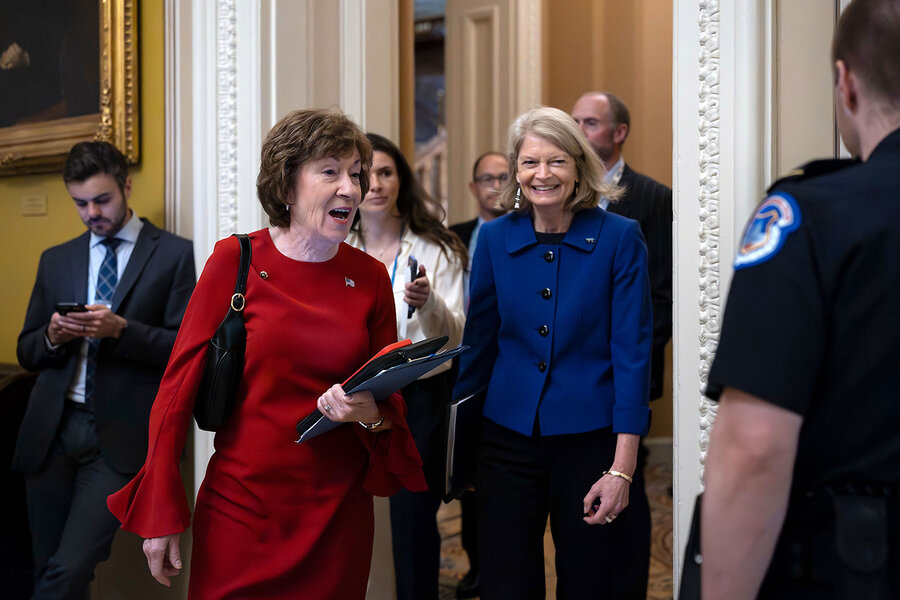
Clashes between the Trump administration and congressional Republicans upended progress on one of their party’s biggest priorities this week – a reconciliation bill that would fund immigration enforcement.
Congress left town Thursday for a weeklong recess after failing to pass the bill, which had been part of Republicans’ strategy to end the Department of Homeland Security shutdown.
President Donald Trump had demanded Republicans finalize that bill by June 1. Reconciliation is a lengthy process, and Republicans had been working for months to meet that deadline.
Why We Wrote This
Some congressional Republicans have pushed back at President Trump on issues including a fund to pay people the justice department finds were wrongly prosecuted. That resistance could make it harder for the president’s party to accomplish its priorities.
But just as senators were getting ready to send the bill to the House, Mr. Trump announced a $1.8 billion “anti-weaponization fund” that he says is to compensate people the Justice Department determines were wrongly prosecuted by the U.S. government. Mr. Trump has routinely complained that he and many of his allies and supporters have been unfairly charged. The fund was created as part of Mr. Trump’s agreement to drop a $10-billion lawsuit against the IRS over the leak of his and his sons’ tax returns.
Critics of the fund have raised concerns that Jan. 6 rioters who targeted police officers could use it to seek compensation.
“This is the kind of legislation that puts a lot of people at pause, because it’s bringing back something that has not polled well for Republicans, something that a lot of Republicans don’t believe in,” says Samuel Chen, a Republican strategist and principal director of Pennsylvania-based Liddell Group.
Republicans needed to move in near lockstep to pass the reconciliation bill. But several expressed discomfort with the fund.
Because of that discomfort, Republican leadership was concerned that enough of their members might vote in support of Democrat-offered amendments on the anti-weaponization fund, meaning that those amendments would be included in the reconciliation bill, setting up a direct confrontation with Mr. Trump.
“The White House dropped a bomb in the middle of a pretty well-planned-out reconciliation [bill] to help deliver on one of President Trump’s priorities,” Republican Senator Lisa Murkowski of Alaska told reporters.
In another blow to Mr. Trump, Senate Republicans had reportedly decided to strip $1 billion from the reconciliation bill – including security measures for Mr. Trump’s ballroom – rather than face the political repercussions of that vote. Democrats have pounded a message that Trump wants $1 billion for a ballroom while Americans are facing rising inflation and gas prices averaging $4.62 per gallon.
Despite Republicans’ defiance of Mr. Trump regarding the reconciliation bill, Mr. Chen doesn’t foresee a turning point in Congress where members start breaking with the president en masse.
“The current Republican party is not about unity, it’s about uniformity,” he says.
But given that Republicans control the House and Senate so narrowly, he says even a few defections could start to tip the scale.
For example, when President Trump contributed to Republican Senator Bill Cassidy’s recent defeat in the Louisiana primary, Senator Cassidy responded in part by criticizing the anti-weaponization fund and voting to advance a resolution to rein in the Iran war. A war powers resolution in the Senate advanced with Republican support, and House Republicans punted a vote on a similar resolution at the last minute that Democrats might have won.
Mr. Trump has recently targeted other Republicans who have opposed him, like Kentucky Rep. Thomas Massie and Texas Sen. John Cornyn, in their primaries. Mr. Chen says this could backfire on the president by freeing up more Republicans to vote their conscience.
“A lot of these things will start falling apart,” he says. “And honestly, the president has to blame himself for meddling in these elections.”