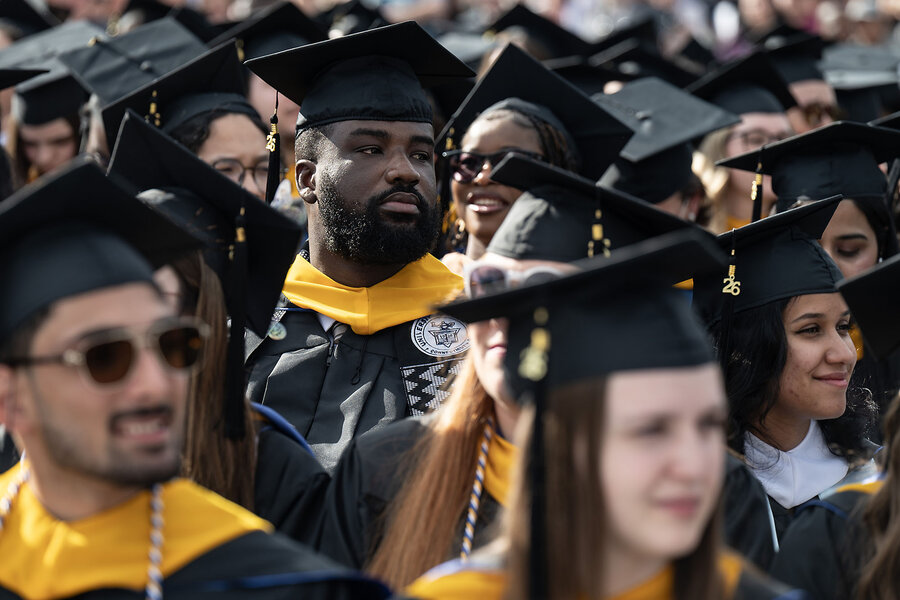
Instead of cheers, commencement speakers at some colleges and universities across the United States heard boos this spring when they mentioned artificial intelligence to anxious graduates facing an employment landscape rapidly being reshaped by AI.
But colleges are hoping that students entering this fall will not graduate with the same level of anxiety about the technology. Schools are scrambling to expand AI offerings with focused majors and are incorporating the technology into their curricula – changes that could lead future graduates to see it more as a tool rather than an existential threat.
A survey of nearly 10,000 students, who had been prospects to start college last fall, found that 42% expect AI to influence their career choice. About 10% said they had already changed their major because of AI, according to an April survey by education consulting firm EAB. Half of the surveyed students expressed uncertainty about how AI could impact their future careers, while many signaled concern, nervousness, and skepticism.
Why We Wrote This
Despite trepidation from some recent college graduates about how AI could reshape their chosen careers, colleges and universities are expanding their offerings. Incoming students express a mix of anxiety and optimism about the technology.
Yet U.S. schools are offering nearly 200 AI bachelor’s degree programs and more than 300 master’s degree AI programs, according to Programs.com, a cybersecurity education platform.
The University of Southern California is starting a $200 million AI program this fall. Drexel University in Philadelphia plans to integrate AI into its experiential cooperative education program, which places students in jobs related to their concentrations, as it launches its AI major this year. Employers have reached out asking that students know how to use AI.
“It’s a market opportunity, but also, this is where things are going,” said Ali Shokoufandeh, interim dean of the Drexel School of Computer and Information Sciences. “In three years from now, if you don’t know AI/ML [Artificial Intelligence/Machine Learning] you won’t have a job. They will not hire you.”
Tool or threat?
This spring, Drexel hosted prospective members of its inaugural class of undergraduate AI majors and their parents. There were introductions to faculty, question-and-answer sessions for moms and dads, and student-led tours.
Professor Dario Salvucci beamed at the group and posed a question.
“When you think of AI, what is the first thing that comes to mind?”
“It’s something that makes your life easier,” answered one student. “Like homework or your classes.”
“It helps you simplify everyday tasks, so you can work on bigger things,” another student said.
Remington Ochoa, a graduating high school senior from Jersey City, New Jersey, was at the session. Later, he said, “Part of me thinks that AI is something that I should go to because it’s helped me in school and with the way that I think.”
Mr. Ochoa’s journey with AI was not one of immediate acceptance.
In ninth grade, he shied away from the technology because friends were using it to cheat at school. But he then started learning how to get what he wanted from AI without compromising himself. He would ask it to help with suggestions on topics for research papers or songs that illustrated a subject matter that he wanted to explore.
“If AI can do something like that, it’s really a teacher in a sense, if it can help you with problems,” he says.
Caution urged
Even as colleges are expanding their AI offerings, some faculty members are urging caution, and administrators are wrestling with policies to avoid its misuse.
The University of California, Berkeley, School of Law recently announced a strict anti-AI policy that prohibits its use for most academic work submitted for credit or during exams. AI can only be used if a class is specifically being taught about the technology.
Justin Raden is an English instructor at the University of Mississippi. He says faculty members owe it to students to present the big picture of AI.
“Faculty have a special responsibility to kind of naysay the technology,” Dr. Raden says. “We should at least be trying to show students all the ways in which it will sell them out and sell them short.”
He adds that schools have wrongfully and rapidly adopted AI in various ways that he disagrees with, including administrative decision making, AI training programs and AI-based degrees.
In March, the University of Mississippi announced it was joining a consortium of other schools – known as NextGenAI – that is backed by ChatGPT developer OpenAI. The university said at the time that its participation would allow it to continue advancing the integration of AI into its mission.
Dr. Raden worries about partnerships between colleges and tech companies to study AI. These companies put up money in the guise of training a future workforce, he says, but they also benefit greatly from owning the intellectual property and getting the labor of everyone associated with the university.
“This has been a very shortsighted and entirely too quick retooling of the university,” he says.
Preparing graduates
Regan Kibby is the newly appointed Student Success and AI Librarian at Community College of Aurora in Colorado. This past semester, at the behest of teachers, he taught classes on information literacy with AI, making sure students have good tools and understand the ethical implications.
“I do recognize that [faculty members] are the experts in their fields and that they want what’s best for their students,” Mr. Kibby says. “I also think that every professor blanket-banning AI without talking about it or teaching it is setting our students up for failure.”
Mr. Ochoa, who ultimately decided to attend the Rochester Institute of Technology in the fall, had already changed his planned major from game design to sound design, then to AI. He says he wants to help people through this technological transition and show them the ways that AI has helped him.
He reads headlines full of doom and gloom with AI potentially stealing jobs that could otherwise await new college graduates, but there’s a fix to that, he says. Companies should integrate AI into their workforces so they get the most out of their current employees. People should use AI to augment their skillsets, he says.
“It’s all on how it’s used,” he says. “At the end of the day, you can use it in a way where it can replace jobs, or you can use it in a way where it can help you boost jobs, and it can be like a partner, rather than something that can steal your job.”