
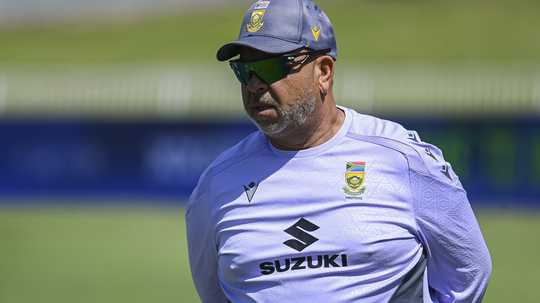
If you’re singleminded you’re able to focus intensely on what you need to do. If you’re bloodyminded you’re stubborn, sometimes not in a good way. Shukri Conrad wants his players to be both in the wake of their thumping by 214 runs in the first Test against Australia at Kingsmead. So much so that he invented a word to make his point.
“Aiden showed us in the second innings that there’s nothing fancy about Test cricket,” Conrad told reporters after the match ended on Tuesday (October 13). “It’s that singlebloodymindedness — ‘I’ve got to bat for a day-and-a-half, irrespective of what it looks like’. Some of our batters can take a leaf out of his book.”
Aiden Markram was entrenched at the crease for two minutes short of six hours and faced 237 balls for his 75. It was easily the longest stay in South Africa’s bid to save the match. Next came Wiaan Mulder, who batted for more than two hours. Of the rest only David Bedingham managed more than an hour. Only Markram and Mulder faced more than 100 balls.
South Africa were on the back foot in the match after losing Markram, Temba Bavuma and Bedingham in 9.3 overs for the addition of just 15 runs on the third day. Their last six wickets tumbled for 129.
Their only player who didn’t get out playing a poor stroke was No. 11 Anrich Nortjé, who pushed forward to a straightening delivery from Beau Webster and edged to first slip.
The shabby shots must have had Conrad and Ashwell Prince, the batting coach, pulling their hair out?
“Are you trying to be funny,” Conrad quipped at that question, a reference to the fact that both he and Prince — and bowling coach Piet Botha — are shaven-headed. “There’s a singlemindedness that goes with Test batting, especially against a world-class attack like Australia’s.
“Where do you apportion blame? Do you apportion blame? We need to be better after this. Yes, we were pulling the last strands [of hair] out with some of the decision-making and the shot-making.
“Dismissals sit in one of three places; technical, tactical or mental. A lot of our dismissals sat in the mental corner. Is that an easier fix than technical and tactical? Probably not.
“What forces you into that error? Is it the situation of the game, the enormity of the occasion, the desperate desperation to do well? All those sorts of things, I’m sure, are factors.”
Conrad wondered whether what he called “rustiness” was an issue. South Africa’s most recent Test before this match was almost 11 months ago in Guwahati. They last played a Test at home more than 18 months ago.
“I remember the Aussies coming back after their hiatus and losing to Bangladesh,” Conrad said. “Maybe this is the one we needed to get out of the way.
Australia hadn’t played a Test since January this year when they went down to Bangladesh by nine wickets in Darwin in August. But they had six Tests while the South Africans had none. Did South Africa’s comparative lack of matches mean they have less opportunity to see what works, and what doesn’t?
“I don’t think we operate from the perspective of being afraid of getting things wrong. Often, because of the few matches we play, we base a lot on what we feel is required tactically and back that up with the necessary personnel.
“We need to look at how we can improve the side without being knee-jerk in our decision-making and panicky. We need to show composure. But the question is always will it make the boat go faster if we make changes or will it slow the boat down? We’re constantly looking at how we can make the boat go faster.”
That much is evident from the way Conrad, who has had 22 matches as Test coach, has deployed players. Discounting two Tests in New Zealand in February 2024, when South Africa sent a significantly depleted squad because of their first-choice players’ SA20 commitments, he has had five No. 3 batters, eight No. 5s and eight No. 6s. Bedingham, Ryan Rickelton and Tristan Stubbs have batted in all three of those positions, and Tony de Zorzi, Mulder and Dewald Brevis in two of them.
Maybe the chopping and changing is unavoidable because South Africa, the current WTC champions, play so few Tests. So they have to keep winning — they will need seven victories in their next nine Tests to be confident of reaching next year’s final. But it surely doesn’t help players settle if they are frequently being tasked with different roles.
An exception is Kagiso Rabada, who is the ace of South Africa’s attack and is picked regardless of opponents or conditions. That he missed the Kingsmead Test because of a hamstring injury was likely a major factor in the way the match unfolded.
“It’s going to sound like an excuse, but when your Rolls-Royce of fast bowlers is not available you’ve got to fashion an attack,” Conrad said.
Lungi Ngidi, Kwena Maphaka, Ottneil Baartman and Lutho Sipamla have also fallen victim to South Africa’s hamdemic in recent weeks. But Rabada is the most prominent patient. What were his chances of playing in the second Test at St George’s Park, which starts on Sunday?
“Hopefully our Rolls-Royce will be purring down the highway.”
Were other changes on the cards?
“We need to get the personnel who we believe are going to front up. We’ve got guys in our squad who deserve a crack. So it’s safe to say that might be an option.”
Uncapped Marques Ackerman looks the likeliest to be given “a crack”. De Zorzi, Corbin Bosch and Senuran Muthusamy are also in the squad, but the availability of De Zorzi — another hamdemic casualty — is uncertain.
That squad was picked for the first Test only. An update is expected on Thursday. Might Conrad and Patrick Moroney, the convenor selector, look outside the current group?
“We’re always looking,” Conrad said.
But maybe not too far.
“This is neither a calamity nor a catastrophe. We just lost a cricket match. It doesn’t mean you’ve got to go soul-searching and questioning all the things we’ve done well and are doing well. We just need to get bloody better.”
Conrad didn’t hit the panic button in the only comparable situation. South Africa have lost five Tests during his tenure, but the first defeat — by India at Newlands in January 2024 — was followed by the two aberrations in New Zealand, both of which were lost.
The other loss was to Pakistan by 93 runs in Lahore in October 2025. How did the South Africans react selectorially in the next match, in Rawalpindi? Keshav Maharaj came back from a groin problem, replacing Prenelan Subrayen, and Mulder made way for Marco Jansen. Maharaj would have played both matches if he wasn’t injured.
A single tactical change was made. And South Africa won by eight wickets. They must have found their singlebloodymindedness.







Leave a Reply