
The first week of the Cuban Missile Crisis played out in secret. President John F. Kennedy and his advisors used the time to evaluate the results of Major Richard S. Heyser’s U-2 reconnaissance mission and to formulate a response. While reporters caught a few hints of increased activity at the White House and unusual troop movements in the southeastern United States, no one outside a small circle of administration officials knew what Kennedy and the country faced.
That changed on Tuesday, October 23. With Kennedy’s nationwide address the night before, the crisis was now public. U.S. diplomats scrambled to secure international support for the impending naval quarantine of Cuba. Kennedy won a major diplomatic and political victory when a near-unanimous Organization of American States (OAS) blessed the decision to impose a naval quarantine on Cuba. Early that afternoon Adlai Stevenson, the U.S. ambassador to the United Nations, gave a strong speech at the United Nations denouncing the Soviet Union’s actions.
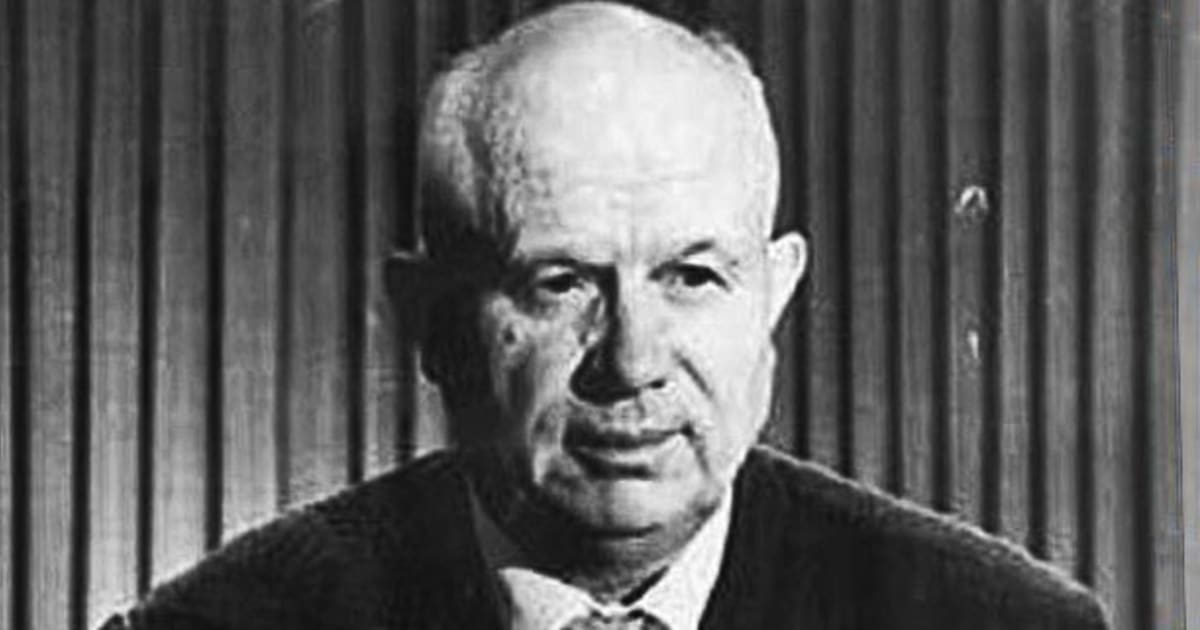
Things turned darker in the late afternoon, however, when the White House received Soviet Premier Nikita Khrushchev’s response to the quarantine. Rather than folding, the Soviet leader accused the United States of lawlessness. The most dangerous days of the crisis had begun.
“Take All Measures”
The OAS met at 9:00 a.m. at the request of the United States in an emergency session at its headquarters in Washington, DC, just blocks from the White House. Secretary of State Dean Rusk reviewed the evidence that the Soviet Union was installing nuclear-armed missiles in Cuba and then asked the OAS delegates to approve two resolutions. The first was a procedural move to allow the introduction of a second, substantive resolution. This latter resolution called for the “immediate dismantling and withdrawal from Cuba of all missiles and other weapons with any offensive capability” and authorized member states to
take all measures, individually and collectively including the use of armed force, which they may deem necessary to ensure that the Government of Cuba cannot continue to receive from the Sino-Soviet powers military material and related supplies which may threaten the peace and security of the continent and to prevent the missiles in Cuba with offensive capability from ever becoming an active threat to the peace and security of the continent.
In offering these resolutions, the United States did not have to worry that Cuban diplomats would work to block or stall the motion. The OAS had expelled Cuba earlier in the year because of its growing ties to the Soviet Union.
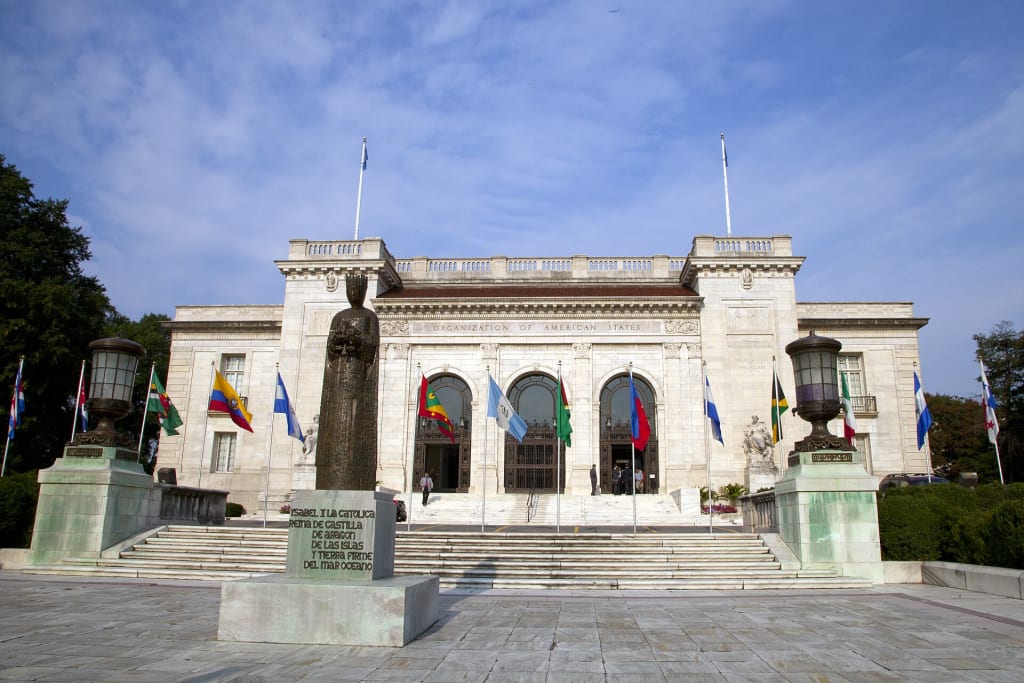
The initial discussion still proceeded slowly, however. Given that the news of the U.S. naval quarantine had broken just the night before, most OAS ambassadors were awaiting instructions from their home capitals on how to proceed. A vote was finally held that afternoon. Every country but Uruguay voted yes. (The Uruguayan ambassador, still awaiting instructions from Montevideo, abstained; his instructions arrived the next day, and he revised Uruguay’s vote to yes.) The United States now had what it claimed was a firm international legal basis for imposing the quarantine.
Action at the United Nations
News of the OAS vote reached New York while Stevenson was addressing the Security Council. Kennedy had worried that the mild-mannered, courteous, and cerebral Stevenson would not present the U.S. case forcefully to the world. During the ExComm’s deliberations the week before, the former governor of Illinois and two-time Democratic presidential candidate had urged Kennedy to first pursue diplomatic options, including making concessions to Moscow, rather than opting immediately for military action that could have “incalculable consequences.”
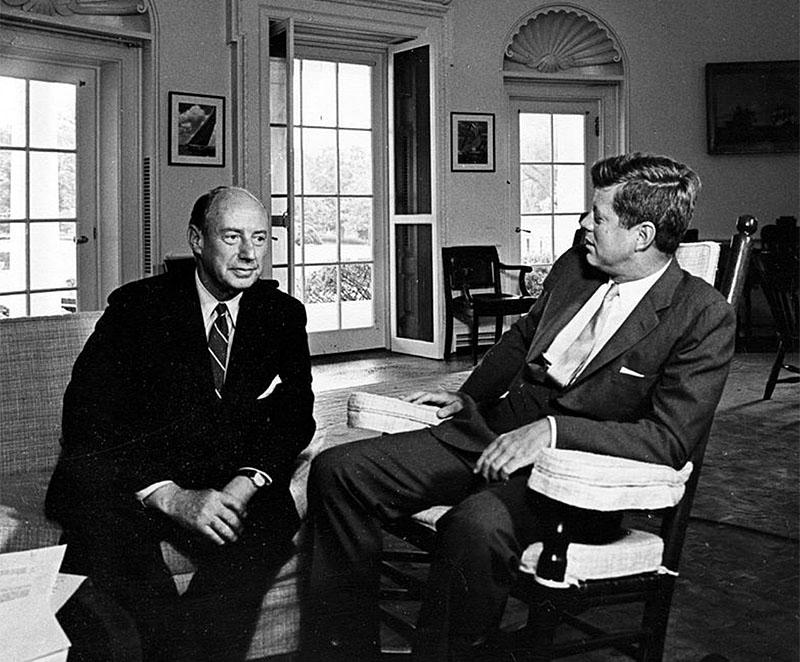
Stevenson, however, pressed the U.S. case vigorously in New York. He lambasted Soviet perfidy and called Cuba “an accomplice in the communist enterprise of world domination.” Kennedy was so pleased with Stevenson’s remarks that he immediately dispatched a telegram to the ambassador: “I watched your speech this afternoon with great satisfaction. It has given our cause a great start.”
(Kennedy’s appreciation of Stevenson’s performance did not extend to protecting the ambassador from a Saturday Evening Post story published after the crisis concluded. The story quoted an “unadmiring official” as saying, “Adlai wanted a Munich. He wanted to trade U.S. bases for Cuban bases.” The unnamed official was Kennedy himself. When the story broke, Kennedy wrote Stevenson a “note to tell you again how deeply I regret the unfortunate fuss which has arisen over the statements contained in the Saturday Evening Post article.”)
The ExComm Meets
While U.S. diplomats were busy building international support for Washington’s position, Kennedy and his advisors continued to meet and review the situation. Pursuant to an executive order that Kennedy had signed the day before, the now formally established ExComm met each day at 10:00 a.m.
In the morning meeting, CIA Director John McCone reported that intelligence suggested that the Cubans were bystanders at the Soviet missile installations rather than active participants. At the request of Secretary of Defense Robert McNamara, Kennedy approved six low-level reconnaissance flights over Cuba to provide additional information about the sites.
As the discussion proceeded, Kennedy saw a photograph of Cuban aircraft lined up wingtip to wingtip, and thus highly vulnerable to a U.S. attack. Worried that the United States might be making the same mistake, he ordered similar reconnaissance flights over U.S. air bases. Those flights confirmed what the president suspected: the U.S. Air Force had also failed to take prudent steps to disperse its aircraft during the crisis.
“Catastrophic Consequences”
In the late afternoon, the White House received what it had been waiting for: Khrushchev’s response. The Soviet Foreign Ministry delivered to the U.S. embassy in Moscow a letter from the Soviet premier. U.S. Ambassador Foy Kohler cabled the message to the State Department, which in turn delivered it to the White House.
Any hopes that Kennedy and his advisors might have had that Khrushchev would offer an olive branch and a quick resolution to the crisis were dashed. The Soviet leader neither admitted to the presence of Soviet missiles in Cuba nor offered any concessions. Instead, he charged Kennedy with warmongering:
I must say frankly that measures indicated in your statement constitute a serious threat to peace and to the security of nations. The United States has openly taken the path of grossly violating the United Nations Charter, path of violating international norms of freedom of navigation on the high seas, the path of aggressive actions both against Cuba and against the Soviet Union.
The statement by the Government of the United States of America can only be regarded as undisguised interference in the internal [affairs] of the Republic of Cuba, the Soviet Union, and other states. The United Nations Charter and international norms give no right to any state to institute in international waters the inspection of vessels bound for the shores of the Republic of Cuba.
Khrushchev ended his letter by expressing his “hope that the United States Government will display wisdom and renounce the actions pursued by you, which may lead to catastrophic consequences for world peace.”
Kennedy Reacts
The ExComm reconvened at 6:00 p.m. Kennedy signed Proclamation 3504, which formally ordered the quarantine of Cuba to begin at 2:00 p.m. Greenwich time on October 24. Kennedy also decided that he would respond to Khrushchev’s letter immediately with one of his own.
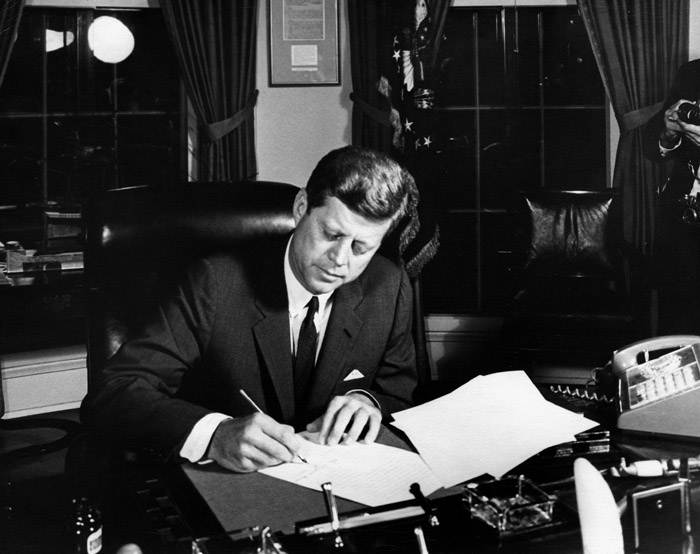
Kennedy’s reply was short and blunt. Rather than take issue with what Khrushchev had written, he repeated his demand that the Soviet leader respect the U.S. naval quarantine:
I hope that you will issue immediately the necessary instructions to your ships to observe the terms of the quarantine, the basis of which was established by the vote of the Organization of American States this afternoon.
Later that night, Attorney General Robert Kennedy met secretly with Soviet ambassador Anatoly Dobrynin at the Soviet embassy in Washington. Acting at the president’s request, RFK hoped that Dobrynin might shed light on what Soviet leaders were thinking. Dobrynin insisted, however, that there were no Soviet missiles in Cuba. He was not dissembling. Unlike Soviet Foreign Minister Andrei Gromyko, Dobrynin did not know that the Soviet Union was installing ballistic missiles in Cuba.
The attorney general left the Soviet embassy at 10:15 p.m. and headed back to the White House. He had little new to tell the president. JFK would have to wait to see whether Soviet ships would breach the quarantine line and force him to make the most consequential decision of his presidency.
Oscar Berry and Jack Patton assisted in the preparation of this article.
The United States celebrates its 250th anniversary in 2026. To mark that milestone, I am resurfacing essays I have written over the years about major events in U.S. foreign policy. A version of this essay was published on October 23, 2012.
Other Posts in This Series:
- “Andrei Gromyko Tells a Lie at the United Nations,” September 21, 1962
- “Major Richard S. Heyser’s U-2 Mission Discovers Soviet Missiles in Cuba,” October 14, 1962
- “The United States Discovers Soviet Missiles in Cuba,” October 15, 1962
- “JFK Learns That Soviet Missiles Are in Cuba—The Cuban Missile Crisis, Day One,” October 16, 1962
- “John F. Kennedy Solicits Dwight D. Eisenhower’s Advice—The Cuban Missile Crisis, Day Two,” October 17, 1962
- “Soviet Foreign Minister Andrei Gromyko Lies to President John F. Kennedy—The Cuban Missile Crisis, Day Three,” October 18, 1962
- “John F. Kennedy Campaigns While the ExComm Debates—The Cuban Missile Crisis, Day Four,” October 19, 1962
- “President John F. Kennedy Fakes a Fever—The Cuban Missile Crisis, Day Five,” October 20, 1962
- “President John F. Kennedy Prepares to Tell the Nation About Soviet Missiles in Cuba—Cuban Missile Crisis, Day Six,” October 21, 1962
- “President John F. Kennedy Tells the World That Soviet Missiles Are in Cuba—Cuban Missile Crisis, Day Seven,” October 22, 1962






Leave a Reply