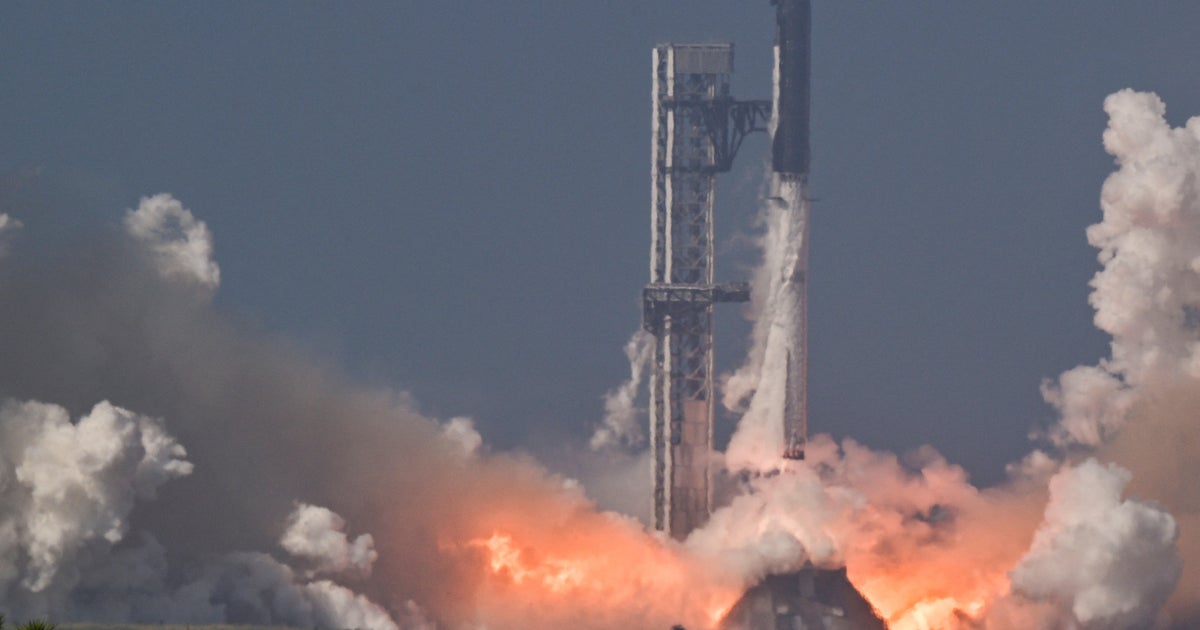
SpaceX launched a revamped Super Heavy-Starship rocket Friday on a flight to test more powerful engines, enhanced control systems and a host of other upgrades needed to streamline operations and improve safety and reliability.
Once operational, Elon Musk’s company is counting on the mammoth rocket to launch larger Starlink satellites and government and commercial payloads, and eventually propel missions to the moon and even Mars.
The upgraded Super Heavy-Starship blasted off at about 6:30 p.m. EDT from a new, beefed up pad at SpaceX’s Starbase launch site on the Texas Gulf Coast. Launch followed a last-minute scrub Thursday due to a minor glitch with a launch pad system and two weather delays beforer that.
Generating up to 18 million pounds of thrust — twice the liftoff power of NASA’s SLS moon rocket — the 33 methane-burning Raptor engines at the base of the Super Heavy first stage pushed the 407-foot-tall rocket skyward atop a brilliant torrent of blue-white fire.
Steve Nesius / REUTERS
It was the first launch of a “version 3” Super Heavy-Starship and the first use of SpaceX’s second Texas launch pad, designed to better withstand the rigors of repeated launches by the world’s most powerful rocket.
Two minutes and 24 seconds after liftoff, now out of the dense lower atmosphere, the Starship upper stage’s six Raptors ignited just before the Super Heavy first stage fell away.
It was programmed to flip around, reverse course and head back toward Starbase for a controlled splashdown in the Gulf, but the rocket had some engine trouble and didn’t reach its target.
“The booster’s primary test objective will be executing a successful launch, ascent, stage separation, boostback burn and landing burn at an offshore landing point in the Gulf of America,” SpaceX said on its website. “As this is the first flight test of a significantly redesigned vehicle, the booster will not attempt a return to the launch site for catch.”
About a minute and 10 seconds after booster splashdown, the 160-foot-tall Starship upper stage engines were expected to shut down, putting the spacecraft on an arcing sub-orbital trajectory targeting a Raptor-assisted splashdown of its own in the Indian Ocean.
During its coast through space, the flight plan called for the release of 22 Starlink satellite simulators from a Pez-like dispenser, including two with cameras to photograph heat shield tiles during re-entry.
SpaceX 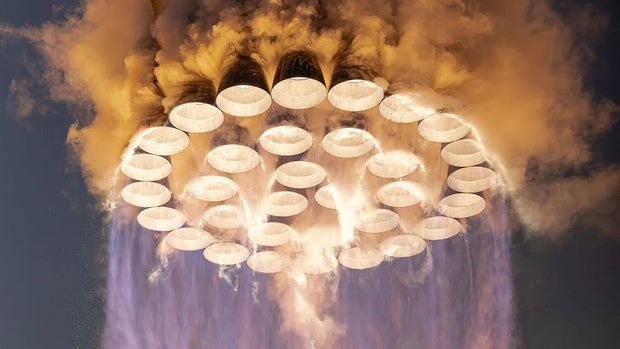
Overall, the Super Heavy-Starship is equipped with about 50 cameras that will send imagery to the ground via the Starlink satellite system.
The flight plan also called for one of the Raptor engines to be re-ignited in space to test start-up procedures in the space environment. One heat-shield tile was deliberately removed to measure the thermal and structural effects of re-entry on surrounding tiles.
“Finally, the ship will perform experimental actions tested on previous flight tests, including a maneuver to intentionally stress the structural limits of the vehicle’s rear flaps and a dynamic banking maneuver to mimic the trajectory that future missions returning to Starbase will fly,” SpaceX said before launch.
SpaceX 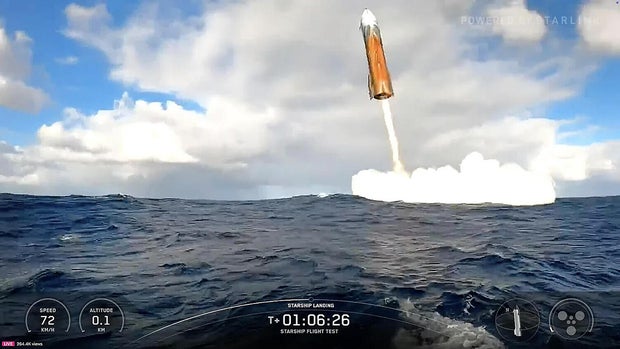
A milestone on the path to the moon
Version 3 test flights are major milestones for SpaceX as the company works to perfect the first fully reusable rocket for operational use launching government and commercial satellites along with science probes and, eventually, piloted flights to Mars.
The flights also are critical to NASA, which is paying SpaceX to develop a version of the Starship upper stage for use as a lander to carry the agency’s Artemis astronauts to the surface of the moon starting in 2028. Shortly thereafter, NASA plans to begin launching multiple missions per year and to build a base near the moon’s south pole.
In the near term, NASA plans to launch its next Artemis mission in 2027, sending up four astronauts in an Orion capsule atop an SLS rocket to rendezvous in Earth orbit with SpaceX’s lander and an alternative being built by Jeff Bezos’ Blue Origin.
NASA/SpaceX 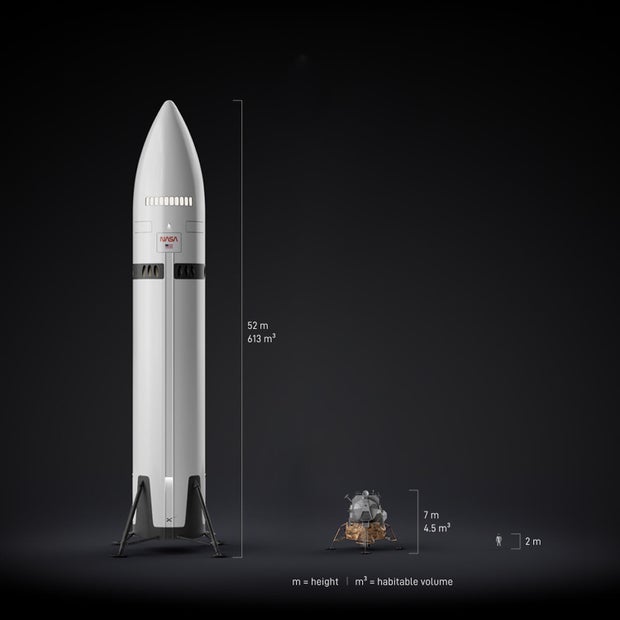
NASA plans tests with both landers during the Artemis III mission, but the flight will proceed even if only one is available. Both companies must launch a successful unpiloted moon landing mission before the agency will attempt to land astronauts in 2028.
Neither company has yet put a moon lander in space and both face daunting test schedules. With version 3 of its showcase rocket now available, SpaceX is working to transition from sub-orbital test flights to orbital missions while continuing work to perfect the systems that will be needed for moon missions.
A major challenge is the ability to autonomously refuel a Starship lander in Earth orbit before it can head for deep space. The version 3 Starship now features the attachment points and fuel-transfer systems that will be needed for those operations.
SpaceX says the first in a series of orbital refueling tests is planned before the end of the year.