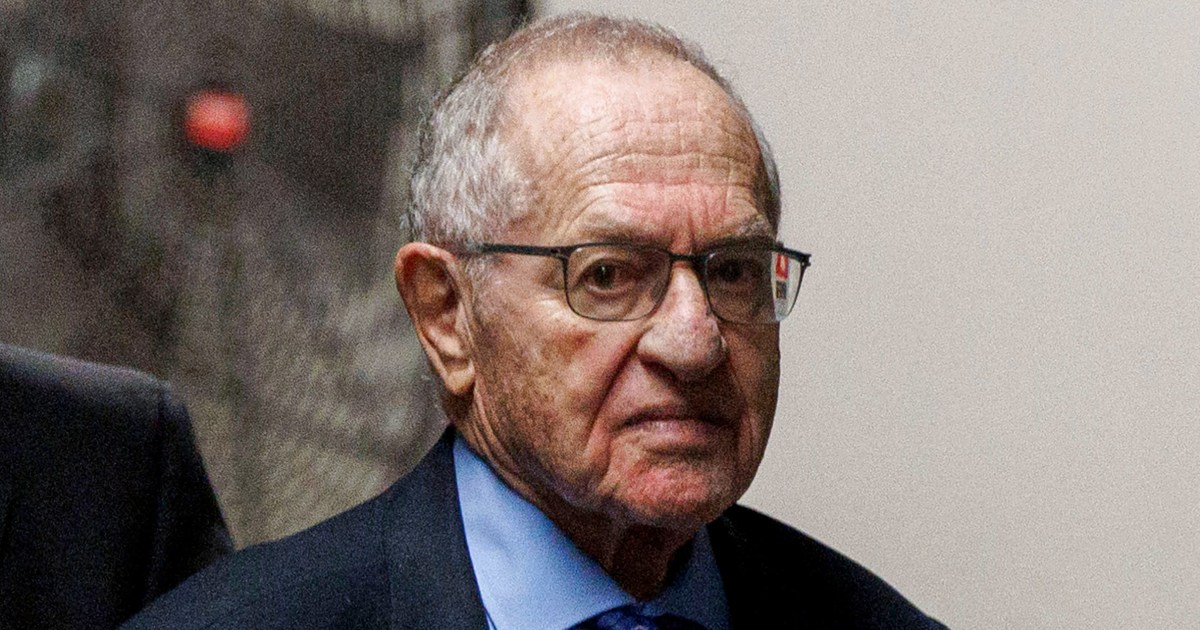
WASHINGTON — The Supreme Court on Monday refused to hear famed law professor and attorney Alan Dershowitz’s defamation claim against CNN, effectively upholding longstanding protections for the news media when reporting on public figures.
Limited time: Save 25% on NBC News subscription
Get exclusive reporting, live Q&As and ad-free reading.

Having lost in lower courts, Dershowitz had asked the justices to revisit the landmark 1964 ruling New York Times v. Sullivan, which said there must be evidence of “actual malice” on a news organization’s part in order for a public figure to pursue a defamation claim.
The court declined to hear the case, a decision with which conservative justices Clarence Thomas and Neil Gorsuch disagreed. Thomas wrote in a brief dissent that the standard to prove an actual malice claim is too “exacting.”
“The ‘actual malice’ standard for public figures ‘bears ‘no relation to the text, history, or structure of the Constitution,’” Thomas wrote.
A spokesperson for CNN declined to comment.
Dershowitz told NBC News in an email that the only issue was “whether we are able to prove malice by clear and convincing evidence— a nearly impossible burden. I believe that the Court will eventually change that standard.”
The underlying claim arises from Dershowitz’s representation of President Donald Trump during the first of two impeachment trials, which took place in 2020. The Senate trial, in which Trump was acquitted, took place after the House impeached Trump for pressuring Ukraine to investigate then-former Vice President Joe Biden’s and his son, Hunter.
Dershowitz accused CNN of misreporting comments he made at the trial about the grounds upon which a president can be impeached.
The case gave the justices, some of whom have previously criticized the Sullivan ruling, an opportunity to either overturn or weaken it.
Such a ruling would have been a blow to media organizations, making them more vulnerable to costly litigation from deep-pocketed public figures, including politicians, celebrities and business moguls.
The Sullivan decision held that in defamation cases involving such people, they had to prove actual malice — that the false claim was made “with knowledge that it was false or with reckless disregard of whether it was false or not.”
Dershowitz’s lawyers argued in his $300 million suit that CNN commentators falsely claimed that he had said at the impeachment trial that a president could not be impeached even if a criminal act was committed. In fact, Dershowitz said that “purely corrupt” acts aimed to benefit a president personally are subject to impeachment, the lawyers said in court papers.
Dershowitz’s broader argument was that Trump should not be impeached over his Ukraine conduct because it was not aimed at benefiting his private interests. His analysis was widely panned by legal experts.
CNN’s lawyers note that the network aired Dershowitz’s full remarks and, after he complained, twice had him on air to explain his position.
A federal judge in Florida and the Atlanta-based 11th U.S. Circuit Court of Appeals both ruled against Dershowitz, saying the “actual malice” standard had not been met, even if there were omissions in CNN’s commentary.
Dershowitz was a longtime professor at Harvard Law School and has had a lengthy roster of high-profile clients as a lawyer, including O.J. Simpson and Jeffrey Epstein.
The Supreme Court has repeatedly turned away previous attempts to overturn the Sullivan ruling. Thomas and Gorsuch have previously indicated it should be reconsidered — a position Thomas has advocated for years.