The U.S. Supreme Court on Monday issued two landmark decisions that protected one agency’s independence from the president while stripping that protection from roughly two dozen other executive branch agencies.
Neither of the rulings in Trump v. Cook and Trump v. Slaughter surprised court-watchers, but both represent significant decisions in the context of President Donald Trump’s efforts to push the boundaries of presidential power.
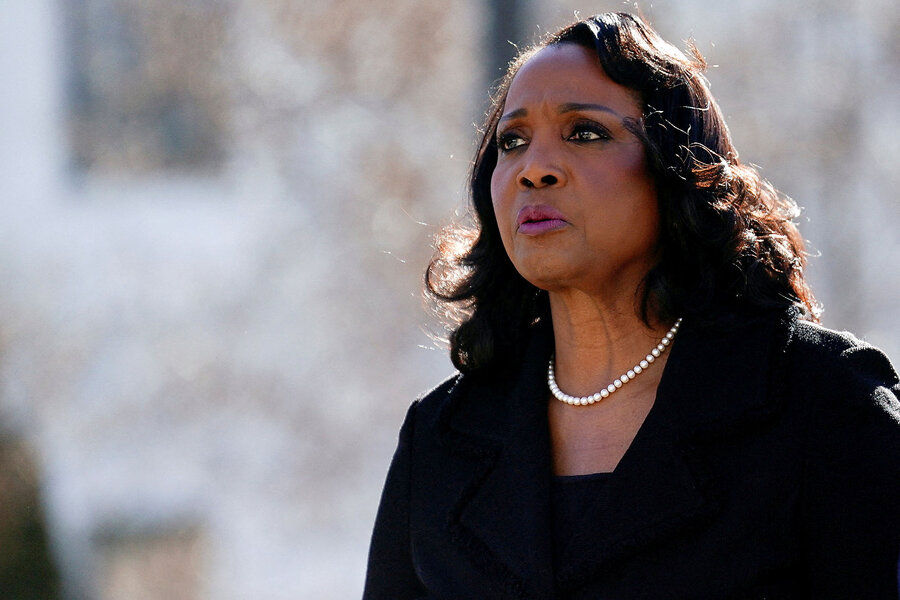
In Cook – a 5-4 decision – the court held that Mr. Trump’s firing of Lisa Cook, a member of the Federal Reserve Board of Governors, “for cause” can be paused while it is reviewed by lower courts. The decision is being interpreted as a victory for the notion that the central bank should be kept independent from the direct influence of the president.
Why We Wrote This
In a pair of rulings, the court expanded the president’s ability to fire officials at agencies with purview over things like nuclear technology and consumer safety, while preserving the independence of the Federal Reserve.
In Slaughter – a 6-3 decision – the court held that Mr. Trump’s firing of Rebecca Slaughter, a leader of the Federal Trade Commission (FTC), without cause was lawful. In doing so, the court struck down a nearly century-old precedent protecting the leaders of independent executive branch agencies from at-will removal by the president.
In sum, the two decisions – both written by Chief Justice John Roberts – transform the limits of the president’s removal power while preserving, for now, the status quo in U.S. monetary policy.
“This is entirely a ‘unitary executive theory’ decision, except for … the Federal Reserve,” says Gillian Metzger, a professor at Columbia Law School. “The court recognizes how disruptive to the economy it would be to get rid of the independence of the central bank,” she adds. “So they’re tempering their argument for that context.”
A more “unitary” executive
The decision in Trump v. Slaughter has been expected for years. It represents a defining victory for proponents of the unitary executive theory, a constitutional interpretation advanced by conservative lawyers since the 1980s that the president should have broad, unilateral control of the entire executive branch. Because “the executive power” is “vested in a President,” per Article 2 of the Constitution, they have argued that the president is entitled to remove any executive branch official whenever they want.
The theory arose from conservatives’ objections to the “administrative state,” an assembly of agencies created by Congress but housed in the executive branch. Such agencies are putatively created to provide expert advice to the president on complex issues such as nuclear technology and consumer product safety. But critics say the bodies have become unelected, unaccountable usurpers of presidential and judicial power.
With the Slaughter decision, Chief Justice Roberts effectively wrote the unitary executive theory into law.
The president “is not all powerful – not by any means,” he added. “But he is not impotent either. He and he alone is vested with ‘[t]he executive Power’ of the United States.”
“Subordinates who exercise the President’s power are subject to removal by him,” continued Chief Justice Roberts. “Then, and only then, can they remain accountable to the President, and the President to the people.”
In upholding Mr. Trump’s termination of Ms. Slaughter, the Supreme Court also struck down Humphrey’s Executor v. U.S. The 1935 decision held that leaders of agencies that perform “quasi-legislative or quasi-judicial” functions could only be fired for cause, which is typically described as “inefficiency, neglect of duty, or malfeasance in office.”
The Supreme Court severely weakened Humphrey’s six years ago. In Seila Law v. Consumer Financial Protection Bureau, the court ruled that the president can fire the heads of executive branch agencies led by one person without cause.
On Monday, the court went further. “If anything more is left of Humphrey’s,” wrote Chief Justice Roberts in the Slaughter majority, “we overrule it.”
Still, the chief justice stressed that the decision affects only the FTC and Ms. Slaughter. The ruling does not “determine the fate of officials not before us,” he wrote. Because the modern FTC “unquestionably exercises executive power,” he wrote – noting the roughly 80 laws the agency now enforces – “we have no occasion today to define the bounds of what such power entails.”
“Not all offices created by Congress necessarily come with executive or even sovereign power attached,” he added.
In dissent, Justice Sonia Sotomayor – joined by her liberal colleagues, Justices Elena Kagan and Ketanji Brown Jackson – called the ruling destabilizing and warned, “Chaos will follow.”
With its decision, she added, “the Court gives the President a power unknown even to the English Crown against which the Founders revolted.”
Federal Reserve unchanged, for now
Minutes earlier, the Supreme Court had issued another landmark decision that left the independence of a different executive branch agency undisturbed.
Unlike with Ms. Slaughter, Mr. Trump fired Lisa Cook – a member of the Federal Reserve Board of Governors – with cause. Specifically, he fired her over allegations that she committed mortgage fraud. Dr. Cook, who has yet to be formally charged, disputes that allegation and is challenging her termination in court.
The Supreme Court’s decision today was procedural – it denied Mr. Trump’s request to block Dr. Cook from continuing to serve while her lawsuit proceeds. But the decision also touched on weightier legal questions, including whether the Fed could be impacted by the Slaughter decision the court just handed down.
In the majority opinion, Chief Justice Roberts wrote that to accept any of Mr. Trump’s arguments “would in effect transform the Federal Reserve’s for-cause protection into at-will employment.” Such “an interpretive leap,” he added, would be “out of step with … our Nation’s tradition of central banking protected from political interference.”
In a concurring opinion, Justice Brett Kavanaugh referenced the court’s decision in Slaughter.
“After Slaughter, there is a clear choice,” he wrote. Either the Fed “may remain independent (with the Governors removable for cause, not at will), or it may not.”
Warning that “even temporary uncertainty” over the bank’s independence could spark political upheaval domestically and economic turmoil globally, Justice Kavanaugh wrote that in his view, and in light of “historical practice and precedent, the Federal Reserve may continue as an independent agency after Slaughter.”
The most substantive aspect of the court’s decision Monday is its rejection of Mr. Trump’s claim that courts cannot review the president’s rationale for firing Dr. Cook. That decision, along with recent comments from Fed chairman Kevin Warsh, have eased market fears that Mr. Trump would be able to bully the bank into lowering interest rates.
Chief Justice Roberts and Justice Kavanaugh “were very clear in their protection of the Federal Reserve, trying to draw some distinctions between it and all other independent agencies that have now fallen under the president’s control through Slaughter,” says Mark Spindel, founder of Potomac River Capital, a Washington, D.C.-based investment firm.
Four members of the high court’s conservative wing dissented from the decision. Justice Clarence Thomas wrote in a lone dissent that Fed board members should not be protected from removal without cause. Justice Samuel Alito, joined by Justice Neil Gorsuch, criticized the majority for siding against Mr. Trump but also for writing a broader opinion than was necessary based on limited lower court proceedings.
Justice Amy Coney Barrett, in her own dissent, made a similar argument. “The constitutional status of the Federal Reserve is entirely outside the scope of this case,” she wrote.
The court’s decision means that lower courts will resume hearing arguments in Dr. Cook’s challenge to her removal.