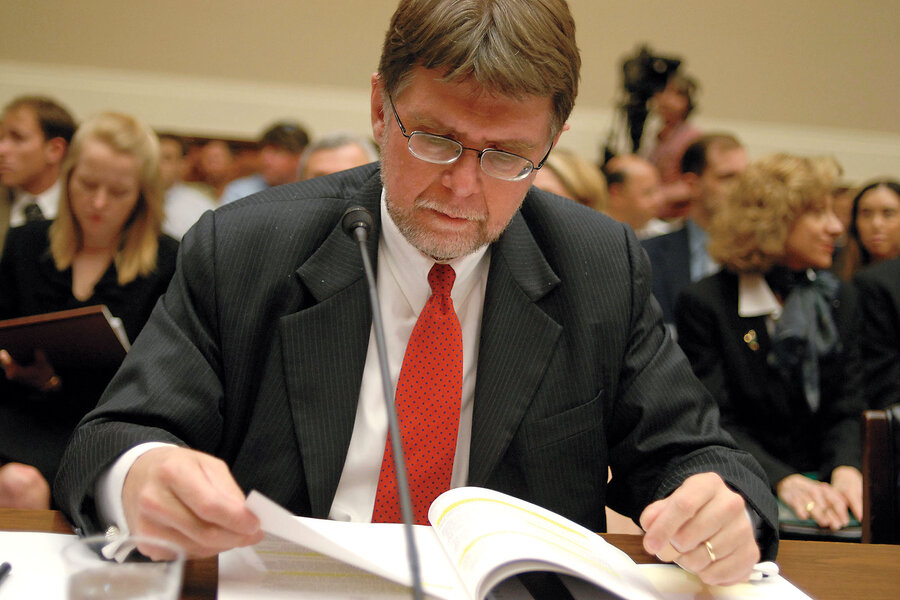
A credit card company returns $114 million to consumers to settle allegations that it violated federal law. A few months later, a large retailer is banned from making unsubstantiated claims about a product it is selling. Most Americans never think about who makes these outcomes possible. But behind both results is the Federal Trade Commission, one of several independent regulatory agencies designed to make decisions without political considerations.
William Kovacic, the FTC’s chairman at the time of both these actions in 2008 and 2009, says the president’s longtime inability to fire commissioners allowed board members to choose what they believed to be “the best policies for the nation.”
Over time, Congress has created dozens of independent or quasi-independent agencies, meant to stay insulated from day-to-day presidential influence. The contours of how that autonomy works in practice have now become less clear after a Supreme Court ruling in June striking down a nearly century-old precedent that had protected leaders of independent agencies from at-will firing.
Why We Wrote This
The Supreme Court’s June ruling in Trump v. Slaughter could shift the balance between presidential control and agency autonomy, legal scholars say.
Ten days after the ruling in Trump v. Slaughter, President Donald Trump fired two Democratic commissioners from the Election Assistance Commission, a bipartisan federal commission that advises states on best practices for helping Americans to participate in voting.
To many legal scholars, the court’s ruling and Mr. Trump’s dismissals are about more than removal protections. They are about who should wield power in a democracy – and how accountability, transparency, and expertise factor into decisions affecting Americans’ everyday lives. As a result of the court’s decision, scholars are predicting a shift in balance between presidential control and agency independence.
“The debate about independent agencies is really a debate about whether or not we can remove certain kinds of decisions from politics and have it be based on expertise,” says David Lewis, a political science professor at Vanderbilt University.
What are independent regulatory agencies, and why did Congress create them?
Independent agencies refer to executive branch organizations insulated in some ways from direct presidential control. They include the Securities and Exchange Commission, which oversees Wall Street, and the Federal Communications Commission, which ensures accessible radio, TV, and satellite communications.
Congress created agencies outside the president’s Cabinet-level departments because it believed some decisions should be guided by specialized, apolitical knowledge and continuity, rather than the priorities of a single administration.
Certain protocols isolate these government functions from presidents’ hands-on control. Fixed and staggered terms created continuity. Multimember bipartisan boards allowed for diverse perspectives. And, until recently, for-cause removal protections restricted outside political pressures.
Presidents have long used their power in some way to achieve political ends in these parts of the federal government, says Mr. Kovacic, the former FTC chairman. The debate has never been about complete independence versus complete presidential control, but rather about where to draw the line.
What is the constitutional debate over independent agencies?
For generations, Americans have debated where the balance lies between presidential control and independent expertise within the executive branch. Each side of the debate argues they are bettering democracy.
In Trump v. Slaughter, a majority of justices agreed with the logic that democracy is strongest when agencies are accountable to the president, as the nation’s elected representative.
This argument is backed by the unitary executive theory, developed by conservative lawyers in the 1980s. The theory posits that the president holds exclusive authority, including unrestricted removal power, over the entire executive branch.
Supporters point to Article 2 of the Constitution, in which “the executive power” is “vested in a President,” and criticize the growth of what they call unaccountable career bureaucrats, who oversee sizable agencies with considerable regulatory power.
With the elected president in control of the entire executive branch, “the people have a greater say now in the way the laws are carried out,” says John Yoo, a law professor at the University of California, Berkeley, and a proponent of the unitary executive theory.
Peter Shane, a constitutional law professor at New York University, disagrees with the Supreme Court’s Slaughter ruling equating presidential accountability with democratic accountability.
“No president can personally embody all of the positions of the majority of voters on every single issue facing the executive branch,” says Professor Shane.
What does the future hold for independent agencies?
Scholars predict the impact of Trump v. Slaughter will likely spread far beyond the Trump administration. Presidents who support agency independence might use their expanded removal powers to keep pace with their predecessors or to satisfy demands from their political base.
Perpetual removal and replacement of agency heads of the opposing party would significantly increase policy fluctuation, says Vanderbilt’s Dr. Lewis, author of the 2003 book “Presidents and the Politics of Agency Design.” He predicts that today’s polarized political climate will only augment this cycle. Businesses are some of the most vulnerable to this “policy flip-flopping,” he says.
Many critics believe the elimination of removal protections will decrease agency expertise. This might be a result of insufficient time to develop technical skills, commissioners nominated for their loyalty to the president, or a decrease in specialists joining the agency in fear of being fired. These analysts fear agencies will become more ideologically homogeneous and their decisions more politically driven.
Terry Moe, a professor emeritus of political science at Stanford University, predicts that Mr. Trump will continue to appoint officials who prioritize loyalty to him over legal requirements and professional standards.
“Really what this amounts to is that there won’t be any independent agencies anymore,” Dr. Moe says.
Mr. Yoo sees the positive outcomes of the case. Citizens will not only have greater influence over the president’s execution of laws, Professor Yoo says, but the government will also become “more transparent and more accountable.”